| Current Issue |
| View as PDF |
| features |
| Feel the Burn |
|
The
New Western Sheriff |
| valley view |
| You are here |
| By the Numbers |
|
Where
Courage Counts |
| recreation |
| Fly Squirrel |
| Balancing Act |
| dining |
|
Confessions
of a Cocktail Snob |
| Chef's Specialty |
| arts |
| The Resurrection |
| The Hope Trigger |
| information directory |
| calendar |
| Winter 2009 |
| listings |
| Galleries |
| Dining |
|
Lodging,
Outfitters/ Guides & Equipment |
| maps |
|
Ketchum
& Sun Valley |
| Gallery Map |
| the guide |
| Last Summer |
| Last Winter |
| Last Fall |
| Contact Us |
|
About
Us/ Contributors |

|
|
Copyright © 2008 Express Publishing Inc. All Rights reserved. Reproduction in whole or in part in any form or medium without express written permission of Express Publishing Inc. is strictly prohibited. The Sun Valley Guide magazine is distributed free four times a year to residents and guests throughout the Sun Valley, Idaho resort area communities. Subscribers to the Idaho Mountain Express newspaper will receive the Sun Valley Guide with their subscription. |

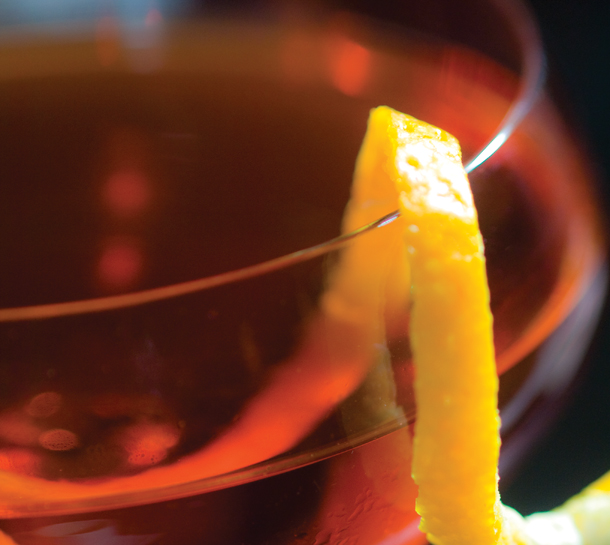
The Negroni is typical of
resurgent classic cocktails. With a dash of bitters on top of gin,
Campari and sweet vermouth, this is no daiquiri.
Confessions of a Cocktail Snob
At one Ketchum lounge, the past is honored, shaken, and
served up, chilled.
By Jon Duval. Photos by Paulette Phlipot.
"You can only serve one of these per customer," Damon Ferrari said as he poured a drink that would be more recognizable in a Prohibition-era speakeasy than your typical modern bar.
At Cavallino, a downtown Ketchum cocktail lounge, Ferrari delves into the
past to provide his patrons with beverages rarely seen in the present.Case in point: the anise-based Barnacle Bill. Silvery gray with an ethereal swirl, its sharp aroma belies the potency of the concoction. The distinct scent of black licorice forewarns the taste buds of imminent assault.
"It’s an apéritif, meant to open your palate in anticipation of a meal," Ferrari said. Despite the drink’s high-octane nature, it’s had a place in degustation for centuries.
It’s clear the French have a different approach to the appetizer. The first sip triggered an involuntary and sharp intake of breath. The air mixed with the cooling, lingering vapors and nearly brought a tear to my eye.
"Take a vodka cranberry: it’s like a liquid
version of pop music—it’s easy to digest,
but there’s not a whole lot of thought or meaning behind it."
—Damon Ferrari
The aroma is Pernod, one of the original brands of French pastis. Created in the early 20th century as an alternative to absinthe, which was illegal in France at the time, pastis was similar to Vincent van Gogh’s infamous libation, minus the allegedly psychoactive wormwood.
Cloudy, dreamy pastis became a Belle Époque mainstay, especially in Provence, where it was diluted with water and sipped slowly over early summer evenings playing pétanque.
That leisurely pastime would likely have been difficult under the influence of 110-proof Green Chartreuse and Parfait Amour. Cavallino’s latter-day incarnation, the Barnacle Bill, is also dangerous near open flame.
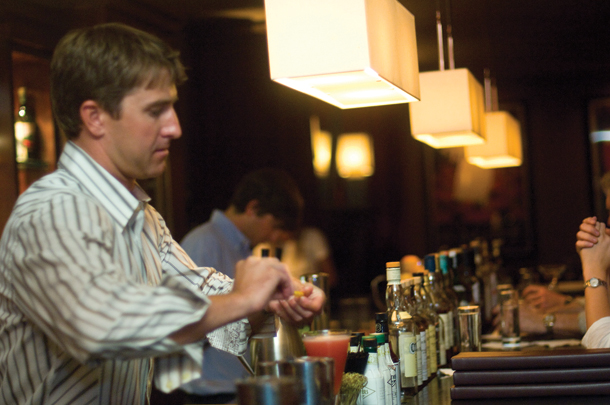
Damon Ferrari revives the rituals of classic drink-making
behind his Cavallino bar.
Ferrari finds recipes in a plethora of sources, including a copy of The How and When, a cocktail hardcover last printed in the early 1940s.
"I think people have dumbed-down cocktails effectively," said Ferrari, who opened Cavallino four years ago. "Take a vodka cranberry: it’s like a liquid version of pop music. It’s easy to digest, but there’s not a whole lot of thought or meaning behind it."
According to Ferrari, vodka is leading the charge in the attack on good taste, because that’s exactly what it lacks.
"By definition, it’s colorless, odorless and flavorless," he said.
The same can’t be said of the Negroni, another traditional aperitif that has gained recent popularity among aficionados. While its scarlet-red color and spiraling orange peel give the impression of a fruity Caribbean that could be wearing a little paper umbrella, the Negroni’s dash of bitters will ambush the uninitiated. Made from herbs, roots or fruit dissolved into alcohol, bitters are used sparingly. Along with gin, Campari and sweet vermouth, the Negroni gets the lips puckering like a teenager at the end of his first date.
The Negroni’s history is literally written on Cavallino’s walls. The lounge is adorned with original linen prints advertising liquors that originated hundreds of years before anyone quaffed a Smirnoff Ice. These posters, as with the drinks themselves, attest to Ferrari’s interest in the past.
"It seemed like a good place to start. Like anything else, it’s good to know where it came from in order to know where it’s going," Ferrari said. "The history lends legitimacy—if these drinks have been around this long, it’s reasonable to assume there must be something substantial to them."
The Pisco Sour is particularly substantial. It begins by cracking an egg and sifting the whites into a small glass before adding Pisco—a Peruvian, Chilean or Bolivian brandy, depending on who you ask. Regardless of nationality, it’s classically mixed with fresh lime juice—pressed daily at Cavallino—and simple syrup.
The creamy froth is then dashed with rouge aromatic bitters. The final product looks like a miniature vanilla milkshake, stained by a pygmy maraschino cherry.
Ferrari said the drink was first created in Lima during the early 1920s, but recent salmonella paranoia has kept many bartenders from using egg whites, crucial for the Pisco Sour’s texture.
Trends have removed these classic cocktails from the repertoire of many modern bottle slingers, but Ferrari is intent on preserving history, one glass at a time.
"And if you don’t like it, I got a Cosmo with your name on it."