

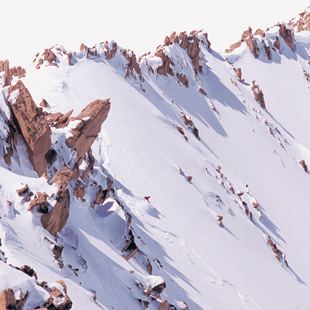
Jeannie navigates a treacherous
slope in the White Clouds
Photos by Ed Cannady
The essential
White Clouds
From near hypothermia to pure joy,
Ed Cannady’s nine-day ski trek through the White Cloud Mountains last
winter proved an intense reminder of what is truly important. Photos by
Ed Cannady.
Pinned to a
10,600-foot pass by a relentlessly savage storm, it was starting to look
like we had wanted this too badly. Descending to our intended camp was
out of the question due to near-zero visibility and potential avalanche
danger. We had to find a place on this narrow, exposed ridge to set up a
tent or face hypothermia.
Although I had
seriously questioned the wisdom of climbing the pass in the face of a
major winter storm, this is exactly why we had come out here: to slip
the reins of our sheltered existence and escape the envelope of comfort
that so often breeds complacency. We had wanted to test our skills in
the harsh vertical world of the winter mountains. In the words of Ralph
Waldo Emerson, “Here we find nature to be the circumstance that dwarfs
every other circumstance, and judges, like a god, all men that come to
her.” Today was starting to look like judgment day.
The day had started
out calmly enough. After being towed by snowmobile to Fourth of July
Creek trailhead, high in the White Cloud Mountains, we started day one
of our nine-day spring ski trip walking along the crest of the range.
Weather had delayed the trip a week already, and we determined not to
let it happen again, despite a less-than-ideal forecast. We were
confident we could deal with whatever difficulties the weather and
terrain threw at us.
We were an
experienced group. Sean Peterson, who loves life as much and as well as
anyone I know, had taken this route six times before; Jeannie Wall, the
toughest among us, is an accomplished endurance athlete and has climbed
big mountains all over the world. Scott Smith is cool and laid back, but
highly skilled and tough as nails. I had done many extended ski trips,
relying on strength and a bomber survival turn that could get me down
any slope, although not necessarily with any grace. Above all, I knew
these mountains.
Our packs were
beastly, holding food, shelter and entertainment for nine days of
high-altitude fun and exertion. But I was comfortable carrying my
80-plus-pound load. After all, this is the only addiction I have ever
struggled with: carrying a heavy pack in steep country.
On top of the pass,
the wind was so fierce it was difficult to stand. Jeannie saw the need
for quick action and began excavating a tent platform in the lee of a
head-high rock, the only thing remotely resembling shelter on the
exposed ridge. We made room for one tent and our packs by digging into
the cornice adjacent to the rock.
Once the tent was set
up—no small feat in the gale-force winds—we were able to settle in for a
crowded but fun night of close companionship. Of course, we always hope
for bluebird skies and great weather, but conditions like these provide
the greatest adventure. And that is why we do this. If it was just for
the skiing, we would ride the lifts on Bald Mountain and make more turns
in a day than we would on this whole trip. But Baldy is comfortable,
predictable and certain. On that ledge, we had to deal with the
discomfort of four people crowded into a tent made for two, hovering on
a small platform in intense winds. There was no ski patrol to tell us
the slopes were safe, and no margin for error because we had no way to
communicate with the outside world. We were relying totally on our
ability to manage whatever circumstance we encountered. And we were
comfortable with that.
The next afternoon,
the storm continued unabated but after almost 24 hours in our cramped
quarters, we were ready to make a move. After taking a close look at the
snow pack and deciding it was safe, we skied slowly, carefully,
deliberately, but almost blindly down to a protected site in the basin
below, where we could set up both tents. The storm raged through the
night, but we were sheltered and looking forward to the storm’s silver
lining: cold snow that would provide days of midwinter powder
conditions.
Dawn broke cold as
the storm finally withdrew its talons. I arose early for the
photographer’s light and watched as the clouds began to lift on the
surrounding peaks. The scene was surreally beautiful and made the extra
weight of a tripod, two lenses and 40 rolls of film seem more than
worthwhile. In that moment, the light reminded me of how important
shadows, fog and mist are to me as a metaphor for my life. I was raised
in a fundamentalist family where everything was illuminated by the harsh
overhead light of moral certainty. There was only black and white, right
and wrong, no shadows, no room for uncertainty or reconsideration of
closely held beliefs. As I matured, I saw that there is often more gray
than either black or white. Certainty is a luxury we long for, but
rarely have. What I hope for now is the clarity to see into the shadows.
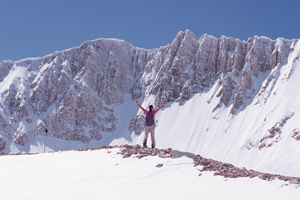
Jeannie
exults in the sheer beauty and quiet of her surroundings.
Slowly, the mountain
kingdom we had entered revealed itself. I have heard these mountains
compared to a visual symphony; this, then, was an ocular Ode To Joy.
Peaks towering to 10,000 and 11,000 feet ringed our camp and long,
blissful runs in perfect powder awaited us. We had work to do.
We managed to exhaust ourselves, but not the available ski lines, as we
explored the north-facing basin above our camp. Sean and Jeannie took
the more daring lines while Scott and I skied more conservative runs
that also provided the best opportunities for me to photograph the other
two.
The next day we left our hard-won campsite and moved north into the next
drainage, stopping along the way for some of the best runs of the trip
from the shoulder of an 11,000-foot peak. We camped for two nights at a
hidden lake nestled at the foot of more beautiful lines than we could
ski in a week, reveling in the warmth of the sun. Sean and I used a
floorless teepee tent beneath which we excavated accommodations for four
people to lounge and cook, and the two of us to sleep. It was luxurious
shelter, elegant in its simplicity.
By day five, Scott
and I, the ones with 9-to-5 jobs, needed some pure R&R. We kicked back
in the sun on a huge granite slab atop a ridge while Sean and Jeannie
kept charging at the sweet, deep snow and precipitous slopes.
I needed this. Beauty
and quiet on this scale exist in few places on Earth. For me, there is
nothing more restorative. I felt great. I felt small. I felt free. I
felt alive. I was at peace. It brought to mind Dylan’s line in Mr.
Tambourine Man, “But for the sky, there are no fences facing.”
The next day we moved
camp again. Booting up a steep pass, we stormed the walls of another
mountain fortress, guarded by sheer walls and wild snow. This was hard
work, but what labor could be more rewarding? Times like these are what
we recall on our deathbeds, rather than those accumulated material
possessions, which, more often than not, end up possessing us in life.

Sean drops in
for another perfect run.
Fabulous, warm, sunny
weather brought easier living and also more variety in our skiing.
Shady, north-facing slopes still provided exquisite powder, and the
south slopes corned up nicely. This camp was home for the next four
days, and its slopes provided some of the most exciting skiing of the
trip, in steep narrow couloirs, as well as some of the longest runs near
the tops of 11,000-plus-foot peaks.
We constructed a luxurious, snowy seating area that we called the
“Voodoo Lounge.” It was here that we spent the warmest parts of the
days, reading and singing along as Sean played the small guitar he
carried. It is hard to imagine enjoying anything more. We ate well
(Sean, a seasoned chef, did the cooking), played hard, spent hours in
meaningful conversation and song, all the while immersed in a profound
peace and staggering beauty that no artist could ever reproduce.
As we began our final
day, leaving camp and heading for the last pass we had to cross—a narrow
keyhole in an immense, otherwise impenetrable rock wall—we had no idea
of the drama awaiting us. In retrospect, it was almost as if the
mountains we had made love to for the previous eight days wanted to
ensure we didn’t take them for granted.
Climbing the south side of the pass, we noticed clouds moving in from
the north, but they appeared to be high and of little concern. When we
reached the top, we found a boxcar-sized cornice and a thick cloud
blanket welling up from the valley floor, blocking the slot that was our
passage back to civilization. Lost in the cloud below was our route, a
thousand feet of up to 45-degree slope, broken by rock and cliff bands
that we could not see. We had no choice. While I can honestly say I
never felt real fear on this trip, I did have moments of what I call
“considerable concern.” This was one of those moments.
Jeannie went to work
immediately, digging a platform on the left side of the narrow defile we
stood in, where the cornice was thinnest. Next, she climbed down the
face of the cornice to build another landing where we could lower our
packs. Then, one at a time, we climbed down to this tiny pad, shouldered
our packs and side-slipped the steep slope, able to see at most 30 to 40
feet below. When we finally emerged from the dense cloud, the light was
still as flat as a campaign promise. We descended the long drainage to
the road in isothermic snow, which became increasingly unpredictable,
causing me to break through and pitch head first several times. But even
these unceremonious face plants could not wipe the smile from my face.
And then it was over.
We had spent nine days with only the essentials, save for my camera,
Sean’s guitar and a little chocolate and rum. Yet, they were the fullest
of days, and we had lacked nothing we really needed. There is something
about being stripped of the clutter of modern life, where wants are hard
to discern from needs, that reminds me of what is truly important.
No, we had not wanted
this too badly, but I had needed it more than anything else in the
world.