

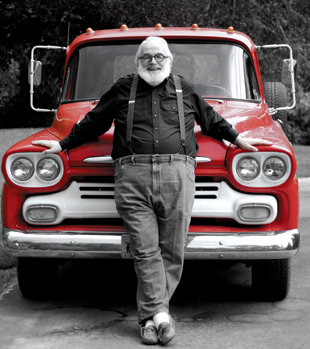
Cruising through Ketchum in his
cherry-red pickup, former network TV-titan Van Gordon Sauter, has
successfully blended into the Ketchum landscape for 18 years.
A conversation
with Van Gordon Sauter
A legend in the world of
broadcast television, Ketchum resident Van Gordon Sauter reigned supreme
as president of CBS News and Fox News for 20 years. Pat Murphy sat down
with this
self-proclaimed “professionally irrelevant and sociallymildewed”
gentleman to digest his musings on the state of network television,
politics, his relationship with Dan Rather
and the future of the Wood River Valley. Photos by Kirsten Shultz.
That burley man with
the abundant salt-and-pepper beard driving the cherry-red 1958 Chevy
pickup around Ketchum is not a mountain man in town from the backcountry
to shop for vittles, or a Santa-for-hire on vacation.
Appearances can
deceive.
Behind the jeans,
suspenders and expensive print shirt is one of American television’s
onetime most powerful executives, Van Gordon Sauter. For 18 years the
former president of CBS News and Fox News has successfully blended into
the Ketchum landscape and lifestyle without being spotlighted as another
of the area’s “celebrity” residents.
That suits him fine.
His years of fame—there were plenty of them in several venues—were heady
and mostly gratifying. In the best years of Sauter’s reign, the CBS
Evening News with anchor Dan Rather held the attention nightly of some
14 million viewers. For one 200-week stretch during Sauter’s era at CBS
(1968-86), Rather was usually No. 1 in the ferociously competitive
television nightly news lineup.

However, if Sauter’s
network broadcasting tenure was bedecked in triumph, he also stirred
controversy and enmity at CBS. As a 1996 New York Times article asked,
“Is Van Gordon Sauter a TV visionary? Or is he a destructive
provocateur?” As years passed, television historians judged he was both,
but probably more visionary. Traditionalists, for example, were outraged
when Sauter insisted on including soft features out of Washington and
New York—but those innovations are now “standard practice at all the
major network news operations,” The New York Times reported.
Sauter committed
virtual heresy when, as general manager of public television station
KVIE in Sacramento—after leaving network news—he suggested public
broadcasting would be better off without any—zero—government support,
relying instead on private and commercial funding. Today, however, that
once-heretic notion is being debated seriously.
Although an imposing,
bulky 250 pounds and six feet tall, Sauter is known and acknowledged by
few patrons during his regular stops in Ketchum at Cristina’s for
breakfast and the Rustic Moose for lunch, or dinner at one of several
favorites between Bellevue and Ketchum.
Even at 71, and with
a few annoying health drawbacks that invite one of his signature
wisecracks (“If doctors say you’re healthy, that means they haven’t done
enough tests”), Sauter is doggedly not retired, either in body or mind.
His encyclopedic range of interests continues to fuel strongly held
opinions and pithy one-liners (one writer described Sauter’s style as
“raffishly flamboyant”).
Gone but not
forgotten as a tower in broadcast news, Sauter continues to receive
requests for speeches, invitations to write newspaper and magazine
opinion pieces and lend expert hands to groups’ programs. Incongruously,
he even was chairman of the California boxing commission for several
years (boxing is a favorite spectator sport for him).
Although a Ketchum
booster, he nevertheless holds harsh views of the town’s changing
character. Ketchum is home between July and November, “the best days of
the year,” he muses. He and his wife of 26 years, Kathleen Brown—an
on-the-go executive with the Goldman Sachs financial house—also have an
11th floor high-rise in Los Angeles’ Wilshire Corridor they share with a
corgi named Sutter (“insufferably arrogant and self-reverential,” Sauter
claims of the dog), and another home in more rural Rancho Mirage,
California.
When in California,
Sauter favors what he calls East Coast formality in attire. But he gives
Ketchum casual unmistakable elegance, too. His owl-eyed, brindle-rimmed
glasses add a touch of chic.
Famous he may be, but
no McMansion digs for this ex-tycoon. Sauter’s genuinely rustic Ketchum
home, built in 1976, is a relatively small main wooden house and two
cabins on three acres, tucked amid beautifully kept heavy landscaping
and a forest of trees in the Gimlet area. The interior is ideal for
kick-back country informality when visiting with Sauter and prodding him
into yeasty reminiscences.
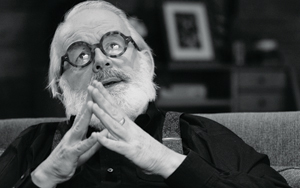
In characteristically
wry, if not acerbic, Sauter style, he describes how he discovered
Ketchum and bought a home. “Suffering the claustrophobia and vulgarity
of Los Angeles,” he recalled, “I cast about for a getaway closer to
fishing and rural ambiance,” mentioning Montana or New Mexico as
possible haunts. Meanwhile, his wife came to Sun Valley for an all-girls
weekend with friends. “Ever the chauvinist, I presumed it would be a
thoroughly benign weekend in terms of impact on my life—just some nifty
women sitting around drinking good wine and laughing hysterically at
their maladroit men.” Brown, 60, is famous in her own right: She’s the
former California state treasurer, an unsuccessful candidate for
California governor, daughter of former California Gov. Pat Brown and
sister of former California Gov. Jerry Brown, whom Sauter admires for
“going through a life transformation” since becoming the serious-minded
mayor of Oakland and shaking the sarcastic sobriquet of “Governor
Moonbeam.”
Instead, as Sauter
recalled, his wife called from Sun Valley and told him to discontinue
the search: She found the perfect hideaway in Ketchum.
So it seems. Sauter’s
lifestyle is a total departure from days as a towering titan in
television. For the past 10 July 4th holidays, he’s led a backcountry
holiday expedition for 20 to 30 friends along the Lewis and Clark trail.
How does a man who
spent hundreds of millions of dollars to entertain and inform millions
of nightly TV viewers occupy his days? He reads The New York Times and
The Wall Street Journal, plus eight or nine Internet news sites, each
day—“from the scurrilous to the penetrating.”
He wrote a novel
(unpublished because “I’m too shy to start finding an agent”) about a
notorious Los Angeles murder. He has a yen for movies. He’s participated
in the Sun Valley Writers’ Conference (a founder, Reva Tooley, is a
family friend). He wanders banks of the Big Wood River searching for
fishing spots. Perhaps surprising, Sauter rarely watches television
(more on that in a moment).
Despite “a heart that
doesn’t pump as well as the doctors would like” and resembling, he says,
a planned-obsolescence 1935 Packard automobile, Sauter scouts the region
for interesting places. “My favorite is Elko, Nevada—gritty, funky,
tough, real, close to the beauty of the Ruby Mountains.”
As a concession to
health, he chews rather than smokes $17 Monte Cristo No. 2 cigars. Life
in Los Angeles is less simple than Ketchum. He has a driver (“my one
indulgence”) to navigate that town’s combative traffic. He works out in
a gym daily “because my doctors said I had to.”
As if to punctuate
the absurdity he feels for strenuous workouts, and those addicted to
no-pain-no-gain regimens, Sauter said he once was a neighbor of the
frenzied fitness fanatic, Richard Simmons—“he could hear me opening a
bag of potato chips.”
Sauter’s gift for
words led to his marriage. Brown, then a member of the Los Angeles
School Board, was offended by a Sauter editorial on the local CBS
station, noting its members (“chronic bedwetters and mystical social
engineers,” in Sauter’s words) had banned candy bars from cafeterias,
but students carried guns or knives. They met over dinner to discuss the
editorial. He instead told her he would marry her.
On a recent
afternoon, Sauter sat with the Sun Valley Guide for an
easy-flowing, spontaneous conversation on topics ranging from A (news
anchors on TV) to Z (zest for life as a young newspaper reporter).
- His politics: “If, say, Pat Robertson is a 10 and MoveOn/Michael
Moore/Blaine County are a 1, I am a determined 8. While I know few
liberals who ever vote Republican, I frequently vote for Democrats. (His
wife is a Truman-style Democrat, but, Sauter says, “like all good
marriages, we know where the pain points are, and we never go there.”)
- Journalism roots: “I will always be overwhelmed with
nostalgia for my newspaper days (in Massachusetts, Detroit and Chicago).
Reporters were randy, drunk, unencumbered by mortgages and wives…(That)
inevitably led to a lot of reprehensible though keenly enjoyable
behavior. What carefree days!” He co-authored two books: Nightmare in
Detroit, about the 1967 riots, and Fabled Land, Timeless River, a
photo-text book about the Mississippi River.
- The past: “I don’t miss anything about my prior jobs.
Nothing. They were great fun and occasionally had true consequence. But
sloth and self-indulgence are highly appropriate and celebrated
qualities at this stage of life. I don’t have a lot of friends from the
‘old’ days. A lot of that is geography. I’ve just moved away from those
worlds. I’m a ‘former’—someone professionally irrelevant and socially
mildewed.”
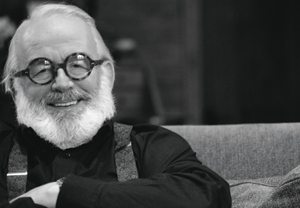
- TV ideology:
“Network television news and the major papers tilt to the left of
center. The overwhelming majority of journalists vote Democratic and
most are liberal. Keep in mind the network organizations and major
papers are housed in cities that are overwhelmingly Democratic. And
liberal. By the standards of Blaine County, these journalists are right
in the middle of the political spectrum.”
- Dan Rather: “While our professional relationship fell
apart, I have kept a personal relationship with Rather. Rather was a
hawk on breaking stories. Tenacious. But he needed, at times, adult
supervision. He ultimately got himself in rough water where he shouldn’t
have been. It was sad. Incidentally, I have fished with Rather and
(now-retired NBC anchor Tom) Brokaw. They are excellent.”
- Watching TV: “I watch very little television, except for
movies and boxing cards. And the NFL playoffs. I adore the Sopranos and
am now addicted to 24. I watch just enough television news to stay
current with the form, but not one iota more. A certain amount of
contemporary television drama, and to a certain degree, comedy, is to me
in close contact with the realities of society. That is healthy and
results in an attractive relevance. On the other hand, a lot of
television is crude and sophomoric. It can’t all be great.”
- Viewers: “We as viewers need to be proactive in viewing
decisions. What we really need to be is deeply involved in what our
children and grandchildren watch. Those decisions should not devolve to
cereal manufacturers and toy makers and clever programmers.”
- Top journalists: “New York Times columnist David
Brooks—non-doctrinaire, incredibly intellectual, spots trends. Times
columnist Tom Friedman—focuses his thinking. NBC Meet the Press
moderator Tim Russert has a great sense of gathering information and
pushing it out to people. Tom Brokaw, one of the best reporters and
journalists. Fox News founder Rupert Murdoch and CBS founder Bill Paley:
two of the most remarkable men. ”
- Katie Couric: “While Couric was the only choice for CBS
News, she was a very good choice. It will take several weeks to a few
months for her and the broadcast to achieve the broadcast they want to
carry into the future. I think she will be successful...if they create a
highly personalized Couric broadcast, and not a generic television news
broadcast with Katie Couric.”
- Journalism’s future: “Increasingly people get news from
a wider range of sources. Internet is for the better. Internet will
break it (news and information) down and break it down, not to community
groups but to interest groups.”
- TV fantasy: “If I had billions of dollars for
television, I would use it to reach the unemployed and uneducated young
men in the major centers of Islamic concentration (with) a video version
of Radio Free Europe and Radio Liberty for a potentially critical force
that, left to its own, will develop a narrow, pre-medieval vision of the
world. And a vision that can collapse into a highly dangerous mindset.”
-His TV record: “I did what I wanted to do and when I
wanted to do it. I did more things right than wrong. I probably helped
more people than I harmed.”
- The valley’s future: “The Wood River Valley, as it is
revered and remembered and celebrated, is gone. The valley is being
paved and built and bermed over. Density will increase. Buildings will
grow taller and more unsightly. Houses will further mutate to sizes that
would mortify the Hapsburgs. Unsold condos will proliferate. Traffic
will garrote the highway and business districts. City fathers prattle on
about affordable housing but in reality it won’t happen on a scale that
comes close to approaching need. The answer for public and private
sector employees will be subsidized housing. Like it or not, Ketchum and
Sun Valley have joined the arriviste universe of Aspen and Jackson.
Hailey, which has more in common with Burley than Ketchum, will hold out
for a while. But Hailey and Bellevue are the Ketchums of tomorrow. I am
always stunned by homeowners, some of whom have been here for only
several years, who say if they were looking for a place to settle, it
wouldn’t be in this valley.”