

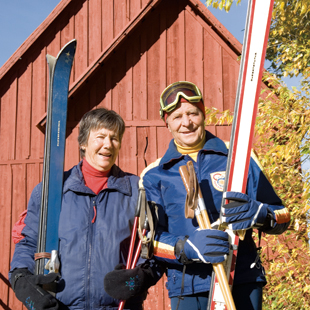
Alice and Andy Scherthanner
Sun Valley Guides
Their license plate
numbers read in the triple digits, which means they’ve been driving in
this town since before most of us had even heard of it. They live at
opposite ends of the valley, and their paths rarely cross. Yet each of
these couples thrives in their niche, shaping the community with strong
character and a commitment to their vision of the Wood River Valley. In
the second of our Sun Valley Guides series, let them guide you through
their slices of valley life. Words by Betsy Andrews. Photos by Paulette
Phlipot.
Old School, Ski
School
“A true friend is one
that asks only what you can give,” says Alice Schernthanner, offering me
cookies, lunch, orange tea and fresh basil (clipped from a pot she has
just brought indoors because of the September frost). She does not offer
me one of the ripe tomatoes. Alice is speaking of individuals, but it’s
a mantra that extends to her 44-year relationship with the Wood River
Valley.
Alice ran the Sun
Valley Children’s Ski School for almost 30 years. She’s taught three
generations of locals and guests, and she’s like the no-nonsense,
old-fashioned mother you hear about and, if you were lucky, that you
had. She is sure of her boundaries, confident of her take on the world,
irritated that her husband, Andy, is out changing a tire on the horse
trailer because not only is he avoiding me but he’s heading out for a
ride. It’s Wednesday, it’s Alice’s day to ride that horse (they have
three), and she doesn’t know where he plans to go, or when he plans to
return.
Andy taught skiing on
Bald Mountain, Sun Valley’s premier area of vertical runs, for 40
winters, retiring three years ago. He is 77, Alice is 68, and the couple
still lives in a home they dug a foundation for and erected in 1962 on
the hillside a mile east of the base of the Warm Springs ski lifts. The
house is surrounded by acres of undeveloped sagebrush, and beyond that,
homes that have seen better days, which they rent to what seems like
half the young workforce of Ketchum. Everything else that is not public
land has evolved from economical ski shacks to million-dollar
properties.
Alice fiercely guards
the old world: the Schernthanner land would make them a fortune—if they
sold it. They do not plan to do so. “What do we need a fortune for?”
said Alice. The acres of blooming sagebrush are a feast for the eye;
they seem a tiny holding, frozen in time, protected only as long as
Alice and Andy fight for them.
The two have truly
realized the ski town dream, arriving during Sun Valley’s heyday, skiing
for a living, building a home and raising six children. What does it
take to follow that dream? Sticking to it, according to Alice, and not
squandering what you’ve got. “If you are cheap, and you don’t go out,
and you don’t give too much away and you don’t have fancy clothes, then
you have a chance. It’s not what you make, it’s what you do with what
you make.” She looks at me pointedly and I wonder if I really needed the
new pair of Merrells.
Alice is beyond
caring what strangers think of her. She shakes her head, remembering
some gossip from years past. “I’ve heard about the few different affairs
I’ve had,” she laughs. “Three, I think. It was news to me.”
Alice and Andy met in
Maine, where she had grown up, and where he had emigrated from Austria
to teach skiing at Sugarloaf Mountain. In 1959, he was sent to Lewiston,
Idaho, while working for a New York company that sold paper and trade
journals. One weekend, he drove to Sun Valley. As he tells it, he
stopped on what used to be an airstrip up on the north Big Wood River,
looked toward Baldy and said, “This is the place I want to live.”
He bought some land,
but then he and Alice moved to California. Alice hated it. “I felt
totally fat and obnoxious there,” she recalls. She described her
neighbors: idle, discontented housewives drinking through the day and
offering their stolid New England acquaintance recreational sedatives.
When Andy found a building crew to frame a house on their Idaho land and
asked if she could be ready to leave the next day, she said, “I’m
already ready.”
Today, many of the
Schernthanners’ Sun Valley friends have moved away. The couple is
cynical about Ketchum’s future, having attended “more town council
meetings,” and having dealt with corporations looking to develop their
corner of sagebrush. A neighbor recently called asking her to clean up
her corral because he’d put his home on the market. “But what if we did,
and then the person who bought the house found out that we just keep our
corral messy?” she asks. This stubborn “take me as I am” attitude has
played an important role in making her dream come true. It’s their
dream. And in it, there is a messy corral.
____________________________________________
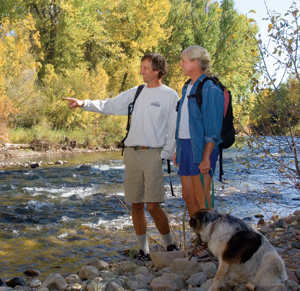
Janet Kellam
and Andy Munter
Mountains and Rivers
Long and lanky, Andy
Munter reclines in a chair as though immobility were his natural state.
Janet Kellam, his wife, leans forward intently, one hand busy with a
chew stick so their new pound puppy, Willie, a slender Australian
shepherd, will chew on it instead of the furniture.
Munter’s lassitude is
deceptive: His idea of relaxation is hiking into the mountains on skis
with Kellam, where the couple spends hundreds of hours annually “just
poking around.” In the summer, they paddle rafts and kayaks down some of
Idaho’s most beautiful rivers.
Both understand the
symbiosis of organisms and environment: It gives to you, and you give
back. As president of the board of Idaho Rivers United and director of
the Sawtooth Forest Avalanche Center, respectively, Munter and Kellam
have taken their love of the Idaho outdoors several steps further than
most.
Kellam has been
buried in an avalanche, but the reminders of mortality the environment
has sent her way haven’t dampened her enthusiasm for the backcountry.
Instead, she has made a career out of promoting safe use of Idaho’s
wilderness. “One of my favorite classes to teach is a women’s avalanche
program; it’s about encouraging them to go out and participate in the
decision-making,” she said. This year, her influence will extend
nationwide as she takes on a new role as president of the board of the
American Avalanche Association.
Thirty years ago,
Kellam had never been in Idaho. As a student at Middlebury College in
Vermont, she was offered a job with Forest Service fisheries biologists
in Stanley. Before accepting, she studied a map. “I saw that it was this
place with almost no roads. I called him back immediately and asked,
‘Can I have the job?’ I kept coming back for summer jobs. I knew it was
home.” By 1980, she was a full-time Idahoan, skiing on the U.S. Nordic C
Team until her discovery of the backcountry marked “the demise of my
race career.”
A native Minnesotan,
Munter arrived in 1977 from Duluth, where he’d co-managed a ski shop. “I
wanted to come to the best ski resort in the West,” he recalled. “I knew
I was employable, and I came for one year.” Now, he’s most recognizable
as the face of Backwoods Mountain Sports, which he bought from its
founder, Bill Wood, in 1983. Fifteen years ago, Munter joined Idaho
Rivers United, a statewide nonprofit river conservation organization.
The group’s agenda includes the Wood River Legacy Project, dedicated to
restoring the lower third of the Big Wood to a living river. “I wanted
to give something back (in return) for this sense of the wilds that the
river has given to me, especially after the experiences I shared while
learning to kayak with my son, Henry.”
Munter is hopeful
about the future of the Big Wood River. “A lot of exciting coalitions
between irrigators and conservationists are being formed. Water is a
huge issue especially in the West, and we hope to help in a little way.
We’re working toward a win-win situation.”
Both Munter and
Kellam realize that conserving the wild parts of Idaho lies in education
and compromise. “The reason I fell in love with Sun Valley is the
mountains and rivers and the people,” said Kellam. “I have spent
significant amounts of time in other communities, and this is a fabulous
community.”
“I just have to ditto
that,” agreed Munter. “There are issues, of course: economic diversity,
growth, the highway, there’s no end of things. But there’s also no end
of people trying to make things better. There are wonderful people, not
just who live here, but who visit here. I can’t really imagine a better
place to live. It’s still a real community. And there are enough models
out there that we can take advantage of their mistakes, and their
triumphs.” ____________________________________________
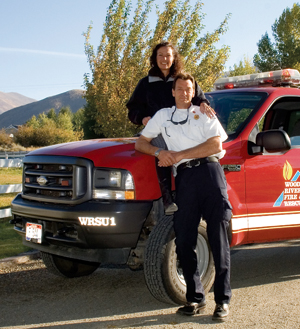
Mealnie and
Jeff Nevins
Horses and
Fire Engines
As the youngest
children in large families, Melanie and Jeff Nevins both thrive on
working with diverse yet like-minded folks toward common goals. This
sometimes means waking up to 30 jousters in medieval garb traipsing
about their ranch. “It’s really fun to look over your coffee in the
morning and there’s this guy in armor,” said Melanie, who has become an
integral part of the Sun Valley Renaissance Faire. She hadn’t even heard
of it a few years ago, until an organizer saw her with her son, Jordon,
who was dressed in Renaissance garb. “We’ll be there!” Melanie assured
her. “Can I bring my miniature ponies?”
That’s a typical
response for the energetic owner of Silver Bell Ranch in Hailey. A
working ranch, Silver Bell buys “green” horses from Germany and Holland,
which employees train for dressage.
Despite the rewarding work, Melanie thrives on giving. She praises the
easy access to philanthropic causes in the Wood River Valley. “You can
make a difference in a small community.”
Her husband, Jeff,
uses the same words—“make a difference”—when he speaks of his work as
chief of operations for Wood River Fire and Rescue. In addition to
overseeing a full-time staff of 10 and a part-time staff of 40, he goes
out on many calls, staunchly supporting his crew. “We have such good
people. We try to create an atmosphere where people feel valued, that
their opinions count.” His volunteers include doctors, construction
workers and river guides. “I love the fire service community. It’s sort
of a national brotherhood—” he struggles to find the right word, not
wanting to exclude women. “Community? But that doesn’t have the same
feel, the feel of family.”
Melanie was a
firefighter, too, for six years, giving it up only when she became
pregnant with Jordon, now 13. “The best part is the camaraderie,” she
said. “There’s not anything like driving down Main Street in a fire
engine, and you’ve got the sirens on and you’re with your friends. Or
you’ve got your Christmas dress crammed in your turnouts and you know
you missed Christmas dinner but you know you made a difference.”
Originally from
Southern California, Melanie moved to Idaho in 1979 after a friend
called and offered her a job. “My car had been broken into two times and
my apartment broken into once in the past six months,” she recalled. “I
moved up in two days.” Jeff had arrived a year earlier, to spend one
winter. He stayed, joining the Sun Valley Fire Department in 1984, and
never looked back. “It just got in my blood, the firefighting.”
The couple moved from
Ketchum to Hailey nine years ago. “Ketchum used to be a wonderful small
town with a lot of diversity, lifestyles, economic levels,” said
Melanie. “It was one group, and it was really rewarding to be a part of.
I feel Hailey now is the same way. It’s very safe. It’s a little
microcosm of everything that’s good. In Hailey,” she continued, “the
pace is slower.” Jeff nods in agreement. “I love Hailey for its value
system.”
But the two don’t kid themselves—they recognize that Central Idaho
presents a homogeneous environment that can repress a creative soul.
They consider travel a fundamental part of raising their son,
reinforcing the value of diversity. In a town that places more value on
how many pairs of skis you have than how many instruments you play,
Jordon plays the mandolin, flute and piano.
Melanie envisions the Sun Valley Renaissance Faire becoming grander.
Jeff holds great hope for the future of the community’s fire services.
“There are a lot of positive things going on,” he said, in spite of the
struggle to stretch resources for a growing population. They realize
that neither will happen by themselves. Getting in there and working
together is everything.
In the background,
Jordon plays Led Zepplin’s Stairway to Heaven. At one point, he looks expectantly at his father. Jeff smiles. “That’s where I usually start to
sing.”