

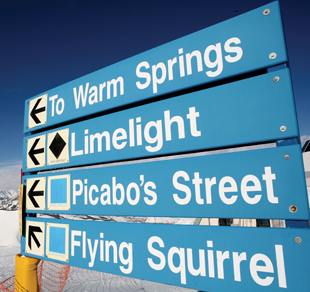
What's a flying
squirrel got to do with it?
Sun Valley ski instructor
Greg Moore navigates through the intriguing origins of the monikers of
Bald Mountain’s ski runs. Photos by Chris Pilaro.
It is widely known
that the 70-year-old Sun Valley resort is situated where it is because
Austrian count Felix Schaffgotsch deemed the surrounding mountains
perfect for skiing. What is not quite so well known is that skiing did
not begin in earnest on Bald Mountain until three years after the resort
opened its doors. Alpine skiing was still in its infancy in America, and
it was thought that there were not enough accomplished skiers to justify
its development in 1936. Management eventually spotted their restless
Austrian ski instructors hiking up and skiing down Baldy on their off
days and quickly determined to realize the untapped potential of that
glorious mountain.
The first lifts were rushed in and opened in 1939. In the ensuing 66
years, the names of the runs on Sun Valley’s cherished Baldy have been
inspired by a variety of sources and events, many of which serve as
bookmarks to the country’s skiing history.
Information for many of the names’ origins listed below was obtained
from Nelson Bennett, who worked at the Sun Valley resort from 1940 to
1960 as ski patrol director and mountain manager, and from Walter
Hofstetter, who worked from 1949 to 1965 as a ski patrolman, mountain
manager and ski instructor.
River Run
The runs first developed on Baldy, which opened in December 1939,
were named after geographical features. Those include Ridge, River Run
and Canyon.
College
Shortly after it was
developed, Sun Valley began to host ski races for college ski teams to
help sell skiing over Christmas vacation. Though the races were not held
on College, the run was named to promote visits by collegiate skiers.
The tradition was somewhat revived in 2005 with the inauguration of the
Holding Cup, a race for teams made up of college alumni. Participants
and Sun Valley Company donate money to the alma maters of the
top-placing teams.
Rock Garden
The most obvious source of inspiration for this name is the run’s
southeastern exposure, where snow melts relatively fast, exposing rocks.
However, the name may also derive from a section of the original
Harriman Cup race course, which was held in 1937 and 1938 on Durrance
Mountain, behind the Sawtooth National Recreation Area headquarters
north of Ketchum. After racers skied down the mountain’s main bowl, they
were funneled into a rocky section called Rock Garden. The race was
moved to the Warm Springs side of Baldy in 1939 and to the River Run
side in 1941. That course included Ridge, Rock Garden and Exhibition.
Durrance Mountain was named after Dick Durrance, who won the race three
times.
Exhibition
Soon to become famous as a showcase for expert skiers, the run was named
for its location under the lift. When Baldy opened, the Exhibition
single chair was part of the only route to the top. One of the lift’s
towers and four of its chairs have been refurbished and installed in
front of the Lift Tower Lodge, at the southern entrance to Ketchum.
Cut-off
When Baldy was first developed, skiers descending Ridge had to continue
down Rock Garden. Cut-off was made to give skiers an alternate route to
Canyon and the Roundhouse restaurant.
Holiday
That name was the winner in a
trail-naming contest held among employees when the run was cut in 1956.
Blue Grouse
The large, dark ground bird is
common on Baldy and throughout the Sawtooth National Forest.
42nd Street
Actually the lower segment of Mid River Run, this trail funnels skiers
on most of the River Run side of the mountain to the base there. Due to
its congested nature late in the day, Hofstetter named it after the
street he had once stayed on in New York City.
Olympic
Named in honor of the 1948 Winter
Olympics in St. Moritz, Switzerland, held the year the run was cut.
Cold Springs
Named after the springs that are
now contained in a small building under the Cold Springs lift. The water
is pumped uphill for use at the Roundhouse restaurant.
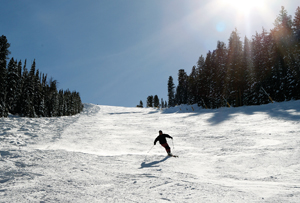
A skier
descends Limelight on Bald Mountain.
Warm Springs
This side of the mountain is named after Warm Springs Creek, which
flows by the base and has numerous hot springs in it. Skiers getting on
the lift can often smell the sulfur from Guyer Hot Springs, just
upstream. In addition to Warm Springs Run, ski runs on this side of the
mountain include:
Limelight
This run was the original lift line for a chairlift built to the top in
1965. Skiers were “in the limelight” as they descended the steep and
narrow bump run under the lift. The run was widened after the current
lift line was cut in 1988 for the Challenger high-speed quad.
International
Originally called Steilhang
when it was cut in 1939, the run was reconfigured in 1960. Hofstetter
gave it its current name to honor international-level downhill races
held there in the early 1960s.
Flying Squirrel
Named by Hofstetter when the run was cut in 1965. “Flying squirrels came
out of the tops of the trees,” he said. “They looked like huge bats.”
Arnold's Run
Named in 2001 for frequent Sun
Valley skier Arnold Schwarzenegger. It had originally been called Flying
Maid, a name given by Hofstetter in honor of two young women from
Seattle who worked as maids at Sun Valley. He said the women often hiked
on Baldy and frequently stopped to visit with the men cutting the run.
One day, he said, they realized with a panic that they were late for
work, and crew members watched the maids bounding downhill to get back
to Sun Valley on time.
Picabo's Street
Named after former Sun Valley
Ski Team racer Picabo Street, who won a gold medal in super G in the
1998 Olympics in Nagano, Japan, and a silver medal in downhill in the
1994 Olympics in Lillehammer, Norway. The run had previously been called
Plaza because it was the widest cut run on the mountain.
Greyhawk
Mountain employees say they’ve
assumed trail crew members saw a gray hawk fly out of the trees when the
run was being cut, similar to what happened at Flying Squirrel.
Cozy
Before the run was cut, Sun Valley
Company owner Earl Holding told mountain manager Max McKinnon that he
wanted a run there that gave him the same “cozy” feeling he got skiing
on Seattle Ridge. McKinnon honored the request, and gave him the name to
boot.
Hemingway
Named for writer Ernest
Hemingway, who made frequent visits to the area beginning in 1939.
Between hunting and fishing trips, Hemingway wrote parts of For Whom the
Bell Tolls, Islands in the Stream and A Moveable Feast here. In 1959,
Hemingway bought a house in Ketchum, where he lived until he shot
himself there in 1961.
Brick's Island
“Brick” was the nickname of a
Sun Valley snowcat driver named Gary Grant, who was killed while on a
machine doing summer trail construction at another ski area.
Seattle Ridge
The area was named after a group
of skiers from Seattle who regularly hiked up the ridge from Broadway
and skied the backside before the lift was built in 1976.
Gretchen's Gold
Named for Gretchen
Fraser, who won a gold medal in slalom in the 1948 Olympics in St.
Moritz, Switzerland. Fraser was the first American alpine skier to win
an Olympic gold medal. She had trained at Sun Valley and later worked
for Union Pacific Railroad, the original owner of the resort, as a
public relations assistant.
Muffy's Medals
Named for former Sun Valley
Ski Team racer Muffy Davis, who won three gold medals in the 2002
Paralympics and a silver medal in the 1998 Paralympics. Davis had just
been named to the U.S. Ski Team’s development squad when she broke her
back during a training run on Bald Mountain in 1989. The accident left
her without the use of her legs.
Christin's Silver
Named for former Sun
Valley Ski Team racer Christin Cooper, who won a silver medal in giant
slalom in the 1984 Olympics in Sarajevo.
Leigh Lane
Actress Janet Leigh was a
frequent visitor and part-time resident of Sun Valley since 1963, and
wrote a historical novel about the resort’s early years called House of
Destiny. The cat track across Seattle Ridge to Broadway was named in her
honor after she died in 2004 at age 77.
Byron's Park
Named for Byron Cady, a Sun
Valley ski instructor who disappeared while rafting the Salmon River.
Presumably he fell in the river while scouting at high water.
Broadway
Named for the famed New York City
boulevard, due to its function as a major artery for skiers exiting the
Bowls.
Frenchman’s Ridge
The old Frenchman’s Mine was located just downhill from where the
lower terminal of the Frenchman’s chairlift now stands. The shaft was
filled in when the lift was built in 1995. Several of the runs in the
area—Au Jus, Can Can and French Dip—follow the French theme.
Graduate
It comes after College.
Janss Pass
Named for Bill Janss, head of
the Janss Corporation, which owned Sun Valley from 1964 to 1977.
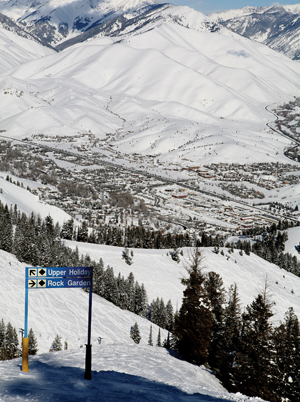
The Bowls
Mayday Bowl
Instructor Florian
Haemmerle, who taught skiing at Sun Valley from its opening in 1936
until the mid 1960s, organized a slalom race on the bowl on May 4,
1938—St. Florian’s Day. Haemmerle’s widow, Bebe Haemmerle, said the race
was for instructors who had decided not to return to Austria for the
summer, and was won by her husband. “He stuck his pole in the snow and
said, ‘I proclaim that this is Mayday!’” she said.
Christmas Bowl & Easter
Bowl After
Haemmerle christened Mayday Bowl, other instructors followed the holiday
theme in naming the two nearby bowls.
Lookout Bowl
Named for the U.S. Forest
Service fire lookout built on the top of Bald Mountain in 1941. The
building is still there but is now used only as a radio repeater
station.
Lefty Bowl
Originally, this was the
farthest bowl to the left (looking up from the bottom) that could be
skied without getting into thick trees. Trees near the bottom of the
bowls farther to the left have since been cleared.
Farout Bowl
Well, it’s pretty far out.
Sigi's Bowl
Named after former Sun
Valley Ski School Director Sigi Engl. Originally from Austria, Engl
served as ski school director from 1952 to 1975.