| Current Issue |
| View as .PDF |
| features |
| Art walks |
| Wolverines |
| 1950s Sun Valley |
| Hillard Hicks |
| arts |
| Raku |
| Quilting |
| Glenn Janss & SVCA |
| living |
| Giving |
| Solar Power |
| Small Spaces |
| recreation |
| Kiteboarding |
| Backcountry Education |
| Vintage SV chairlifts |
| dining |
| Omlettes |
| Trail cuisine |
| Coffee |
| calendar |
| Winter 2006 |
| listings |
| Galleries |
| Dining |
| Fitness |
| Lodging |
| Equipment |
| Outfitters |
| maps |
| Ketchum & Sun Valley |
| Gallery Map |
| the guide |
| Last Fall |
| Editorial Submission |
| Calendar Submission |
| Advertising Submission |
| Advertising Rates |
| About Us |

|
|
Copyright
© 2005 Express Publishing Inc. All Rights reserved. Reproduction in whole or in part in any form or medium without express written permission of Express Publishing Inc. is strictly prohibited. The Sun Valley Guide magazine is distributed free twice yearly to residents and guests throughout the Sun Valley, Idaho resort area communities. Subscribers to the Idaho Mountain Express newspaper will receive the Sun Valley Guide with their subscription. |

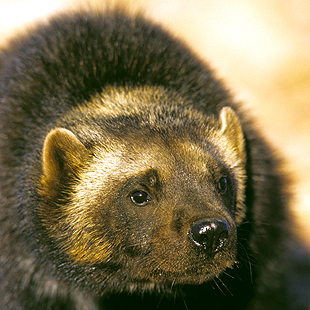
Photo by Daniel J. Cox
Wolverines
Ghosts in our woods
By Gregory Foley
Photos by Daniel J. Cox
They are creatures of legend. Most people have never seen one and never will. Few have any idea what they look like or where they exist. Yet, stories about their ferocity and prowess abound.
They are said to present a whirlwind of noise and teeth to chase grizzly bears and packs of wolves from their carrion. They are said to hound herds of animals many times their own size into submission, sometimes slaughtering them in large numbers and gorging themselves on the carcasses. And they are depicted as dangerous pests that travel unseen, secretly ravaging backcountry cabins, camps and traps. They have been called “glutton,” “devil bear” and “woods devil.”
Wolverines, it would seem, are often feared, seldom seen and rarely appreciated.
As one story goes, told decades ago by an Inuit native of Alaska, a half-ton polar bear once crushed a wolverine to its chest, but then dropped dead when the cradled beast tore out its heart.
Jeff Copeland, a wildlife biologist for the U.S. Forest Service who has studied wolverines in the northern Rocky Mountains for nearly two decades, says most of what people think they know about the stout carnivores is based largely on fables.
“Before the 1980s, much of our understanding of wolverines came from woodsmen and trappers and their overactive imaginations,” Copeland said. “It was considered this phantom of the high-mountain backcountry, this ferocious beast. Most of this is myth, but nonetheless I’m always amazed at what they’re capable of.”
Indeed, the relatively few researchers who have studied wolverines in the Rocky Mountain West characterize them as impressively powerful, resourceful and mobile. They have been known to wear down and kill animals as large as moose and caribou, generally in winter when the prey are more vulnerable. They survive in rugged mountainous areas that are often defined by deep snow and frigid temperatures. And they travel incredibly long distances over difficult terrain, sometimes up to 25 miles in a single day.
While wolverines are “ferocious in their own right,” Copeland said, their aggressiveness has been greatly exaggerated, largely because most of the initial encounters between humans and wolverines occurred when the animals were bound in painful leg-hold traps, usually set for other fur-bearing species.
“They’re certainly not the biggest and baddest creatures in the woods,” Copeland said. “I think really the hallmark of the wolverine is its almost insatiable need to be on the move. They cross a topo map like we cross the street.”
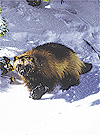 The
wolverine is the largest land-dwelling member of the weasel family. It
resembles a small bear but its movement and behavior is distinctly similar
to its weasel relatives, which include the fisher and the badger. Most
have a thick, dark brown coat, a light facial mask and a pale stripe that
runs laterally across the body to a bushy tail. They survive primarily
as scavengers, often traveling long distances, using their keen sense
of smell to find fallen ungulates—elk, deer, moose or caribou. They also
prey on small mammals, including marmots and ground squirrels, and occasionally
forage for insects and vegetation. They are a feared predator—adult males
can reach 40 pounds and three feet long—but are also preyed upon, primarily
by mountain lions, wolves and bears.
The
wolverine is the largest land-dwelling member of the weasel family. It
resembles a small bear but its movement and behavior is distinctly similar
to its weasel relatives, which include the fisher and the badger. Most
have a thick, dark brown coat, a light facial mask and a pale stripe that
runs laterally across the body to a bushy tail. They survive primarily
as scavengers, often traveling long distances, using their keen sense
of smell to find fallen ungulates—elk, deer, moose or caribou. They also
prey on small mammals, including marmots and ground squirrels, and occasionally
forage for insects and vegetation. They are a feared predator—adult males
can reach 40 pounds and three feet long—but are also preyed upon, primarily
by mountain lions, wolves and bears.
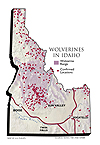
Once common across much of North America—including the entire northern United States, the Rocky Mountains and California—the wolverine’s continental range today is essentially limited to Idaho, Montana, Alaska and Canada, as well as parts of northern Washington and northwest Wyoming. Wolverines are also found across the northern latitudes of Europe and Asia.
In Idaho, wolverines inhabit the state’s central mountain ranges—including the Smokys, Sawtooths, Boulders and White Clouds—and much of the vast wilderness that stretches north to the Canadian border.
Robin Garwood, wildlife biologist for the Sawtooth National Recreation Area, the 756,000-acre complex of public lands north of Ketchum, said track verifications and occasional sightings each year confirm the presence of wolverines in the region. However, the species’ preference for remote forests and high-mountain cirques, coupled with its tendency to avoid humans, keeps the number of verified sightings quite low.
“They’re considered to be doing pretty well here,” Garwood said. “One reason, it’s thought, is that there is so much roadless area.”
The roadless areas included in the SNRA and the nearby 2.3 million-acre Frank Church-River of No Return Wilderness now comprise some of the most critical habitat for wolverines in the Lower 48 states. While wolverines have been exterminated from large areas of their historical range by trapping, poisoning and the pressures of development, Central Idaho has been, and continues to be, prime wolverine country, a rare refuge that provides ample food, cover and room to roam.
It is believed that explorer Meriwether Lewis encountered a wolverine when Lewis and Clark’s Corps of Discovery was in the vicinity of Lemhi Pass, on the Idaho-Montana border, in August 1805.
“We saw an animal which we took to be of the fox kind, as large or rather larger than the small wolf of the plains (coyote),” Lewis wrote. The animal was shot by the team’s hunter but “recovered and got out of our reach,” he noted.
More than a century later, in the late 1930s, one researcher believed that wolverines had been exterminated from Idaho. But, in the 1950s, studies revealed that the secretive creatures had persisted, and by the 1970s confirmed sightings started to increase.
“Up to the 1950s, wolverines were dramatically reduced, probably because of poisoning campaigns to protect livestock from carnivores,” Copeland said.
Today, it is established that wolverines in the United States typically do not prey on livestock.
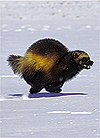 Chuck
Harris, state nongame wildlife manager for Idaho Fish and Game, said the
number of wolverines in Idaho today is not known but it is believed the
species maintains viable populations in Central Idaho, the Frank Church
Wilderness, the Bitterroot-Selway Wilderness and other points north.
Chuck
Harris, state nongame wildlife manager for Idaho Fish and Game, said the
number of wolverines in Idaho today is not known but it is believed the
species maintains viable populations in Central Idaho, the Frank Church
Wilderness, the Bitterroot-Selway Wilderness and other points north.
“By definition, they do not occur in large numbers,” Harris said. “They need big ranges, they produce small litters, and they don’t reproduce every year.”
Wolverines are uniquely adapted to living in Idaho’s mountainous habitat. They are powerfully built, with mighty jaws that can crush through frozen bone, yet they are light enough to travel over hardened snow. Their large, clawed feet serve as natural snowshoes and help to dig through snow—sometimes several feet deep—to prey on rodents hibernating below.
The wolverine’s Latin name, Gulo gulo, means glutton, in reference to the now-dismissed notion that its appetite for meat is insatiable. It is not a “snarling, drooling, nasty predator” or a glutton, Copeland said, but it does have adaptations that might have contributed to its mythical status. It has an exceptionally large stomach that allows it to consume sizable amounts, and it has unusually thick heart walls, which could contribute to its legendary endurance.
In Scandinavia, where wolverines are notorious for preying on reindeer, “they’ll go for hours, sometimes days, just tracking an animal and chasing it until it wears out,” Copeland said.
Wolverines, like many carnivores, are relatively solitary creatures that require substantial home ranges. And, despite stories about their aggressive nature, they generally avoid one-on-one contact with humans. Garwood said one report in the SNRA of a man claiming to have been chased up a tree by a wolverine was never substantiated.
In fact, Harris said, in Idaho there has never been a documented attack of a wolverine on a person.
“They basically try to avoid people,” he said.
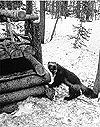 Copeland,
who today is considered one of the nation’s foremost authorities on wolverines,
from 1992 to 1995 conducted what is considered to be the most thorough
study of wolverines ever done in Idaho. The research—which was done in
a 4,800-square-mile area of Central Idaho, mainly in locations south,
east and north of the Sawtooth Wilderness—not only answered the question
of whether the region had a viable population of wolverines, it provided
important new insights into the carnivore’s biology, behavior and habitat.
Copeland,
who today is considered one of the nation’s foremost authorities on wolverines,
from 1992 to 1995 conducted what is considered to be the most thorough
study of wolverines ever done in Idaho. The research—which was done in
a 4,800-square-mile area of Central Idaho, mainly in locations south,
east and north of the Sawtooth Wilderness—not only answered the question
of whether the region had a viable population of wolverines, it provided
important new insights into the carnivore’s biology, behavior and habitat.
The study arose from what Copeland considers to be a watershed event in raising the status of the wolverine in the Rocky Mountains. A trapper from the Wood River Valley in the 1970s unintentionally trapped and killed a wolverine in the Sawtooth Valley, between Ketchum and Stanley.
Conservationists persistently raised questions about the wolverine population in the region, and after the Forest Service acknowledged that very little was known about wolverines in Idaho, federal funding was allocated in 1991 to study them.
During the study, Copeland used baited metal-barrel and log-box traps to live-trap wolverines and monitor them using surgically implanted radio transmitters. Nineteen different animals were captured and studied, with some astounding results.
Copeland determined that male wolverines in the area maintained a home range of about 500 square miles, but did not keep the land all to themselves. A “harem” of several females might also reside in the area, as well as one or two young adults. Females maintained exclusive home ranges that were considerably smaller, about 100 square miles.
Copeland also collected new data on where the animals located their dens and what they ate. He discovered that Idaho wolverines are susceptible to predation, mostly by mountain lions. And he found that human disturbance of dens will prompt mothers to abandon a den site and move elsewhere, risking danger to her offspring, called kits.
By better defining areas where females might be in a den with kits, Copeland has helped the SNRA determine where it can permit backcountry helicopter skiing without adversely impacting wildlife.
But the most interesting findings, Copeland said, came from studies of an old male wolverine, which he named “Socks,” for the patch of white fur on one of his feet. Socks was trapped the second year of the study in the Challis National Forest.
“He was an old, scarred-up male who was sort of the patriarch of the south end of the Frank Church Wilderness.”
As Socks was being monitored, Copeland was also caring for an orphaned female kit captured from the same area. When the young wolverine was released, she started feeding at one of Copeland’s traps, and was repeatedly captured, sometimes two or three times a week.
 “I
talked to my wife,” Copeland said, “and she said, ‘Maybe her dad will
find her and take care of her.’” The notion seemed unlikely, however,
because common wisdom dictated that adult male wolverines are not social
and never associate with younger animals.
“I
talked to my wife,” Copeland said, “and she said, ‘Maybe her dad will
find her and take care of her.’” The notion seemed unlikely, however,
because common wisdom dictated that adult male wolverines are not social
and never associate with younger animals.
The next day, Copeland picked up a signal from the young female. She was 10 miles north of the trap, and she was not alone.
“She was with Socks,” he said. “They traveled together for three days.”
The two wolverines then split up, but later Copeland found the female was repeatedly turning up in the same places as Socks.
“She followed him around and learned where to find food. It’s like he was showing her the ropes.”
The following winter, Copeland discovered that Socks was traveling with a single young male.
“This was totally contrary to what we would have expected,” he said. “The young animals were hanging out with their father and learning how to be a wolverine.”
Based on rough estimates calculated by population densities, Copeland now estimates that Central Idaho, from the South Fork of the Boise River to the Middle Fork of the Salmon River, probably supports between 50 and 150 wolverines—perhaps the greatest concentration in the Lower 48.
But, says Copeland, there is concern in the scientific community about the long-term future of the wolverine in Idaho and other parts of the West. While wolverines are protected in Idaho—in 1981 Fish and Game listed them as a nongame species of “special concern”—they are legally trapped in Montana, Alaska and Canada.
Petitions filed in 1995 and 2000 to have the wolverine protected by the Endangered Species Act in the Lower 48 failed. The U.S. Fish and Wildlife Service found that a “threatened” or “endangered” ESA listing was “not warranted,” mainly because too little was known about the wolverine’s status.
At the same time, people are venturing more and more into wolverine habitat. Copeland fears that as human activities expand, the reclusive wolverines might be driven out of the fringes of their range. Winter recreation—backcountry skiing and snowmobiling—can adversely affect wolverines while they are rearing kits in the spring.
“The prime reason wolverines persist where they do is the habitat, the wilderness. As long as these areas are protected, wolverines should persist,” Copeland said. “But as winter recreation develops in places that are not protected, like the Smokys, the wolverine could be displaced. That is the concern.”
 In
spite of the challenges, wolverines are holding on to their niche in Idaho’s
diverse alpine ecosystem. Like ghosts, they roam the forests and high
peaks, all the while watching over their young, teaching them how to survive.
Certainly, Socks has yielded to the tests of time. But in his place, another
patriarch is undoubtedly traversing the wilderness, quietly reigning over
his range, and seeking to keep the age-old myths at bay. •
In
spite of the challenges, wolverines are holding on to their niche in Idaho’s
diverse alpine ecosystem. Like ghosts, they roam the forests and high
peaks, all the while watching over their young, teaching them how to survive.
Certainly, Socks has yielded to the tests of time. But in his place, another
patriarch is undoubtedly traversing the wilderness, quietly reigning over
his range, and seeking to keep the age-old myths at bay. •