| Current Issue |
| View as .PDF |
| features |
| Art walks |
| Wolverines |
| 1950s Sun Valley |
| Hillard Hicks |
| arts |
| Raku |
| Quilting |
| Glenn Janss & SVCA |
| living |
| Giving |
| Solar Power |
| Small Spaces |
| recreation |
| Kiteboarding |
| Backcountry Education |
| Vintage SV chairlifts |
| dining |
| Omlettes |
| Trail cuisine |
| Coffee |
| calendar |
| Winter 2006 |
| listings |
| Galleries |
| Dining |
| Fitness |
| Lodging |
| Equipment |
| Outfitters |
| maps |
| Ketchum & Sun Valley |
| Gallery Map |
| the guide |
| Last Fall |
| Editorial Submission |
| Calendar Submission |
| Advertising Submission |
| Advertising Rates |
| About Us |

|
|
Copyright
© 2005 Express Publishing Inc. All Rights reserved. Reproduction in whole or in part in any form or medium without express written permission of Express Publishing Inc. is strictly prohibited. The Sun Valley Guide magazine is distributed free twice yearly to residents and guests throughout the Sun Valley, Idaho resort area communities. Subscribers to the Idaho Mountain Express newspaper will receive the Sun Valley Guide with their subscription. |

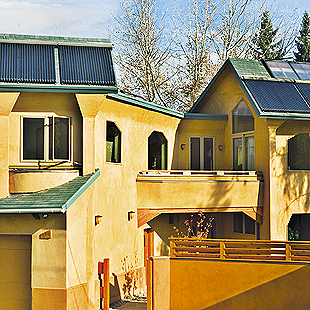
Photo by David N. Seelig
Serious about solar
The Wood River
Valley wakes up
to the power of the sun
By Tony Evans
At the end of a long dirt road near Soldier Mountain on the Camas Prairie, Bill and Faus Corlett restacked a 100-year-old farmhouse and guest quarters using salvaged building materials collected over 25 years. Sandhill Farm came together on a budget and with persistence. Built 1.5 miles beyond the reach of power lines and road maintenance, it is only accessible during winter via skis or snowshoes. Yet Sandhill Farm doesn’t lack for creature comforts.
Eight photovoltaic solar panels beside the farmhouse collect enough solar energy to power a satellite television, computer, well pump, lights and other appliances throughout the year. Yes, even through those long, cold winter months.
 Since
2003, the Corletts have enjoyed “free” electricity from the photovoltaic
cells that transform solar radiation into electricity, which is then stored
in eight deep-cycle batteries in the farmhouse. An electrical inverter
transforms the DC battery current to 120-volt for household use.
Since
2003, the Corletts have enjoyed “free” electricity from the photovoltaic
cells that transform solar radiation into electricity, which is then stored
in eight deep-cycle batteries in the farmhouse. An electrical inverter
transforms the DC battery current to 120-volt for household use.
“We always planned to build an energy-independent place out here,” said Bill. “It would have cost $80,000 to run power lines. I spent $11,000 instead on solar panels and batteries, which paid for themselves in the first five years.”
The Corletts’ location in the snowy Soldier Mountain area is no hindrance to their energy production. In fact the winters sometimes produce more power than the long, hot summer days. Reflection from the snow cover on the hills surrounding the farm has generated an unexpected surge in electricity.
Once a year, the Corletts purchase about 600 gallons of propane gas, which is used for cooking and to pump heated fluid through radiant heat floors with a solar-powered pump. An antique wood stove is also used to warm the house, which resembles a turn of the century homestead despite its renewable energy innovations. A passive solar greenhouse on the property produces edible greens year-round.
Independent-minded people such as the Corletts are not alone in the rush to use solar technology, even during Idaho’s interminable winters. Recent advances in inverter technology and hot water heating systems, as well as rising energy prices, have made solar technology more attractive than ever to mainstream homebuilders.
 There
are three basic sources of solar energy for domestic use: structural passive
solar design, photovoltaic electricity generation, and passive solar hot
water heating. All three can be used during the cold but sunny Idaho winters
to reduce energy consumption. With over 300 blue banner days per year
in the Sun Valley area, residents are beginning to wise up to this renewable
energy source.
There
are three basic sources of solar energy for domestic use: structural passive
solar design, photovoltaic electricity generation, and passive solar hot
water heating. All three can be used during the cold but sunny Idaho winters
to reduce energy consumption. With over 300 blue banner days per year
in the Sun Valley area, residents are beginning to wise up to this renewable
energy source.
In fact, so high has the recent demand for solar energy been, that it has led to a shortage of photovoltaic cells, according to Scott Gates, renewable energy administrator for Idaho Power Company.
“I hear from people that they are waiting up to six months for PV cells,” said Gates, who oversees 25 interconnected solar systems in southern Idaho, including the home of Morgan Brown, founder of Sun Valley Solar and the consulting firm Developing Green, LLC, based in Ketchum.
While independent off-the-grid systems in Idaho, like Sandhill Farm, number in the thousands, in-town grid-tied systems are relatively new. There are only 25. Brown’s is one such system, the advantage of which is that it has no need for batteries. Brown’s home is connected to the valley’s electrical grid and his electricity meter runs both ways, actually selling surplus power back to the utility during sunny days.
 Although
co-generation, or net-metering, has been allowed since 1978, the process
of tying into the electrical grid became much simpler in June 2004 when
the Idaho Public Utilities Commission simplified net-metering requirements
by waiving insurance requirements, and setting a $100 hook-up fee for
residential customers. In January 2006, the government will offer the
first federal tax incentives for solar technology installation in a generation.
Although
co-generation, or net-metering, has been allowed since 1978, the process
of tying into the electrical grid became much simpler in June 2004 when
the Idaho Public Utilities Commission simplified net-metering requirements
by waiving insurance requirements, and setting a $100 hook-up fee for
residential customers. In January 2006, the government will offer the
first federal tax incentives for solar technology installation in a generation.
The grid-tied Hulen Meadows home of Brown and his wife, architect Rebecca Bundy, was designed with 25-foot, open-truss ceilings, superb woodwork and walls of windows to create a spectacular showcase for energy-conscious design. Yet, even the simplest energy-efficient homes begin with the same basic passive solar design principles: south-facing walls filled with windows to shed light on daytime living areas, while northern areas are reserved for garages, closets and bedrooms.
Overhanging eaves protect living spaces from scorching, high-angle summer sunlight (60 degrees), while allowing for low-angle light (20 degrees) to penetrate the interior during winter. Concrete in floors, countertops and masonry fireplaces acts as a thermal battery, collecting heat during the day to radiate overnight in winter. It also absorbs heat in summer, leveling the average interior temperature throughout the year.
 In
total, Brown included $50,000 worth of renewable technology in the design
of his Hulen Meadows home. According to a recent appraisal, this expenditure
increased his home equity dollar for dollar. “If the systems are attractively
installed, they not only cut the pollution in the atmosphere, but also
increase the value of your home,” he says.
In
total, Brown included $50,000 worth of renewable technology in the design
of his Hulen Meadows home. According to a recent appraisal, this expenditure
increased his home equity dollar for dollar. “If the systems are attractively
installed, they not only cut the pollution in the atmosphere, but also
increase the value of your home,” he says.
Proper design is essential for a successful energy-efficient home. “You can’t add technology to poor design and expect good results,” said Dale Bates of Living Architecture in Ketchum.
An energy-efficient demonstration home built by Bates on the property of the Living Architecture offices in Ketchum employs “sun tubes” that spray sunlight through reflective cylinders into the darker, north-facing rooms during the day. Clerestories surround the upper walls, providing light without compromising privacy. Kitchen skylights employ prismatic polycarbonate glass that multiplies reflected light above a year-round tiny garden planted behind the kitchen sink.
“The light is important, not just for heat,“ said Bates. “In the winter around here, we spend 80 to 90 percent of our time indoors. The human mind is affected hormonally by this lack of light.”
The Bates home is rigged with 22 data-logging sensors in walls, ceilings and outside areas that will be tracked and measured by a California Institute of Technology graduate to chart overall effectiveness of the site in terms of energy consumption during the next year.
 “The
bulk of energy consumption in this area is spent in home heating, rather
than electricity,” said Bates. Therefore, he advises making the bulk of
one’s solar investment in state-of-the-art solar hot-water systems. Both
Dale Bates and Morgan Brown use the latest generation of roof-mounted
water heating systems made of evacuated tubes filled with a combination
of glycol (anti-freeze) and water that circulates through the floors of
a home, as well as heat exchange systems to provide domestic hot water
needs.
“The
bulk of energy consumption in this area is spent in home heating, rather
than electricity,” said Bates. Therefore, he advises making the bulk of
one’s solar investment in state-of-the-art solar hot-water systems. Both
Dale Bates and Morgan Brown use the latest generation of roof-mounted
water heating systems made of evacuated tubes filled with a combination
of glycol (anti-freeze) and water that circulates through the floors of
a home, as well as heat exchange systems to provide domestic hot water
needs.
For local builders like
Garth Callaghan of Hailey, the challenge in going solar lies in the installation
of these hot water systems, which must withstand extremes in temperatures
throughout the year. Plumbing contractors are learning a new set of skills
to meet the exacting standards
of solar technology.
“One of the principles in green building is to use local builders,” said Callaghan, who works with local contractors willing to challenge themselves, rather than seeking help from specialists out of the area. “The idea is to sustain your community as well as the environment.”
Even though Idaho Power corporate headquarters in Boise is fitted with a 100-kilowatt photovoltaic system of its own, enough to power a floor of computer equipment within Idaho Power’s corporate offices, Gates, energy administrator, points out that Idaho has some of the lowest utility rates in the country.
 “This
may be good news or bad news, depending on how you look at it. It’s tough
to promote solar in Idaho in terms of economic incentives,” said Gates.
“In any case, a lot of times the decision to use renewable energy is an
emotional one, rather than strictly economic.”
“This
may be good news or bad news, depending on how you look at it. It’s tough
to promote solar in Idaho in terms of economic incentives,” said Gates.
“In any case, a lot of times the decision to use renewable energy is an
emotional one, rather than strictly economic.”
Out at Sandhill Farm, Bill Corlett is eyeing the creek that flows through his property for an inexpensive hydropower generator. He also has plans for a wind generator that will help top off his batteries as the sun gets lower during the winter months.
“That’s when the wind comes, during winter,” he says. “It’s a shame to see it go to waste.” •