| Current Issue |
| View as .PDF |
| features |
| Art walks |
| Wolverines |
| 1950s Sun Valley |
| Hillard Hicks |
| arts |
| Raku |
| Quilting |
| Glenn Janss & SVCA |
| living |
| Giving |
| Solar Power |
| Small Spaces |
| recreation |
| Kiteboarding |
| Backcountry Education |
| Vintage SV chairlifts |
| dining |
| Omlettes |
| Trail cuisine |
| Coffee |
| calendar |
| Winter 2006 |
| listings |
| Galleries |
| Dining |
| Fitness |
| Lodging |
| Equipment |
| Outfitters |
| maps |
| Ketchum & Sun Valley |
| Gallery Map |
| the guide |
| Last Fall |
| Editorial Submission |
| Calendar Submission |
| Advertising Submission |
| Advertising Rates |
| About Us |

|
|
Copyright
© 2005 Express Publishing Inc. All Rights reserved. Reproduction in whole or in part in any form or medium without express written permission of Express Publishing Inc. is strictly prohibited. The Sun Valley Guide magazine is distributed free twice yearly to residents and guests throughout the Sun Valley, Idaho resort area communities. Subscribers to the Idaho Mountain Express newspaper will receive the Sun Valley Guide with their subscription. |

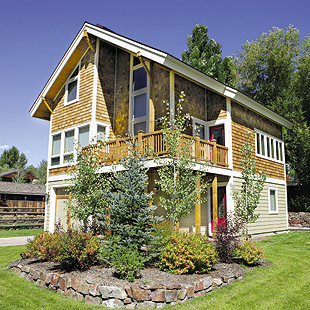
Photo courtesy Denali Design
Small is beautiful
Living small resonates
By Megan Thomas
In a land where castles dominate the landscape, intimate living spaces can prove to be the true kingdoms.
Building and occupying small homes is a growing trend in a valley rapidly running out of room. These spaces are historically mindful, environmentally conscious and architecturally innovative.
“The big ones are easy to design. You have all kinds of square footage. You can do anything you want,” said Jeff Anderton, whose company, Denali Design and Construction, recently built two small houses in west Ketchum. “There is an architectural challenge in small homes.”
Anderton and other builders, architects and homeowners are venturing away from the valley’s predominant bigger is better attitude and discovering comfort in smaller spaces.
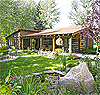
Step inside the Broadford cabin. Originally constructed in the 1880s by one of the valley’s miners, the Broadford cabin in Bellevue exemplifies just how luxurious living small can be.
The cabin sits adjacent to a brook, nestled in a grove of quaking aspen. This charming setting provided the owners with ample reason to embark on an ambitious renovation. The result is a 780-square-foot historic home filled with 21st-century amenities.
Owners Edward and Elise Lobel, along with Conrad Brothers Construction, transformed the rugged 19th-century cabin into a miniature castle, all designed on 8.5 by 11-inch paper.
Updating the historic structure proved difficult because Blaine County regulations restricted the renovation to the existing footprint and roofline. The limitations required contractors to build from the inside out.
 Years
of structural shifting had left an 11-inch height difference between bedroom
corners. The crooked nature required the Conrad Brothers to develop some
unique methods to correct the visual imbalances. The resulting renovation
retains the original log siding, and the two structural additions they
made are visible only in a change from square beams to round.
Years
of structural shifting had left an 11-inch height difference between bedroom
corners. The crooked nature required the Conrad Brothers to develop some
unique methods to correct the visual imbalances. The resulting renovation
retains the original log siding, and the two structural additions they
made are visible only in a change from square beams to round.
In keeping with the theme of historic preservation, a door that has witnessed two centuries hangs on the front wall as a decorative rather than functional reminder of the cabin’s origins.
Within, a kitchen, bedroom, bathroom and den have all been decoratively squished into the limited floor plan, and space saving modifications heighten the appeal of these snug quarters. In the kitchen, a diminutive dishwasher pulls from a drawer, a mini refrigerator preserves food and a bench seat doubles as storage.
Adjoining the kitchen, the den is the heart of the home. Frosted glass sconces illuminate the cabin with a candle-like light, reviving the lodging’s early rustic atmosphere. And a cushy bunk bed tucked into a corner is a childish reminder of the need to utilize all available square footage.
A delicate harmony emerges from within this Idaho mining cabin. Peppered with modern conveniences, the home proves that better words for small and old are intimate and historical—a charming combination.
However, it is not always necessary to renovate a derelict cabin to enjoy Lilliputian-style living. New construction has finally caught on to the feasibility of living small (something Europe has been inventively dealing with for centuries).
Embracing the mining spirit exemplified in the Broadford cabin, last year Bellevue-based general contractor Janet Barton built a neighborhood of 21st century homes that hold true to pioneering principles.
“I feel like people want a sense of place, a sense of belonging. It’s no different than 1880,” said Barton of her cozy neighborhood design.
Returning to Bellevue’s original 1880 town plat, which called for 6,000-square-foot residential lots closely spaced, Barton developed 12 small homes, ranging from 1,500 to 2,100 square feet, on the city’s north end.
“(In the 1880s) unless you were the owner of the mine, you lived in a modest, economical home,” Barton said. But, just because they are small, Barton saw no reason for modern day equivalents to lack ingenuity and desirability. The cheery colors and individual designs she implemented in the new neighborhood have brightened Bellevue’s landscape.
While Barton’s reasons for building smaller living spaces are economic, others choose to do so as a nod to the environment. “Sometimes keeping the small size is for cost; for me it is for keeping a lighter touch on the land,” said Ketchum-based architect Susan Scovell.
That light touch comes with a host of environmental advantages. Smaller homes require less building material, use less heat, consume less water, and need less energy.
 Scovell
decided early in her architectural career to design solely smaller living
areas. Her commitment contrasts with others, who gravitate toward expansive
architectural ventures.
Scovell
decided early in her architectural career to design solely smaller living
areas. Her commitment contrasts with others, who gravitate toward expansive
architectural ventures.
“(Small) is a better proportion for the human body … it’s hard to get comfortable in these huge volumes of space,” Scovell said.
The minimalist scope of Scovell’s projects achieves a sense of spaciousness by maximizing natural light, implementing open floor plans and incorporating imaginative design elements.
The small space of her own home employs many of those space-saving elements that she utilizes in her work. For example, firewood stored under the fireplace, an extra six-inch ledge in a bathroom and an open shower arrangement all conserve space while adding visual pleasure.
With expansive windows, Scovell welcomes natural light to breathe airiness into the small space. The kitchen, void of high cabinetry, flows into the great room with clean lines and simple decoration.
Builder Jeff Anderton employed a similar premise in the two small homes he built in west Ketchum. “In a tiny home we can still incorporate an awful lot of architectural detail that has the detail that anything bigger would have.”
His project required a change in zoning regulations, which made way for two smaller freestanding homes in an area zoned for one large duplex. With a 600-square-foot building footprint, one of the homes uses three stories to total 1,950 square feet of livable space.
 The
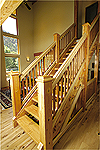
result is a home built vertically, with an awareness of the land. A two
story stacked staircase saves floor space and its open design—there are
no enclosing walls or solid steps—allows the eye to move through the attractive
wooden stairs and take in the whole home with little visual barrier.
The
result is a home built vertically, with an awareness of the land. A two
story stacked staircase saves floor space and its open design—there are
no enclosing walls or solid steps—allows the eye to move through the attractive
wooden stairs and take in the whole home with little visual barrier.
“If (small homes) are done correctly,” said Anderton, “they can have architectural appeal, a cozy feel and are all the way around more environmentally friendly.”
Such small living spaces achieve a castle-like stature, immeasurable in square feet. •