| Current Issue |
| View as .PDF |
| features |
| Art walks |
| Wolverines |
| 1950s Sun Valley |
| Hillard Hicks |
| arts |
| Raku |
| Quilting |
| Glenn Janss & SVCA |
| living |
| Giving |
| Solar Power |
| Small Spaces |
| recreation |
| Kiteboarding |
| Backcountry Education |
| Vintage SV chairlifts |
| dining |
| Omlettes |
| Trail cuisine |
| Coffee |
| calendar |
| Winter 2006 |
| listings |
| Galleries |
| Dining |
| Fitness |
| Lodging |
| Equipment |
| Outfitters |
| maps |
| Ketchum & Sun Valley |
| Gallery Map |
| the guide |
| Last Fall |
| Editorial Submission |
| Calendar Submission |
| Advertising Submission |
| Advertising Rates |
| About Us |

|
|
Copyright
© 2005 Express Publishing Inc. All Rights reserved. Reproduction in whole or in part in any form or medium without express written permission of Express Publishing Inc. is strictly prohibited. The Sun Valley Guide magazine is distributed free twice yearly to residents and guests throughout the Sun Valley, Idaho resort area communities. Subscribers to the Idaho Mountain Express newspaper will receive the Sun Valley Guide with their subscription. |

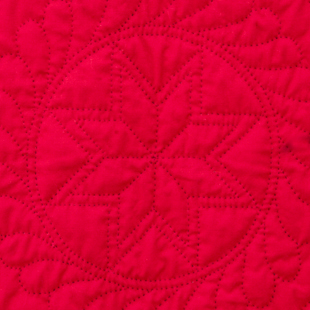
Photo by David N. Seelig
Quilting pioneers
An art of craft,
quilting blooms
in the 21st century
By Betsy Andrews
A small quilt called “Autumn Tones” hangs on the design wall of Leslie Rego’s studio in the shadow of Sun Valley’s Bald Mountain. It was made not for use but rather for display, and she’s waiting to hear if it has been accepted into an exhibition at New York’s Noho Gallery—an art show.
Very few of Rego’s quilts are rejected; she is among the country’s premier fiber artists. Her internationally award-winning quilts have been displayed in quilt shows and museums throughout America and Europe.
Things are happening in the quilt world that have not been seen before,” said Rego, who points out that the same cannot be said of some traditional art forms, such as painting. She uses state-of-the-art technology—machine quilting and machine embroidery—and new materials like glittering silk threads developed just a few years ago.
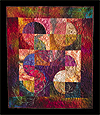
 “Summer
Hues” steps even further from tradition, with its undulating, asymmetric
edges that echo the design within. The swaying machine-embroidered forms
suggest freedom; the machine quilting buzzes like busy insects over the
swirling feast of jewel-toned batiks. The billowing embroidery seems a
natural progression from earlier quilts such as “Processional Carpet,”
with its plantlike forms, inspired by the stencils that color the streets
of Guatemala each Easter, framing a central medallion cut from a traditional
Guatemalan woman’s ceremonial blouse.
“Summer
Hues” steps even further from tradition, with its undulating, asymmetric
edges that echo the design within. The swaying machine-embroidered forms
suggest freedom; the machine quilting buzzes like busy insects over the
swirling feast of jewel-toned batiks. The billowing embroidery seems a
natural progression from earlier quilts such as “Processional Carpet,”
with its plantlike forms, inspired by the stencils that color the streets
of Guatemala each Easter, framing a central medallion cut from a traditional
Guatemalan woman’s ceremonial blouse.
Rego lived in Guatemala for many years, met her husband there, and raised a family. Although she’d grown up sewing her own clothes, she didn’t start quilting until pregnant with her first child. Her first project was a crib quilt, hand quilted in a traditional pattern in subdued tones.
It was so boring!” Rego laughed. When she began quilts for the next two children, she made it interesting by getting creative. Combining cutting-edge technology with personal experience has always been a major component of quilt making, and after 20 years, Rego’s work reaches to another country and to a time past while forging the future of quilting.
From their upper-class origins as expensive hand-painted Indian textiles in 17th century England, quilted bedcoverings (essentially a top and backing sewed together over an insulating lining) took on new life once they arrived in the new world of America.
Patchwork, or ‘piecing,’ became a way to create decorative surfaces for a functional item using homespun wool, flax and cottons. The vast majority of quilts made on the American frontier have been lost to time—they were used, and most of them, in the words of 91-year-old Billie Beuhler, a third-generation Wood River Valley resident and professional hand quilter, “were used up.”
 Although
uncountable, coarser frontier quilts were produced at the time, most existing
quilts from the 18th century were made in the parlors of the well-to-do
East Coast cities, appliquéd from fine fabrics as showcases to potential
husbands of “the feminine skills.”
Although
uncountable, coarser frontier quilts were produced at the time, most existing
quilts from the 18th century were made in the parlors of the well-to-do
East Coast cities, appliquéd from fine fabrics as showcases to potential
husbands of “the feminine skills.”
In 1793, the cotton gin made cheap cotton fabric widely available, and in the 1800s, a young girl pieced a dozen quilt tops in preparation for marriage. Once married, she stitched in the evenings after laboring since dawn. Quilts were needed in her unheated home; as many as four or five were layered on a bed. In 1850, the sewing machine further democratized a craft that was already practiced by women of all skill, creativity and economic levels. Over a thousand patterns were developed, largely based on the women’s environment, Log Cabin and Flying Geese being two of the most popular.
Because quilting was so time-intensive and personal, quilts were seldom sold, so were free from market pressure and remained a medium for women’s self-expression. Not many other avenues of expression existed; quilting offered one that would last longer than the bread they’d baked that morning.
Quilts also celebrated personal milestones: a birth, a wedding. Some became visual journals that kept memories alive for future generations. Others expressed community interests, celebrating centennials or making political statements. A common pattern known today as Irish Chain was once popular in New England as a proclamation against slavery. All preserve scraps of American culture. A quilt pieced by Buehler’s mother in Hailey in the mid-20th century contains the first Mickey and Minnie Mouse fabric ever printed.
Even early on, quilts were made for competition. Quilt contests became common at county fairs, and remain so today, challenging women to innovate and excel. Each September, hundreds flock to the Sawtooth Mountain Mamas Quilt Festival in Stanley, Idaho, where prizes are awarded, quilts are sold, and workshops offered.
 Most
entries are contemporary quilts made by Idaho women, either individually
or in one of more than 30 guilds throughout the state, which put on annual
or biannual shows of their own. But that’s small beans compared to the
international quilt shows in Kentucky, Chicago, Europe and Japan. In 2004,
the International Quilt Festival’s 30th annual show in Houston, Texas,
attracted more than 50,000 attendees from three-dozen countries. Quilting
has become a $2 billion industry in America and continues to grow as fabrics
become more interesting and varied, techniques are developed, communication
grows, and women have more resources within their control.
Most
entries are contemporary quilts made by Idaho women, either individually
or in one of more than 30 guilds throughout the state, which put on annual
or biannual shows of their own. But that’s small beans compared to the
international quilt shows in Kentucky, Chicago, Europe and Japan. In 2004,
the International Quilt Festival’s 30th annual show in Houston, Texas,
attracted more than 50,000 attendees from three-dozen countries. Quilting
has become a $2 billion industry in America and continues to grow as fabrics
become more interesting and varied, techniques are developed, communication
grows, and women have more resources within their control.
“It’s still mostly women,” said Rego, “which I kind of like.”
Beuhler remembers a few men in her youth who quilted. “They were considered unusual,” she chuckles. “But I’m sure they were a great help to their wives.”
Women’s emancipation was among the greatest advances in quilting history. Together with a renewed interest in handcrafts in the ’60s and ‘70s, it paved the way for this ladies’ home craft to enter the larger context of global art.
Is quilting an art or a craft?
“We could talk about that ‘til we’re blue in the face,” said Rego wryly. “Quilts are now in that blurry area, although, with some, I don’t see how they cannot call it art.”
Quilting is a craft that has, by many in the past and present, been transformed into art through personal vision, technical skill and originality.
Some quilts (craft) predated developments in painting (art) by over a century. An exquisite Log Cabin quilt in the Blaine County Historical Museum, dated 1875-1920, makes the point. Constructed from three-quarter-inch strips of silk scraps, each block centers on a square of black velvet in an arrangement that gives the abstract pattern a three-dimensional quality that wasn’t achieved in abstract art until at least 30 years later.
Another striking example from the early 1800s looks thoroughly modern in its simple, balanced geometry. Had it been painted and hung on the wall at the time, it would have been laughed out of the house, or at least off the wall and back onto the bed.
While quilts were recognized as a useful, decorative medium of self-expression for women, they were left out of the mainstream of art history, neither influenced nor influencing significant trends outside of quilting. Cezanne wouldn’t fragment light and space for another 80 years; Matisse wouldn’t dream his bold, textile-inspired compositions until 20 years after that.
 Today,
foreign labor has brought the patchwork quilt to anyone who can shell
out $130 to Pottery Barn. Rather than devalue quilts, such wide availability
has popularized them, highlighted the craftsmanship of hand-worked quilts,
and aroused interest in their history.
Today,
foreign labor has brought the patchwork quilt to anyone who can shell
out $130 to Pottery Barn. Rather than devalue quilts, such wide availability
has popularized them, highlighted the craftsmanship of hand-worked quilts,
and aroused interest in their history.
Beuhler teaches two hand-quilting classes a year at the College of Southern Idaho’s Hailey campus. Hailey is home to a thriving quilt shop. Alta Addler, who organizes the Sawtooth Mountain Mamas Quilt Festival, has noticed resurgence in the popularity of hand quilting, especially with young girls. She attributes it partly to the fact that it’s easy to transport, so it lends itself to travel by car or plane. It can also be interrupted, so it fits into lives punctuated by the ringing of cell phones.
“We do have a lot of quilters here,” insists Susan Coon, who for many years belonged to the local guild. “The women who quilt here are islands unto themselves.” Rego admits to being a loner, and Beuhler counts her hours at the quilting frame as “quiet time.”
Today, communication is cheap and easy. With a world of information available via computer and television, more people are realizing unexplored territory within themselves. For them, quilting has become not only a medium to assert individuality and self-expression in a made-in-China world, but also a place of creative meditation to explore that new frontier. •