| Current Issue |
| View as .PDF |
| features |
| Art walks |
| Wolverines |
| 1950s Sun Valley |
| Hillard Hicks |
| arts |
| Raku |
| Quilting |
| Glenn Janss & SVCA |
| living |
| Giving |
| Solar Power |
| Small Spaces |
| recreation |
| Kiteboarding |
| Backcountry Education |
| Vintage SV chairlifts |
| dining |
| Omlettes |
| Trail cuisine |
| Coffee |
| calendar |
| Winter 2006 |
| listings |
| Galleries |
| Dining |
| Fitness |
| Lodging |
| Equipment |
| Outfitters |
| maps |
| Ketchum & Sun Valley |
| Gallery Map |
| the guide |
| Last Fall |
| Editorial Submission |
| Calendar Submission |
| Advertising Submission |
| Advertising Rates |
| About Us |

|
|
Copyright
© 2005 Express Publishing Inc. All Rights reserved. Reproduction in whole or in part in any form or medium without express written permission of Express Publishing Inc. is strictly prohibited. The Sun Valley Guide magazine is distributed free twice yearly to residents and guests throughout the Sun Valley, Idaho resort area communities. Subscribers to the Idaho Mountain Express newspaper will receive the Sun Valley Guide with their subscription. |

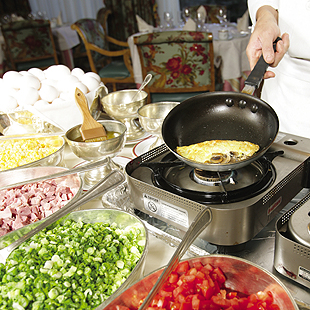
Photo by Chris Pilaro
Omlettes
When the outdoors beckon with crisp blue skies and inches of fresh powder, something quick, warm and savory tops the wintertime breakfast menu: the omelette. This speedy, healthy and hearty dish has enduring popularity and longevity because of its protein-packed versatility, based on an infinite choice of fillings. Cooking an omelette has been likened to riding a bicycle—something awkward and challenging at first, something that may take a little concentration, but definitely something that anyone willing to try can accomplish. The added bonus: like riding a bike, once you master the skill, it is with you for life.
The perfect omelette begins with the right equipment. Chef Scott Wamsley of the Lodge Dining Room at Sun Valley Resort suggests using a good nonstick pan with a heavy bottom. Moreover, the pan should be the right size for the omelette you wish to make; a 6-inch pan is a good fit for a two-egg omelette. Also, plastic or rubber utensils work best because they will not damage the omelette.
Wamsley recommends using fresh eggs to achieve a better final result. The eggs can be whisked together, alone or with a little water (a tablespoon or less), whose addition makes the omelette fluffier.
A subject of debate among omelette aficionados is the proper heat at which they should be cooked. High heat browns the eggs; low heat requires a lengthier cooking process. A nice medium heat is best, suggests Wamsley because “the eggs won’t color, but will cook fairly quickly.”
When Wamsley whips up an omelette at home, he uses a mixture of butter and good quality oil, which prevents the butter from getting too hot and burning. Pour the eggs into the pan when the butter is completely melted and has just begun to foam.
Once on the heat there are two ways to proceed. The French method is to stir the eggs carefully as they set—this is the method employed by chefs at the Lodge Dining Room during brunch because it is a little quicker. The American method is to gently pull the edges of the omelette inwards after it has begun to set. This allows the raw egg on top to flow underneath where it will have its turn to cook.
Never leave the omelette unattended at this critical stage of preparation, as the cooking time is mere minutes regardless of the method you choose. Because of this, plan ahead with the fillings. The French generally limit their omelette fillings to cheese, rolling the finished omelette into thirds. The American omelette reflects the nation’s fondness of sandwiches, employing the “more is better” rule, and the stuffed concoction is, out of necessity, only folded in half.
Fillings can be incorporated in different ways, but the general rule is that warm accompaniments go inside the omelette, and the cool ones—like sour cream—belong on top. Fillings can be added as the eggs are cooking, and the omelette can be flipped in the pan so the fillings have a chance to cook at the bottom of the pan; such an omelette is flipped one more time before serving—perhaps a challenge for the kitchen novice. While in culinary school, Wamsley’s instructors suggested placing a piece of toast in a pan and flipping it to master the technique.
The other option is to cook the fillings separately and add them to the pan at the last moment.
It has been said there are as many ways to cook an omelette as there are omelette recipes. In the end, this should not deter the home chef; instead, it should be taken as an opportunity to express creativity and to experiment until discovering what works best for you.
— Angela Erickson