| Current Issue |
| View as .PDF |
| features |
| Art walks |
| Wolverines |
| 1950s Sun Valley |
| Hillard Hicks |
| arts |
| Raku |
| Quilting |
| Glenn Janss & SVCA |
| living |
| Giving |
| Solar Power |
| Small Spaces |
| recreation |
| Kiteboarding |
| Backcountry Education |
| Vintage SV chairlifts |
| dining |
| Omlettes |
| Trail cuisine |
| Coffee |
| calendar |
| Winter 2006 |
| listings |
| Galleries |
| Dining |
| Fitness |
| Lodging |
| Equipment |
| Outfitters |
| maps |
| Ketchum & Sun Valley |
| Gallery Map |
| the guide |
| Last Fall |
| Editorial Submission |
| Calendar Submission |
| Advertising Submission |
| Advertising Rates |
| About Us |

|
|
Copyright
© 2005 Express Publishing Inc. All Rights reserved. Reproduction in whole or in part in any form or medium without express written permission of Express Publishing Inc. is strictly prohibited. The Sun Valley Guide magazine is distributed free twice yearly to residents and guests throughout the Sun Valley, Idaho resort area communities. Subscribers to the Idaho Mountain Express newspaper will receive the Sun Valley Guide with their subscription. |

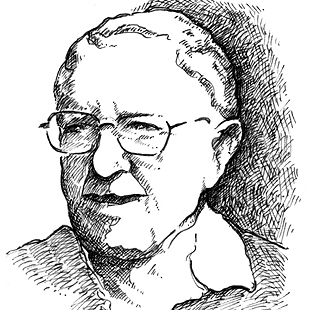
Hillard Hicks. Illustration by E.B.
Phillips
Hillard Hicks
recounts the Triumph
mine
avalanche of 1938
By Rebecca Meany
Thunder rolled off the mountain. Winter ferociously proclaimed it was not about to surrender its last few weeks to the forgiving climate of spring. As weather conditions gathered, snow layers rattled, sending an avalanche plummeting down.
Hillard Hicks, hunched over a powder box in a shed, gathered coal for fellow swing-shift workers at Triumph mine north of Hailey that night in 1938. His ears alerted him to the danger.
“I heard the noise, so I lay down,” said Hicks, now 88. He threw his body over the coal pile, as the shed collapsed around him. The box of coal had small air spaces, he said, offering life-sustaining oxygen. For three hours he maintained consciousness. Then life began to slip away.
“I held my breath for as long as I could,” he said. “That’s the last thing I remember.”
Now, 67 years later, the waning summer sun warmed Hillard Hicks’ back as he spoke with clarity about that February night when his mini den of refuge was minutes from becoming his icy tomb.
“We’d been scared of snow slides,” he said. “They laid us off for two days because of it.”
Thoughts of a 1917 snow slide that killed more than a dozen people at the same site silently badgered the workers. That Sunday, however, he returned to work loading ore onto trams. Conditions made the drive to the mine impossible; he left his car on the road and walked the remaining mile. His shift had barely begun when the snow slide roared over him.
A poke to the back roused him from his unconscious state after being trapped for more than five hours. “Oh my God, he’s alive,” he heard. Other mineworkers found him after uncovering two other survivors.
“They carried me up the hill to the brick house,” Hicks said. “Four of them carried me. Put me on a door with one guy on each end. My nerves were shaking, and they had to hold me down.”
A doctor from Hailey was called in and gave Hicks strict orders. “He gave me a tumbler of whiskey,” Hicks recalled. “He said, ‘drink that and don’t drink anything else.’” When he woke up a few hours later, he drank a glass of water, which his stomach promptly expelled.
After a week’s recovery, he went back to work. Although he took that week without pay, he was glad to have the job to go back to. “We got 50 cents an hour, $75 a month,” he said. “Damn right, that was real good (pay).”
•
Hillard Hicks was born in 1917 north of Gooding, Idaho, and made his first trip to Ketchum in 1923. A career as an airline pilot took him around the world, but he always came back to visit the Wood River Valley. Indeed, the area’s rivers, fields, ballrooms and bars are all intertwined in his life’s story. “The way this town was, there were 135 people in the winter,” he said. “You could pass out in the street in front of the Casino and not get run over.” He retired in the late 1970s, splitting his days between Miami and Ketchum. “Since then I’ve been bumming. Fishing, hunting and drinking whiskey, Dewar’s and soda,” he said. “That’s all there is left.” That, and a quick wit from a man who cheated death and lived to tell a hundred tales.