| Current Issue |
| View as .PDF |
| features |
| Art walks |
| Wolverines |
| 1950s Sun Valley |
| Hillard Hicks |
| arts |
| Raku |
| Quilting |
| Glenn Janss & SVCA |
| living |
| Giving |
| Solar Power |
| Small Spaces |
| recreation |
| Kiteboarding |
| Backcountry Education |
| Vintage SV chairlifts |
| dining |
| Omlettes |
| Trail cuisine |
| Coffee |
| calendar |
| Winter 2006 |
| listings |
| Galleries |
| Dining |
| Fitness |
| Lodging |
| Equipment |
| Outfitters |
| maps |
| Ketchum & Sun Valley |
| Gallery Map |
| the guide |
| Last Fall |
| Editorial Submission |
| Calendar Submission |
| Advertising Submission |
| Advertising Rates |
| About Us |

|
|
Copyright
© 2005 Express Publishing Inc. All Rights reserved. Reproduction in whole or in part in any form or medium without express written permission of Express Publishing Inc. is strictly prohibited. The Sun Valley Guide magazine is distributed free twice yearly to residents and guests throughout the Sun Valley, Idaho resort area communities. Subscribers to the Idaho Mountain Express newspaper will receive the Sun Valley Guide with their subscription. |

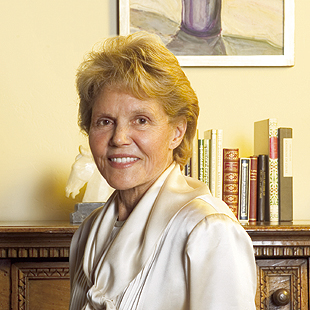
Glenn Janss. Photo by David N. Seelig
Idaho's First
Lady of Culture
How Glenn Janss transformed
a Western
ski town into a cultural Mecca
By Pat Murphy
When taking its first steps, 35 years ago next July, the Sun Valley Center for the Arts did not have a long line of philanthropists waiting, with generous checks in hand, to perform their civic good deeds.
Not on your life. In fact, the grand dame, founder and driving force of the area’s premier arts and cultural organization vividly remembers being warned as she undertook to introduce culture to the Wood River Valley that “all the people there talk about is pigs and cows.”
The then-widowed Glenn Cooper was amused by the folklore, but refused to be discouraged, thank you, and commenced—struggled is a better word—to forge one art form, one smidgen of culture at a time. Early settings were primitive and borrowed, and decidedly inelegant precursors of today’s renowned center and its multi-million dollar, professionally staffed programming with a spreading national reputation for the polished use of multidisciplinary projects.
Astonishing growth and success is only part of a far larger and more crucial story: the Center’s staggering impact on the community.
To fully understand that vast, overarching influence, view the Center as an incubator that has given birth to virtually every art form in south-central Idaho—galleries, performing theater, a wide range of music—including a symphony—crafts, libraries, literary retreats and seminars. The Sun Valley Writer’s Conference undoubtedly was nurtured in this garden of cultural richness.
Furthermore, the Center has bathed the Wood River Valley with an élan that demonstrably influences decisions of families to move here and enjoy a cultural climate rare for such small towns.
Now, on the eve of its 35th anniversary in July of 2006, the Center is poised for its most auspicious leap. With city of Ketchum approval of plans and financial commitment of its board, the Center is planning a new $8.75 million, 25,000-square-foot home—nearly six times larger than its current setting of 4,700 square feet. And Executive Director Sam Gappmayer’s plans go beyond the Ketchum home office. Earlier this year, the Center took over the old Ezra Pound home in Hailey, re-christening it the Sun Valley Center for the Arts, Hailey.
A slight, golden-haired grandmother of 73 with a touch of pixy in her manner, Glenn Cooper Janss (she would marry widower Bill Janss in due course) looks back on the pioneering days with affection and understandable pride, as well as amazement of what she and stalwarts at her side pulled off with scant more than their energetic passions for art and high hopes.
The Center and Glenn Janss are inseparable and actually are virtual synonyms: the story of one is the story of the other. Like life-changing episodes of so many who give so much of themselves, Glenn Janss’ Sun Valley odyssey began in the late 1960s in pain and grief. Her first husband, William Cooper, had died of cancer.
With five children on her hands and a yen to escape the galloping growth of Los Angeles to begin anew in a smaller setting, she heard from a friend that Sun Valley “is the best kept secret around.”
What she found on arriving, however, was an area with reminders of a raw past as a frontier mining town. Dirt roads were common. For a young widow who’d known haute museum art in cosmopolitan Los Angeles, an opportunity worthy of her hunger for challenge was about to descend on her.
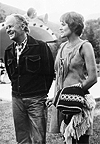 Longtime
Los Angeles family friend Bill Janss, an Olympic skier who had purchased
Sun Valley Resort in 1968, confronted Glenn with an idea as she convalesced
from a hip she broke skiing. (Irrepressibly active, Glenn continues to
snowmobile and ski, and hosted a family dog-sledding vacation in Alaska
for her 70th birthday.)
Longtime
Los Angeles family friend Bill Janss, an Olympic skier who had purchased
Sun Valley Resort in 1968, confronted Glenn with an idea as she convalesced
from a hip she broke skiing. (Irrepressibly active, Glenn continues to
snowmobile and ski, and hosted a family dog-sledding vacation in Alaska
for her 70th birthday.)
Start an arts center, Janss suggested. His instinct was that the onetime mining town needed a shot of culture for the onset of a population of newcomers seeking a good life that offered more than just skiing.
By 1969, she’d formed the Sun Valley Creative Art Workshops, recruiting able artisans in the fields of painting, ceramics, weaving and photography. Janss donated 6.7 acres, which housed the resort’s sled dog kennels, to be developed into workshops and classrooms, later sold to become today’s Community School.
“We weren’t looking, way, way out into the future,” Glenn recalls. Her modest staff conducted classes in the arts across the valley, even driving to Carey, a 46-mile trek that must have seemed far-off in those days.
Meanwhile, her vision of broader horizons burned incessantly. “Something is missing in the development of the total human being” without art, she mused. “It’s about beauty. We must honor and nurture that. Arts stimulate compassion and generosity and stretch the imagination.” The future was now clear: what began as a tenacious, but amateur, effort was maturing into a demanding, full-time crusade.
Bill Janss had started something. Glenn asked to borrow Dollar Cabin for a theater workshop and photography classes. The resort’s Quonset hut was borrowed for dance classes. Employee housing on the resort grounds was borrowed in summers for out-of-town students—as many as 500 over a summer. The Potato Gallery, displaying art works, was created in what is now the Sun Valley Gift Shop on the Mall.
By 1971 it was official—the Center received its non-profit status. Tragedy struck again in 1973. Ann Janss, Bill’s wife, was killed in an avalanche on Trail Creek—ironically, while skiing with Glenn.
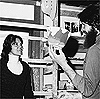 That
was January. In June, Glenn and Bill married, creating a family of eight
children, ranging in age from eight years old to 30. She was 43, Janss
was 57, but the momentum for the Center was picking up. Having prodded
Glenn into her arts and culture cause, Bill Janss continued lending a
hand through the Janss Foundation, including underwriting the costs of
the Center’s first director, Dr. James Belson, and ambitious new programs,
such as the Institute of the American West, a humanities division that
hosted annual conferences and a film festival of old, classic westerns.
That
was January. In June, Glenn and Bill married, creating a family of eight
children, ranging in age from eight years old to 30. She was 43, Janss
was 57, but the momentum for the Center was picking up. Having prodded
Glenn into her arts and culture cause, Bill Janss continued lending a
hand through the Janss Foundation, including underwriting the costs of
the Center’s first director, Dr. James Belson, and ambitious new programs,
such as the Institute of the American West, a humanities division that
hosted annual conferences and a film festival of old, classic westerns.
But the urgency for more permanency and less reliance on temporary, make-do facilities for classes and other programs became clear when the ski resort was sold to Earl Holding in 1978 and use of resort dwellings ended. After operating for several years in reduced circumstances at Walnut Avenue Mall, the Center moved to its current location on 5th Street in Ketchum in 1994.
Today, the sheer variety and reach of the Center’s programs are almost beyond comprehension, all executed with a staff of only 13 and a budget of about $2 million—but, of course, with the indispensable caring support of 600 volunteers.
Take its recent “Defining America: 1925-1940” program, a collection of Depression-era 1930s photos, film, printed material and quizzes for young people. On a modest budget of $42,000, artistic director Kristin Poole and her small staff staged 16 basic programs with a bouquet of 84 separate items. Some programs are two years in planning. Some go on the road to small universities, others are farmed out to local schools, churches and the Sun Valley Company for display.
In addition to hundreds of generous donors, the Center relies on several dependable fundraisers—the long-running annual four-day Wine Auction that raises more than $1 million and the 35 year-old Sun Valley Arts and Crafts Festival (a $35,000 contributor)—plus humanities grants.
The Center gallery’s quiet, unhurried ambiance is just right for those who want to leisurely take in static displays. Poole acknowledges culture can be intimidating for first-timers. So they regularly schedule a Family Day to familiarize families with the wide range of arts and programs available. The idea, she says, is to make the Center “fun” as well as informative.
Young people who might otherwise not have had the chance are introduced to dance and even such esoteric but intriguing subjects as how a violin works.
Stuffy, however, is not the Center’s idea of culture. An upcoming program in the spring, for example, is dedicated to “Paradise Paved”—complete with examinations of skate boarding, among other urban topics.
Harking to what Bill Janss hunched in the 1970s, Poole said the Center’s founders recognized that “a community can’t be built on a ski mountain alone,” and young people especially would suffer without an arts center to introduce them to culture.
Among those who sing praises for the Center is Dan Drackett, a retired advertising executive who devoted his own funds to founding The Arts Foundation, the primary purpose of which is to study a consolidated arts and culture center in the valley.
Drackett sees the Wood River Valley area evolving into a “cultural destination where there’s always something going on intellectually as well as athletically.”
He recalls Glenn Janss telling him that she started the Center because “without it we would be a community without a soul.”
The Center...
the early years
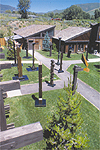 1971—Although
the idea of an arts center bore fruit in 1969, it wasn’t until July of
1971, 35 years ago this summer, that it received its non-profit status
and The Sun Valley Center for the Arts and Humanities was officially born.
Pictured is the Center’s first home, now the Community School campus in
Sun Valley.
1971—Although
the idea of an arts center bore fruit in 1969, it wasn’t until July of
1971, 35 years ago this summer, that it received its non-profit status
and The Sun Valley Center for the Arts and Humanities was officially born.
Pictured is the Center’s first home, now the Community School campus in
Sun Valley.
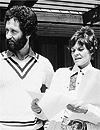 1973—Dr.
James (Jim) Belson, the Center’s first director, was hired in this year.
“I remember, as that was the year I married Bill,” recalled Glenn. “He
said, ‘We’re going on honeymoon,’ and I said ‘I can’t, I need to be here
when the students arrive,’ and he replied, ‘Well, then we’ll fund a director
for a year and after that it’s up to you.’ So we went on our honeymoon—fishing
in Norway!”
1973—Dr.
James (Jim) Belson, the Center’s first director, was hired in this year.
“I remember, as that was the year I married Bill,” recalled Glenn. “He
said, ‘We’re going on honeymoon,’ and I said ‘I can’t, I need to be here
when the students arrive,’ and he replied, ‘Well, then we’ll fund a director
for a year and after that it’s up to you.’ So we went on our honeymoon—fishing
in Norway!”
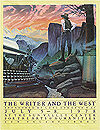 1975—Dr.
Belson started the Institute of the American West, a humanities division
of the Center. The Institute existed until the late ’80s and sponsored
an annual conference on topics relating to culture in the West—including
a film festival celebrating the western.
1975—Dr.
Belson started the Institute of the American West, a humanities division
of the Center. The Institute existed until the late ’80s and sponsored
an annual conference on topics relating to culture in the West—including
a film festival celebrating the western.
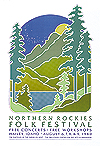 1977—The
Center was the original founder of the Northern Rockies Folk Festival.
The outdoor musical extravaganza continues still, although under new management.
Now in its 29th year the event has attracted such big names as Sam Bush
and Eileen Ivers.
1977—The
Center was the original founder of the Northern Rockies Folk Festival.
The outdoor musical extravaganza continues still, although under new management.
Now in its 29th year the event has attracted such big names as Sam Bush
and Eileen Ivers.
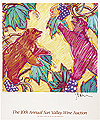 1981—The
first Sun Valley Wine Auction was held in this year. Now a crucial element
of the Center’s fundraising efforts, the auction was Glenn’s idea. After
visiting the Ste. Chapelle Winery Auction in 1979, she was stunned by
the amount of money people paid for wine. Within two years she had transported
the idea to Sun Valley. “It was very small at first, on our campus and
there were maybe 40 of us. We all brought wine to sell and bought each
other’s wine, and the next summer we all brought the same wine back and
bought it again!”
1981—The
first Sun Valley Wine Auction was held in this year. Now a crucial element
of the Center’s fundraising efforts, the auction was Glenn’s idea. After
visiting the Ste. Chapelle Winery Auction in 1979, she was stunned by
the amount of money people paid for wine. Within two years she had transported
the idea to Sun Valley. “It was very small at first, on our campus and
there were maybe 40 of us. We all brought wine to sell and bought each
other’s wine, and the next summer we all brought the same wine back and
bought it again!”
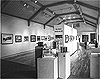 1986—The
Potato Gallery moved from the Sun Valley mall to the old church across
from Atkinsons’ (now Room & Board) when the Center relocated to the
Walnut Avenue Mall in the mid-eighties.
1986—The
Potato Gallery moved from the Sun Valley mall to the old church across
from Atkinsons’ (now Room & Board) when the Center relocated to the
Walnut Avenue Mall in the mid-eighties.
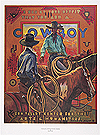 1990—The
Center’s successful annual gallery exhibition “I See By Your Outfit That
You Are A Cowboy” began in this year and ran until 1998. The exhibition
celebrated the cowboy through art, poetry and music. The format of the
exhibition was a precursor to the successful multi-disciplinary projects
the Center stages on a regular basis today. •
1990—The
Center’s successful annual gallery exhibition “I See By Your Outfit That
You Are A Cowboy” began in this year and ran until 1998. The exhibition
celebrated the cowboy through art, poetry and music. The format of the
exhibition was a precursor to the successful multi-disciplinary projects
the Center stages on a regular basis today. •