| Current Issue |
| View as .PDF |
| features |
| Art walks |
| Wolverines |
| 1950s Sun Valley |
| Hillard Hicks |
| arts |
| Raku |
| Quilting |
| Glenn Janss & SVCA |
| living |
| Giving |
| Solar Power |
| Small Spaces |
| recreation |
| Kiteboarding |
| Backcountry Education |
| Vintage SV chairlifts |
| dining |
| Omlettes |
| Trail cuisine |
| Coffee |
| calendar |
| Winter 2006 |
| listings |
| Galleries |
| Dining |
| Fitness |
| Lodging |
| Equipment |
| Outfitters |
| maps |
| Ketchum & Sun Valley |
| Gallery Map |
| the guide |
| Last Fall |
| Editorial Submission |
| Calendar Submission |
| Advertising Submission |
| Advertising Rates |
| About Us |

|
|
Copyright
© 2005 Express Publishing Inc. All Rights reserved. Reproduction in whole or in part in any form or medium without express written permission of Express Publishing Inc. is strictly prohibited. The Sun Valley Guide magazine is distributed free twice yearly to residents and guests throughout the Sun Valley, Idaho resort area communities. Subscribers to the Idaho Mountain Express newspaper will receive the Sun Valley Guide with their subscription. |

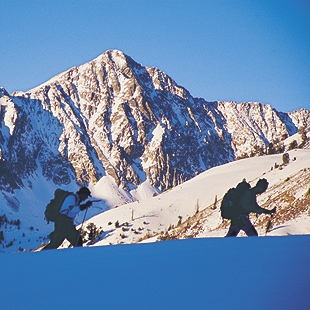
Photo by Matt Leidecker
The other country
It's survival of
the educated
in the backcountry
By Matt Furber
In Idaho’s vast wintry backcountry, avalanche terrain is fraught with danger. A solitary cry for help can echo from a glacier-scarred peak to a forested drainage, heard only by passing elk.
Traveling in groups with advanced backcountry skills is essential to survival for individuals, as well as the group, if companions get buried in an avalanche. In the event of a slide, even the fastest snowmobile-mounted rescuers are of little use to a victim buried under the snowy rubble or severely injured in freezing conditions. Survivors must be trained to dig out and stabilize the others, and only fate determines which member of the group is called upon to act.
In winter conditions,
miles of pristine snow are just waiting for the unprepared explorer to
slip up. Accidents happen under the most favorable conditions, even to
local pros with years of experience and training. A human factor exists,
and humans are famous in the animal kingdom
for making poor choices.
The Wood River Valley community has responded to this danger by developing an elite backcountry rescue network.
“The rescue scene here in Blaine County is headed up by the Blaine County Sheriff’s Department and the (primarily volunteer) Blaine County Search and Rescue,” said Rick Allington, director of the Galena Backcountry Ski Patrol, a group of unpaid, specially trained volunteers who respond to winter backcountry emergencies. “But it’s also the Ketchum Fire Department and groups like Sun Valley Heli-Ski and Sun Valley Trekking.”
While many organizations participate in backcountry search and rescue, the Galena Patrol is the only one whose sole focus in training is to rescue those in trouble in the snow-covered backcountry.
People experienced in backcountry travel bet their lives on their equipment. Being fit is also a top priority, but even the physically fit’s chances rapidly diminish if they do not know the proper skills to survive in Idaho’s remote, rugged wilderness terrain.
Know how to trek safely and know self-rescue techniques, said Janet Kellam, director of the Sawtooth National Forest Avalanche Center (SNFAC), based in Ketchum. “Search and Rescue is like a cell phone. It may help you. But if someone is buried in an avalanche, there is no time to go for help,” said Kellam.
This 1,000-foot-wide avalanche, on Baker Peak in the Smoky Mountains, was likely triggered by snowmobilers five days after Steve Waltcher was swept down the nearby Titus Ridge.
The Galena Patrol agrees and is dedicated to teaching the skills necessary to safely enjoy the challenges of winter backcountry travel, avoid dangerous situations and take action when disaster strikes. “If it happens in the winter and it’s an avalanche, the chances are it’s going to be a retrieval, not a rescue,” said Allington, of its rescue operations. “If you’re up on Galena Summit, it’s going to take two hours for someone to get to you. If your companions can’t dig you out, you’ve had it.”
•
An example of that grizzly rule is Ketchum resident Steve Waltcher.
On March 25, 2005, Waltcher was skiing Titus Ridge, on the west side of Galena Summit, with Ketchum residents Tom Pomeroy and Lee Melly. Wisely, they had chosen to ski the slope one at a time. However, Pomeroy said later that he had suspected the pitch Waltcher chose was too dangerous. Although Waltcher’s memory differs, Pomeroy recalls that he tried to convince Waltcher not to ski the pitch. “I told him ‘I’m not skiing that.’ I tried to talk him out of it twice.”
Pomeroy positioned himself at the top of a different line a hundred yards to the north along the ridge, while Melly stayed directly above Waltcher. Pomeroy and Melly watched from their separate vantage points, and observed Waltcher take five or six turns before the slope broke loose and Waltcher disappeared into a slide of snow.
After being swept through trees by an avalanche calculated to be about 140 feet wide and one- to two-feet deep, Waltcher sustained multiple fractures including both femurs, one of which was a compound fracture. He also broke his pelvis in five places. The avalanche, on an east-northeast facing slope, slid about 500 vertical feet, said Chris Lundy, a forecaster with SNFAC.
“The first thing I come
to, other than being unlucky
about being caught in an avalanche, is I can’t imagine a more smooth and
easy rescue,” Waltcher said.
“After the slide came to a stop, Tom and I were instantly in communication with each other,” recounted Melly. “I traversed to Tom, and we did an initial assessment of our options in getting down to Steve safely. We heard Steve call out for help, so we knew that it was not a complete burial, and that Steve was, for the moment, alive and breathing, which was something of a relief.”
The line that Pomeroy had chosen to ski didn’t slide, perhaps due to its lower slope angle and slightly more southerly aspect. Melly skied down to Waltcher first and, once he had reached a place of safety, Pomeroy followed.
“I was first to Steve,” continued Melly. “He was on the surface of the snow, broken and severely angulated around the tree that had strained him from the avalanche. You can imagine if you took a pencil and broke it horizontally around a tree, that was the way Steve was.”
Melly’s training as a
certified Wilderness First Responder kicked in. “It was traumatic to see
a human body presenting in all the wrong form. His thighs were broken
at nearly a right angle, and one of his feet was rotated 190 degrees from
normal —and yet the training gave me focus, and offered
me a linear progression to follow. It was a great gift to me.”
Melly and Pomeroy struggled in waist-deep snow to carefully extricate Waltcher from the tree and move him to the level work platform Pomeroy had excavated, where they could try to stabilize his injuries and treat him as best they could for shock and hypothermia.
Melly continued to address Waltcher’s medical condition while Pomeroy skied out the Titus Creek basin to Galena Lodge, where he dialed 911 and Sun Valley Heli-Ski.
 The
skiing party was well equipped with an insulating camping pad, waterproof
bivouac sack and extra insulation to keep Waltcher as warm as possible
until help arrived. “Without that extra insulation I don’t think I would
have made it through the night or even until the arrival of the helicopter,”
said Waltcher. “That is the problem of shock
The
skiing party was well equipped with an insulating camping pad, waterproof
bivouac sack and extra insulation to keep Waltcher as warm as possible
until help arrived. “Without that extra insulation I don’t think I would
have made it through the night or even until the arrival of the helicopter,”
said Waltcher. “That is the problem of shock
and hypothermia.”
Members of Galena Patrol gathered, geared up and set out from Galena Summit 30 miles north of Ketchum within a half hour after the emergency call came in. Led by patrol member Miles Canfield, who is also of the Ketchum Fire Department, the group started over land to Waltcher’s location.
There was no guarantee an air rescue would be possible since the clear blue banner day the skiers had started out in had disintegrated into snow squalls and storm cells. Flying in such challenging winter conditions (they were twice grounded during the rescue), Sun Valley Heli-Ski pilot Lon Stickney was able to deliver three Heli-Ski guides and paramedic Chris Stephens to Waltcher’s position. The guides prepared an improved landing spot for the helicopter, helped package Waltcher onto a backboard and carried him some 200 yards downslope to the helicopter landing zone for the flight out.
“They flew in during a momentary break in the weather,” said Melly. “It was an awesome experience to see a helicopter come out of that sky. I was preparing to spend the night out there.”
Stickney delivered Waltcher to St. Luke’s Wood River Medical Center, just south of Ketchum, where he was stabilized and later transported to St Luke’s in Boise via LifeFlight helicopter.
Approximately three hours passed between the time of the avalanche and the helicopter’s arrival at Titus Creek basin—a remarkably short period for a backcountry rescue. “All the planets lined up for him,” said Allington. “It was the Sun Valley Heli-Ski guides’ last day of the season. If they hadn’t been there and he had had to wait for us to reach him and hike him out on a sled, he wouldn’t have made it.”
“Some of it clearly was just having a helicopter pilot willing to do a cowboy kind of rescue out in the storm,” said Waltcher from Stowe, Vt., where he is recuperating from his injuries. “There’s definitely a lot of reasons I’m alive today. Looking back, I shouldn’t have skied that slope. In the backcountry, you try to minimize the risk as much as possible. Sometimes there are things you overlook.
“I ski Titus Ridge more than any other place in the Idaho backcountry,” he said. “Looking back, there’s almost a tameness that develops in your own mind. When you get caught in an avalanche (in familiar terrain), it’s like being caught with your pants down.”
 Waltcher
had called the avalanche advisory that day (as had Melly and Pomeroy,
according to the avalanche accident report filed by SNFAC). The SNFAC’s
Backcountry Avalanche Advisory and Weather Forecast for Friday, March
25, 2005, at 7 a.m. had read: “Several triggered sluffs occurred in the
Titus area on north and south aspects and they grew quite large and ran
further than expected. Collapsing of the snowpack was widespread around
Titus Ridge…”
Waltcher
had called the avalanche advisory that day (as had Melly and Pomeroy,
according to the avalanche accident report filed by SNFAC). The SNFAC’s
Backcountry Avalanche Advisory and Weather Forecast for Friday, March
25, 2005, at 7 a.m. had read: “Several triggered sluffs occurred in the
Titus area on north and south aspects and they grew quite large and ran
further than expected. Collapsing of the snowpack was widespread around
Titus Ridge…”
•
The Galena Patrol was conceived 25 years ago by backcountry skiers seeking just such advanced training in avalanche safety and first aid. Today, the patrol is not only a select group of winter rescue first responders, it is an organization dedicated to educating individuals and professional rescue groups alike on winter safety and emergency cold weather aid so others can enjoy the area’s famous backcountry.
Sun Valley Police Chief Cam Daggett, a founding member of the patrol, recalls being dropped by helicopter into the White Cloud Mountains to search for a buried snowmobiler in 1983. Due to an oil leak, the helicopter was grounded for the night and the patrol had to shift the search toward shelter, which the team found in an old cabin. Such is the resourcefulness and training of the members.
“We know they have that certifiable training,” said Mark Sheehan, a deputy with Blaine County Sheriff’s Department and also a founding member of the patrol. His primary rescue work now, however, is year-round with Blaine County Search and Rescue. “They are trained and understand what our needs are. I feel confident if I tell someone from (the Galena Patrol) to do something that it will get done.”
Ketchum surveyor and snowboarder Bruce Smith, a member since the mid 1980s, is the avalanche advisor for the group. He, like most members of the team, keeps a quiver of backcountry equipment ready for action in case of emergencies and, of course, for his own enjoyment.
“I have a snowmobile now. You never know what we’re going to need,” said Smith, who has even swapped skis and snowshoes for ice axes and crampons to help with rescues. “With all the different tools, there’s always a way I can get there.”
And therein lies the key to the patrol. They will always get there. When that call comes through 911, a phone tree system is quickly activated and members do their best to get out there in the fastest time possible.
Of course, if lady luck is smiling on the injured, as she undoubtedly was on Waltcher, a helicopter might reach the site first. But weather or terrain often precludes that, or such equipment might not be available (only one helicopter is locally available for rescues during the winter season, Sun Valley Heli-Ski’s).
Depending on the patrol
is not enough, however. “You are your best line of defense, just because
of the logistics of getting a rescue crew out to where you are,” said
Allington. “Prevention is the motto for people out there.” •
Additional reporting by Jennifer Tuohy
Education,
education,
education.
Galena Backcountry Ski Patrol Director Rick Allington’s top tips for would-be backcountry travelers are: “Don’t go out without education—your brain is your most important survival tool. Education means knowing how to use equipment such as avalanche beacons, how to evaluate avalanche conditions, how to choose safe routes, what to do if an avalanche occurs, basic first aid and knowing when to stay home or ski on Baldy rather than venture into the backcountry.
“Have the correct clothing for any type of weather that you could possibly encounter. Bring plenty of food and water (especially water), and always let somebody know where you are and when they should sound the alarm if you are not back safely.”
Steve Waltcher says his avalanche encounter taught him to set out on every trip as if he might have to spend the night outdoors. His kit bag from now on will contain: extra high-insulation clothing, hot fluids, a first aid kit, a bivouac sack/shelter, a foam pad, a lightweight stove and extra head and neck insulation.
There are many local resources available for information about backcountry travel. For details on SNFAC’s avalanche classes see the Calendar, page 108, or call 622-0095, www.avalanche.org. The Galena Patrol will offer a Level One avalanche course for members beginning on Dec. 7. Anyone is welcome to become a member regardless of experience. They will be offering further classes throughout the season. Call Rick Allington at 788-7802 for more information. The Avalanche Advisory phone hotline run by Sawtooth National Forest Avalanche Center (622-8027) contains reports recorded as a daily telephone message. Information is updated by 7 a.m. daily during the season. •