Something
a little Western
Ski Joring
marries two sports
in their extremes
By Jennifer
Pattison
Are you ready to cowboy up? Perhaps you are more inclined to ski gracefully down Baldy and leave it at that, thank you very much.
Well, here is a chance to experience two of the West’s favorite sports—at the same time. It’s called ski joring. A combination of skiing, the sport of the new West, and horseback-riding, the sport the West was built on, skijoring is as wild and Western as it gets.
This isn’t for the fainthearted, competitor or spectator. A union of two sports at their extremes, ski joring is fast, furious, dangerous and, of course, exciting. There are only a handful of towns in the world where one can glimpse the sport, and Hailey is one of them.
Saturday and Sunday, Jan. 29 and 30, the Rotarun Ski Area, four miles West of Hailey, will host the 5th Annual Smokey Mountain Ski Joring Association race.
Although its roots, as with most alpine sports, can be found in Scandinavia, ski joring as it is today is a true product of the West.
Following World War II, regular Americans started to embrace skiing as a national past time. This was in some part due to the Tenth Mountain Division, better know as the Ski Troops, who, upon their return from fighting in the mountains of Europe, were instrumental in developing the fledgling ski resorts of America’s West.
As ski joring legend has it, a couple of Tenth veterans, back home on the ranch in Colorado, decided to spice up their customary horse racing by towing a skier behind them. Throwing a rope on their saddle horn, they galloped off around a barrel and back. The first one to return, with skier still in tow, became the winner of North America’s inaugural ski joring race.
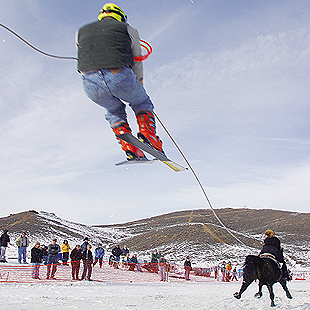
Today, equestrian ski joring has become a highly specialized, competitive sport, where the skier navigates a course of gates and jumps, some up to 8 feet high, while collecting rings. With official competitions taking place in five Western states, ski joring is quickly developing into America’s fastest growing extreme sport.
To truly grasp the concept of ski joring, imagine water-skiing, but on snow. Visualize being pulled by a horse instead of a boat and remember one crucial fact: Snow is a lot less forgiving than water.
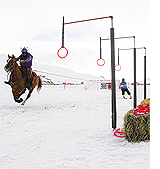 A ski joring race
can take one of two formats: The horse either runs straight down a
1000-foot track, or around an oval track. The Hailey race utilizes the
straight track format. The skier, who is pulled along by a horse at full
gallop, clings to a 33-foot rope as he navigates jumps and gates and
collects plastic rings. Competitors race individually, and the fastest
time wins the day. The winner of the whole event is the skier, and
rider, with the fastest combined time over the two days. Other than time
penalties—added for a long list of infractions—the principle rule is
that the skier must be upright, on at least one ski, and holding onto
the rope when he crosses the finish line.
A ski joring race
can take one of two formats: The horse either runs straight down a
1000-foot track, or around an oval track. The Hailey race utilizes the
straight track format. The skier, who is pulled along by a horse at full
gallop, clings to a 33-foot rope as he navigates jumps and gates and
collects plastic rings. Competitors race individually, and the fastest
time wins the day. The winner of the whole event is the skier, and
rider, with the fastest combined time over the two days. Other than time
penalties—added for a long list of infractions—the principle rule is
that the skier must be upright, on at least one ski, and holding onto
the rope when he crosses the finish line.
Hurtling down a snow and ice covered track at speeds of up to 40 mph presents some serious risk. The most common damage is done to the knees. Kurtis Stutz, president of the Smokey Mountain Ski Joring Association, estimates that there is an average of three blown knees a race. The injury occurs most often with new ski jorers.
“The biggest mistake new people make is changing direction in mid air. You can’t do that. If you change the direction of your skis in the air, that doesn’t change the direction you’re travelling in. (The horse dictates that.) So, when you hit the ground, your skis are going one way and your momentum is going the other way, and your knee is gone,” Stutz says.
Of course, extreme sports wouldn’t be extreme if they weren’t dangerous. Still, Stutz points out, one can take precautions. “Most of the skiers are wearing knee braces nowadays. Skiers have to wear helmets and a lot of the riders are starting to ride with bull rider flack jackets. We had a gal two years ago in Leadville, Colorado, whose horse rolled over the top of her. She was in intensive care for three weeks. It’s a very extreme sport.”
There have been national championships held in ski joring for 27 years, but the sport’s governing body, the North American Ski Joring Association, was only formed in 1999. They sanction the races and award points in the two top divisions of ski joring, the open division for the pros, and the amateur’s sport division. At the close of each season the skier and rider with the most points in each division are crowned National Champion. The 2005 season starts on Wednesday, Jan. 5 in Bozeman, Mont., and covers seven races across five states, concluding with the National Finals in Red Lodge, Mont., March 12 and 13. The 2004 season was an Idaho whitewash in the sport division. Both the national champion rider, Jeff Schroder, and the national champion skier, Jobe Board, hail from the Wood River Valley, as well as the runners up Kurtis Stutz (skier) and Kendra Kinghorn (rider).
If the idea of ski joring is piquing your interest, Stutz advises against taking it lightly, “We’ve had guys from the U.S. ski team come in strutting and talking trash all night long at registration. By the fourth gate they’re on their face. This is a whole different ball game. You don’t have gravity pulling you down the track, you’ve got a 1500 pound horse.” If you are an expert skier with an alpine racing background, are able to pick a line and know how to run gates then, according to Stutz, you should just about be able to stay upright on a ski joring course.
Whilst the riding might not seem as challenging as the skiing, Stutz still cautions against flippancy. “A lot of riders consider themselves good, but unless you’re willing to really open up your horse—make him go as fast as he will go—then you’re not ready to bring a horse to a ski joring race. The liability release forms clearly state that your horse can be killed doing this.” The major danger for a horse is losing its footing on the tightly packed four inches of snow and ice that comprises the race track, a danger increased by towing an adult skier who is swinging back and forth across the track at high speeds.
Extreme sports are only fun because there’s a chance of being killed, or at least seriously damaged, right? So, if those words of warning haven’t discouraged you entirely, contact the Smokey Mountain Ski Joring Association and they’ll sort you into the appropriate division.
At the Hailey race there will be eight divisions racing. As well as the open and the sport divisions, there are snowboarding, women’s and long jump divisions. If this is your first time however, try the local’s division; you won’t have to deal with the jumps. There is also an event for the little ones, the Peewee division, where a parent can pull a child along at any speed he or she feels comfortable with. Parents are responsible for providing something or someone to pull the peewees along.
Stutz says they won’t discriminate based on species: “We’ve had guys running on mules. We even had a camel show up once. People can bring their dogs, too, if they want!” •