
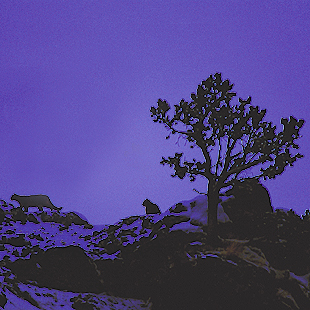
Photo By Thomas D. Mangelsen
Shadow
cats
in our midst
Always elusive, mountain lions maintain a presence in the Wood River Valley
by Matt Furber
During the long and cold winter of 1999, the residents of the Wood River Valley were haunted by recurring visits from one of the area’s common, though mysterious, wild species.
Under the deep, cold veil of night, sleek feline predators slipped into neighborhoods and made easy prey of domestic animals. By winter’s end, nearly a dozen house cats and at least one dog were gone. But few people ever saw the predators. Few people ever do, for the shadow cat is aptly named.
Mountain lions are as common throughout the Wood River Valley today as they were in 1999, though encounters like that winter’s rash of lost pets have not been repeated since. Wildlife officials generally agree that the lions, beset with hunger during the particularly difficult winter, followed deer and elk into the valleys and found it easy to prey on domestic animals in areas where people moved into their traditional winter range near the valley’s river bottoms.
Another uncommon event may have prodded the cats to stay near civilization longer than usual.
In February 1999, an avalanche broke free from the upper reaches of Hailey’s Della Mountain, sweeping a herd of two dozen deer over a 200-foot cliff into the Big Wood River. When the torrent of snow came to a halt in the channel of the Big Wood River, frozen hooves stuck willy-nilly out of the snow.
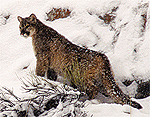 Photo
By Thomas D. Mangelsen
Photo
By Thomas D. Mangelsen
It was an easy meal for the mountain lions, which habitually travel the river bottom in the winter.
“As snow melted, there were more bodies. It was a huge opportunity for (the lions) to live well for the winter,” said Lee Frost, a retired, 29-year veteran conservation officer with the Idaho Department of Fish and Game. “From Bellevue to Ketchum, there were about nine to 10 lions working the river bottom.”
Following the avalanche, some smaller predators and scavengers—including eagles, coyotes and foxes—joined the free meal, but mountain lions had the run of the spoils, Frost said.
Despite their typically elusive behavior, some Hailey residents who lived near Della Mountain described watching the big cats as they hung out in trees between meals, swinging their tails as they enjoyed the uncommon bounty.
It was natural for them to find fresh meat they didn’t need to work to kill, Frost said. “They are opportunistic predators.”
Though they are seldom seen, mountain lions are every Idaho resident’s neighbor. If you’ve been on a hike, you’ve probably been startlingly close to a large, slinking cat that crouched, unannounced, in the shadows of the forest.
“If you are out there you’ve probably been looked at by a lion,” Frost said.
They go by nearly a dozen names: cougar, puma, panther, painter, mountain screamer, catamount and, in Native American culture, ghost walker. Perhaps the most fitting moniker, however, is shadow cat.
Some years back, the owner of a Ketchum coffee shop encountered a mountain lion on the front porch of her West Ketchum cabin. “It was really amazing,” recalled Nicola Potts. “He was there, and then, with a swish of his tail, he was gone. He didn’t run away. He just slinked around the corner and disappeared like magic. They really are shadow cats.”
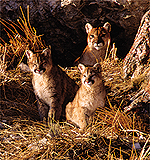 Photo
By Thomas D. Mangelsen
Photo
By Thomas D. Mangelsen
Hunters and Fish and Game officers, who respond to calls about mountain lions that venture onto civilized turf, are the people who typically get the closest look at the elusive creatures.
Silver Creek Outfitters hunting guide Bryant Dunn saw a large cat in the Park Creek drainage of the Pioneer Mountains, not far outside of Elkhorn. Out elk hunting at the time, he first thought he saw two deer. Then he looked through a pair of binoculars.
"It was an enormous tom. It was amazing to see how he moved,” he said, describing in pantomime how the cat prowled—reaching from the shoulders with powerful front legs.
“His body was this long,” Dunn said, spreading his arms slightly less than his 6-foot arm span.
For years before,
Dunn said he had seen what he believed to be that particular mountain
lion’s food caches, a phenomenon that occurs when cats cover their kills
between meals with sticks and rocks.
Like Dunn, many hunters have a mountain lion story. Some take place in
the remote reaches of wild Idaho. But sometimes, like during the fall of
1998, they occur right on the side of a road.
During that fall’s hunting season, a female lion with kittens killed a deer along Warm Springs Road near Penny Lake. The cats returned daily to feed, and word rapidly spread. The daily feedings soon became a spectacle, and many a local resident talked about it over morning coffee or evening beer. Although biologists believe mountain lion populations in the Wood River Valley are healthy, there is little empirically derived data clarifying their numbers.
What is clear is that interactions between people and mountain lions are increasing as human populations expand, and habitats continue to overlap.
Rick Hopkins is a wildlife ecologist on the board of The Cougar Fund, a Jackson, Wyo. organization dedicated to protecting mountain lions throughout the Americas. Hopkins consults with communities on how people can work to co-exist where their home ranges overlap. Presently, he is working with Riverside County in Southern California to draft a management plan beneficial to both species.
“In the 1990s, the population of Riverside County grew by 76 percent,” he said, pointing out how quickly human development can push into lion habitat. Hopkins said people are choosing to move into a natural environment, but when nature touches them, there is a disconnect between the choice and the consequences of living in proximity to all things wild.“The development style results in greater interaction with cougars, more calls to Fish and Game,” he said.
This year, a mountain lion perched in a tree outside a house in Ketchum until the owners turned the lights off. Another was spotted on a farm in the Southern Idaho town of Buhl.
Last year, a young emaciated cat showed up on a porch in a posh mid-valley subdivision. The animal was taken to a veterinarian but ultimately died from malnutrition.
In what may have been the most dramatic local showdown between a resident and mountain lion in recent history, a local resident used a shotgun to fire at a cat after it killed his prized hunting dog.
The cat was later found dead.
The Latin name for the mountain lion is Felis concolor, meaning cat of one color, another apt name. They are the only cats, aside from lions, with predominately single-color coats.
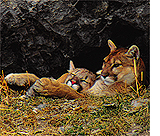 Photo
By Thomas D. Mangelsen
Photo
By Thomas D. Mangelsen
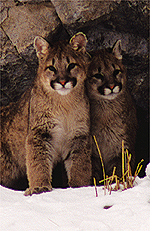
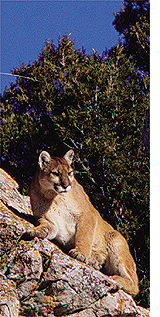
Mountain lions have tawny, grayish fur with dark highlighting on their faces, ears and the tips of their tails. Males are larger than females, but adults can weigh from 75 to 150 pounds and measure 4.5 feet from their noses to their hindquarters. Their tails, used for balance while hunting, jumping and running, generally measure another 3 feet.
They are highly territorial and adaptable and live in regions ranging from lowland deserts to mountains over 14,000 feet high. They usually live between eight and 10 years.
If you’ve ever watched the impressive athletic abilities of a house cat, you have a small taste for the physical prowess of a mountain lion. They have jumping abilities to make any Olympic athlete green with envy. They can jump 35 feet of horizontal distance, 20 feet straight up and 60 feet down. Biologists observed one cat jump 10 feet up into a tree with a deer carcass in its mouth.
They use this extraordinary talent to leap onto prey after carefully stalking it, but they also ambush their prey from cliffs and trees by jumping onto the victim’s back. They can kill a large deer with a bone-crunching bite to the skull.
They usually hunt at dusk and dawn.
Although they are efficient and powerful hunters, mountain lions are also among the hunted. Hopkins said more mountain lions are harvested today than even during the bounty period of Western settlement, when killing predators fetched a handsome price.
“There were a whole lot fewer people then,” he said. “Now we have a whole guide industry marketing the killing of animals. We are actually shooting several hundred more cougars each year than 50 years ago. I think there are states where we have ratcheted up our harvesting. There is significantly more pressure on cougars than when we didn’t have a management scheme.”
Hopkins doesn’t completely discount hunting as part of mountain lion management, but he does believe more information is needed before it can be determined one way or another whether mountain lion populations are out of the woods.
Although Idaho has the highest harvest rate in the country, it still maintains a 1990s female mountain lion kill rate of 38 percent, compared with 50 percent around the rest of the West.
 Photo
By Thomas D. Mangelsen
Photo
By Thomas D. Mangelsen
This year, the state of Colorado maintained its hunting quota at 760 animals. About half that number are taken each year in the state, but the Colorado Division of Wildlife is planning to pursue an extensive study to gauge the quota with actual sustainability of the population. “They admit they can’t justify the quota,” Hopkins said.
Cougars were once found in all 48 contiguous United States and were the largest-ranging predator in the country, but at the dawn of the 21st century, they face increasing pressures that threaten their long-term survival. They are now found in only 13 states.
“The cougar has a tendency to avoid human dominated landscapes,” Hopkins said. It is the urban corridors in the East, Southern California and the cities of the Pacific Northwest where their continued survival is most in question.
Palmer said he does not have an accurate count of mountain lions in the local region because of the cats’ large range. Males have a range of about 125 square miles. But Frost said estimates of their numbers and relative health correlate to the condition of mule deer and elk populations, their primary food sources, and those animals are doing well.
“A number is elusive,” Frost said. “It is difficult to come up with estimates with ground surveys. Mountain lions don’t stick around like elk when you do a count from the air.”
In fact, the last major research project on the big cats ended when Michael Gratson, an Idaho Department of Fish and Game senior wildlife research biologist perished in a helicopter accident in December 2000 while conducting mountain lion surveys along the Lochsa River near Lowell. The surveys were part of a complex study designed to address the decline of the Lochsa elk herd.
Much of mountain lion success correlates to the health of prey populations, but with other factors such as habitat loss, human development, and increasing numbers of people playing in mountain lion habitat, the potential for contact between the species increases and creates a threat to their continued survival.
 Photo
By Thomas D. Mangelsen
Photo
By Thomas D. Mangelsen
Yet their populations are slowly improving in parts of their ancestral range. The range, which still includes the Western U.S., once stretched from the Yukon in Canada through all 48 states and into Central and South America as far south as Patagonia.
Despite their craftiness and ability to elude even the most watchful pair of eyes, mountain lions face common misconceptions that stem from encounters that occur when their prey are closer to town, particularly in winter.
When another hard winter like the deep snows of 1999 occurs, the cats will be back.
“With a harsh winter, no question about it, we’re going to see more lions,” Frost said, adding that the phenomenon should not be a reason for people to worry. Mountain lions typically steer clear of people.
“This county is so outdoor oriented that if we were on a lion’s menu they’d be picking us off five or six a week,” he said. “There is so much misconception. More people are killed in North America by charging moose.”
Aside from the lucky few, not many Westerners have caught even shadowy glimpses of mountain lions in the wild. So it might be a little ironic that Hawaiian surfer Andy St. Onge had front-row seats while on a mountain bike ride in Croy Canyon west of Hailey.
St. Onge was visiting his brother, Joe, an outfitter with Sun Valley Trekking.
“Look, there go two moose,” Andy said, screeching to a stop as the ungulates forked in different directions. “Look, there goes a mountain lion,” he exclaimed.
Andy returned to Hawaii thinking the experience was business as usual, while his brother has yet to see a lion.
Shadow cat indeed. •