
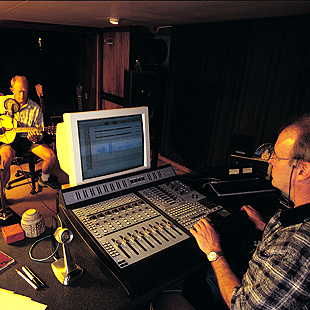
Photo by David N. Seelig
Recording
off the map
Amos Galpin and Mountain Beach Studio
By Dana Dugan
On the wall in Amos Galpin’s Ketchum recording studio is a framed gold record of Peter Cetera’s solo effort, “Solitude/Solitaire.”
It marks a high point for Galpin, a longtime musician and recording engineer, and his Mountain Beach studio.
Galpin wrote the opening song, “Big Mistake,” for the album with Cetera, formerly of the band Chicago. Gold albums were never Galpin’s aim, and while it was an unusual collaboration, writing songs, playing with bands and making music has been Galpin’s life since he moved to the Wood River Valley in 1970.
Born and raised in Connecticut, Galpin always wanted to ski in the West. After buying some land with family members, he eventually decided to make Ketchum his home.
Galpin is first and foremost a musician. His first band was the Ha’Pennys, and he first recorded as a drummer at a division of Decca Records in Boston in 1965.
“It was my first experience recording,” he said. “I’m not technical in any way. I was just a guitar player who wanted to hear it come back.”
When Galpin moved to Ketchum, he formed a band with musician Mark Slocum. Originally called Soup Ticket, it was eventually renamed the Mark Slocum Band, which still performs today. Galpin recalls playing 150 nights a year on Main Street in Ketchum.
“All the girls who danced then have since married, had children and divorced. But then so have I.”
In fact, by the time his son, Nate, was 8 or 9, Galpin had decided enough was enough. Also the father of an adopted daughter, Mot, who was born in Thailand, Galpin quit the band in 1983 and built himself a music studio. His career as a musician was not over.
His involvement with the band The Fabulous Toastpoints, with which Galpin still plays, has proved less stressful on his schedule as an involved father and studio owner.
Author Ridley Pearson and guitar maker Fletcher Brock, the original Toastpoints members, invited him to sit in with them one night.
“Fletcher and I invited Amos, and he just ripped our heads off with his lead guitar,” Pearson said. “He’s phenomenally gifted. He amazed Fletcher and me so much that within about two days he was in the band. We were writing some music, and he began writing too. Pretty soon we became a band that played all original music. He’s an incredibly smart guy, an incredibly gifted musician. Given all that, we should just lock him up so the rest of us can get on with our lives.”
As for Galpin, he went in with no idea how it would all turn out.
“We’d set up in an empty bar and worry no one would come. Ridley would say ‘don’t worry’ and before long the place would be jammed with literary types from New York and Chicago. I thought ‘this is the only band I really want to play in.’ It’s been 20 years.”
Galpin’s first studio client was Steve Miller of the Steve Miller Band, who lives north of Ketchum. Randy Young was the sound engineer at the time. The studio recorded basic tracks for Steve Miller’s “Italian X-Rays” album over the course of two months.
“Steve was such an amazing client to have in here, but the reality of being way off the map sunk in afterwards,” said Galpin of the remoteness of Ketchum and Idaho from the music scene.
Galpin remembers that when managers and clients would visit his studio, they would notice immediately that the equipment wasn’t up to industry standards. The studio branched out into other enterprises to stay afloat, including designing and installing sound systems for hotels, schools and private homes—a journey Galpin was only too happy to end.
One of the Mountain Beach’s quirkier aspects is the old hallway musicians use to move between the studio and engineering room. Known as Graffiti Hall, it’s covered with drawings and signatures from everyone from Steve Miller and Muzzie Braun to Barbra Streisand, who came in to check out the space.
Steve Miller contributed one of the more fascinating artifacts. Someone used a woodcutter tool to cut out Miller’s outline against the studio’s door. Above it he wrote, “Hi, come on in and be great.” Galpin eventually brought the door home for safe keeping.
Editor Kim Schneider, who has worked on Warren Miller’s ski movies for years, rented space at Mountain Beach for his company Scream West.
“Kim was the kind of person I wanted to be here. He has such a positive aura. We’ve had a number of different tenants. There’s an ebb and flow of business. We’ve made the building fit as the studio has changed.”
Currently, Galpin and his son Nate are renovating the space where Schneider held sway for seven years for a rehearsal space, complete with lounge, loft and kitchenette.
Galpin’s sound engineer Robbie Wood has worked with him for nine years.
“He’s the cornerstone of the business,” Galpin says.
The studio consists of a large, fully insulated studio with sand-filled, 2 feet by 6 feet thick walls, a thermal floor and 14-feet high ceilings. Wood’s control room was designed like a horn with nonparallel walls to eliminate standing waves.
“For the mix to translate, you need a room that’s very smooth,” Wood said.
Wood, who is also a songwriter, musician and composer, uses software called Pro Tools, which enables multifaceted recording and editing on a computer. However, “no amount of Pro Tools tweaking can make a bad sound good,” Wood said.
Actors Richard Dreyfuss, Scott Glenn, John Larroquette, Peter Cetera, Demi Moore and Bruce Willis are among the people who have used the facilities at Mountain Beach. Sportscaster Tim Ryan has also used the system linked to a studio in Manhattan.
“We replaced every line of Bruce’s in ‘Hart’s War,’” Galpin said.
Director Gregory Hoblit came to Mountain Beach to direct his star to sound older. Wood laughed at the memory.
“Bruce went upstairs and just yelled curse words for ages. When he came down he said, ‘Now I feel older.’”
Mountain Beach can connect to any other studio in real time around the world.
“It creates a bridge between two boxes, going both ways. We can do dialogue with full quality audio that can be redone on the spot and worked on simultaneously,” Galpin explained.
Galpin has recently expanded his enterprise.
“I started a little record company called Empty Beach in Boise. It’s probably what I should have done in the beginning,” he said of the new location. The name is a play on the abbreviation—Mt—of his Ketchum studio.
Housed in an historic building in downtown Boise, his label already has a few artists on the roster. Ned Evett who plays a mean glass fretless guitar of his own design was the first signed. Evett has since recorded three albums with Empty Beach. Galpin met Evett through Ketchum resident and business owner Todd Rippo in 1996 when Rippo cut a demo CD at Mountain Beach.
“He got a development deal with Universal out of that,” Galpin said.
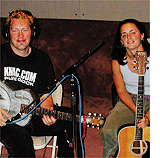 Ned
Evett and Molly Venter take a break during a recording session at
Mountain Beach.
Ned
Evett and Molly Venter take a break during a recording session at
Mountain Beach.
This past fall, Galpin recorded a jazz band in Boise called Sixth Street. Another client is former Ketchum resident, singer and songwriter Molly Venter, who recorded her first CD in 2004.
“She sings beautifully. Her career is at the beginning. It’s fun to work with someone just starting out. And I’m on the label because it’s my label,” he laughed. “I recorded my own record because I wanted to learn about the process from that end.”
Always the musician, Galpin continues his own music career. On his CD “Rock N Roll Recidivist,” old friends pitched in. Cetera helped him arrange “You’ll Go,” and provided vocals, as well as playing bass on “Dreaming of Bones.” Miller plays lead guitar on “Down on the Town,” a song that is typical of the entire CD. It’s “all original, blues based, very straight ahead rock ‘n’ roll,” he said. “I’m not promoting Amos the rock star, but Amos the songwriter. These songs are for anybody.”
As the studios continue to evolve, Galpin considers his fortune.
A studio off the map is only as good as the people who come through its doors to work. One can learn a lot while the talented are on the premises.
“I think of Steve and Peter as total mentors for me. Watching how Steve worked with his band was a great learning experience. Working with Peter on songs was like a crash course or a master’s seminar in songwriting. It was a thrill to be there when he recorded ‘Big Mistake’.”
Carole King has also rented his home studio for a while, holing up to write and record.
“I got to know Carole a little bit and saw how she worked. Everybody has their own way. You see how these people did it.”
Experience learning from and with the best has tuned his ear and honed his skills.
“It’s designed for accurate listening,” Galpin said, looking around the sound room at Mountain Beach.
“You can be sure when the music is played elsewhere it sounds the same. It’s been quite a journey.”
Online downloading, Galpin said, has decimated the music world. Where there used to be many small to medium sized record companies, now there are only a few and it’s hard for all the talented people out there to get together.
Mountain Beach is Galpin’s best effort at keeping those connections intact.
“It’s an interesting world, but you have to have courage.” •