Photo by Hillary Maybery
Thirty
years
and still ticking
Boulder
Mountain Tour Nordic Race
Celebrates 30th Anniversary
By Becky Lomax
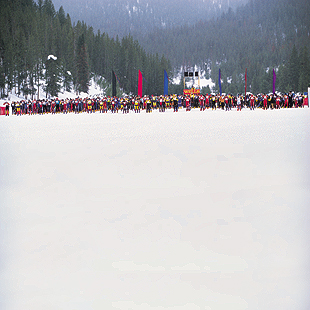
As I line up among 1,000 skiers poised at the starting line of the Boulder Mountain Tour Nordic Race, I wonder: “Am I nuts?”
Here I am, a first-time skate racer heading out for 32 kilometers with skiers from half the states in the nation and five foreign countries.
While the fastest skiers would cross the finish line in roughly 75 minutes over a trail system stretching between the Galena Lodge 22 miles north of Ketchum and the Sawtooth National Recreation Area Headquarters eight miles north of Ketchum, I’d be lucky to duck under the finish banner in double that time.
 Photo
by Hillary Maybery
Photo
by Hillary Maybery
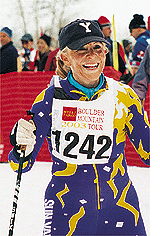
Little do I realize that in front of me stands a woman who has entered the race for the past 28 winters. Regardless of weather conditions, Sun Valley’s Jo Ann Levy takes her smile to the starting line.
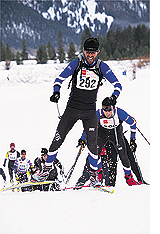
In the early kilometers, steep descents turn sharply. Following the advice of experienced racers, I hop into the classic tracks behind several other skiers to gain speed. As we accelerate, a racer falls below us. I screech into a snowplow to avoid the crumpled heap. Large divots nearby indicate the fate of more than one skier.
After the road crossing, a nasty, steep climb enters a thick forest. The relentless ascent plods upward as kilometer markers creep by. I wonder: “Why am I skiing uphill on a course that loses elevation?” Perhaps, the Galena Backcountry Ski Patrol will find my collapsed body.
A husband lobs comments at his wife to improve her technique. She is not impressed.
Finally, the first aid station appears. Volunteers grin, extending paper cups of water and warm energy drinks. I’d like to answer their questions with more than a nod, but I can barely breathe. I swill down several cupfuls of water. A gobble of banana and brownie chunk boosts sagging spirits before I ski off.
Good snow conditions prevail—reasonably fast, but not icy. That’s not the case every season.
In Boulder Flats, a headwind cuffs me, nearly blowing me backwards up the hill. Levy remembers a blizzard here one year where the wind whipped snow “like needles hitting my skin.”
 Photo
by Hillary Maybery
Photo
by Hillary Maybery
With five kilometers left, winds ease as I enter the protection of cottonwoods. With eyes closed in fear, I descend across a narrow bridge. Still intact, I ski on. Within a few smooth sailing kilometers along the Big Wood River’s banks, the finish banner glides by over my head.
Celebrating its 30th year in February, the annual Wells Fargo Boulder Mountain Tour Nordic Race will fire the starting gun once again. Beginning as a local event in the 1970s for a few cross-country buffs, the race now ranks as one of 11 prestigious Nordic races in the American Ski Marathon series. A day for a few skinny ski diehards has grown into a three-day festival.
Elite Nordic skiers and beginners alike will hop the buses to the starting line. In spite of all the huffing and puffing, in spite of the fear of ski poles jabbing me, in spite of headwinds, I’ll be lined up at the back of wave nine, and I’ll be looking up ahead for familiar faces, like that of Jo Ann Levy, who will head out for her 30th race.
Beginner racers should heed her veteran advice: “Don’t get caught up in a really frantic start. Some people are trying to win the race in the first mile. Just ski within your own comfort, and it will be a really fun experience.”
In the early years,” Jo Ann Levy says, “not many people were cross-country skiing, but now it’s really neat to participate in an event with elite skiers.”
In its infancy, 30 or so locals entered the race, the brainchild of a Nordic threesome: Dale Gelsky who ran Galena Lodge, Rob Kiesel who started the Sun Valley Junior Cross Country Ski Team and Bob Rosso of the Elephant’s Perch in Ketchum. Thirty years ago no trail spanned the distance from Galena to Sun Valley, and organizers punched in a new path every year, roughly following Highway 75.
“Often four or five of us on big, long, fat skis skied the entire thing side-by-side to push air out of the snow before snow machines could pack the course,” laughs Rosso, president of the Boulder Mountain Tour. “We used to set the track with little underpowered snowmobiles. Packing trail and setting track took forever!”
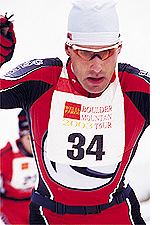 Photo
by Hillary Maybery
Photo
by Hillary Maybery
Before the Harriman Trail was constructed, which today does span the length of the course, the route took the path of least resistance in its 1,100-foot descent through the Wood River Valley. For much of the way, snow berms along the highway became trails replete with rocks thrown from highway snowplows.
“(The course) gradually made use of natural openings in the trees and the power line clearing that ran between Owl and Prairie creeks,” Rosso says. A single-skier-wide, the trail allowed little room to pass other skiers. “Most of the time, we’d all ski in one big line, stepping aside if a faster skier wanted to pass.”
Stanley’s Kathy Rogerson remembers the first race in the early 1970s. “We all used heavy classic skis.” She smiles at visions of how much they weighed compared to today’s gear. In addition, six to eight road crossings posed special dilemmas.
“No one shoveled snow onto the road then,” she says, “so every time you hit a road crossing, you had to take your skis off, walk across, and put them back on.”
Between the less efficient equipment and tedious road crossings, fast skiers completed the course in roughly three hours.
Snow conditions often changed due to the length of the race and the change in altitude. Levy remembers stopping to wax midway through the race, digging various ingredients out of the small pack she carried.
“Sometimes conditions changed a lot during the day, and you had to put klister on halfway through the race. It’s a fun sort of adventure to handle whatever Mother Nature throws at you.”
“One year it snowed too much,” says Rosso, “and another year it snowed too little.”
Colleen Connery of Ketchum also remembers her worst year when snows dumped six inches overnight and continued pelting her during the race.
“It was really hard and so deep,” Levy says of that same year. “It was like skating in heavy cream cheese.” She also remembers her husband slogging in classic tracks after an overnight snow buried the course.
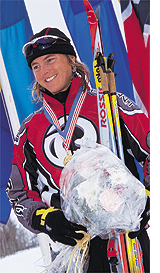 Photo
by Hillary Maybery
Photo
by Hillary Maybery
Over the years, organizers have moved the trail farther away from the highway.
“The north side of the road held a wicked downhill in the race’s last third,” says Levy of the original course. “I was chicken about going down something scary like that. I’m glad it’s gone.”
Rosso describes the old route: “We used to cross the bridge at Baker Creek, where the old highway cut up hill, and follow that from Easley to SNRA, but it was very exposed to the sun which wreaked havoc on waxing.”
The Boulder Mountain Tour evolved from classic cross-country style to a combination of skate and classic after Bill Koch introduced skate skiing at the 1976 Innsbruck Olympics. The course has been widened and grooming altered to add a skate lane.
“By 1979 we were skating, although it was on classic skis with less grip wax,” says Rosso.
Levy was one of the last to switch over. “I was not an easy convert!”
Today, the race is freestyle, which means anything goes. Although a few classic skiers enter each year, the parallel tracks often become obliterated by skating masses.
The race has grown so popular it now requires more volunteers to produce than it had entries in the early years. Where the early days needed a fistful of dedicated volunteers, today more than 300 community members participate in organizing, producing and cleaning up. Its $90,000 budget covers very few paid staff.
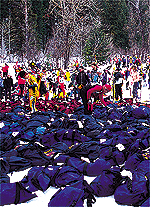 Photo
by Hillary Maybery
Photo
by Hillary Maybery
Three aid stations sponsored by local organizations dot the route to provide water and snacks at 12, 22 and 27 kilometers into the race. Levy remembers the years without aid stations, and notes that when organizers added them, the food was sometimes unique. “One station served oysters on the half shell,” she says.
The Boulder Mountain Tour’s 32K is shorter than the usual 50K races in the American Ski Marathon series, but its unique features and historical prestige place it in the big leagues, attracting elite factory team racers from Rossignol, Atomic, Subaru and others.
In 2003, fast course conditions saw new men’s and women’s records set. From Boulder, Colo., Eric Meyer crossed the finish line in 1:06.27 while Ketchum’s Brooke Baughman set the women’s record at 1:12.36.
With 1,047 entries, the 2004 race was the biggest ever, requiring eight waves of skiers to break up the contestants. First-time racers—nearly one third of the entries—line up at the back to clear the way for the pros and semi pros.
For 2005, race organizers will cap entries at 1,000.
“Because of busing logistics, closing the road for one crossing, and the fact that we cannot physically widen the trail anymore, we want to limit the field size,” explains Rosso. However, organizers plan to expand the start into nine waves, “which should ease congestion in waves three through five.”
In addition to wave changes, the event will celebrate its history and growth.
“We plan to display historical photos and nostalgia of the race in the registration tent,” says Rosso, “and most definitely, celebrate several folks who have competed all 30 times.” •