Photo by Doug Abromeit
Fighting winter's
white demons
National Avalanche Center
makes its home in Ketchum
By Greg Stahl
When you work in the business of predicting avalanches and when your after-work playground includes the ample winter backcountry of the Rocky Mountains, chances are pretty good you know someone who’s tangled with the deadly forces of an avalanche.
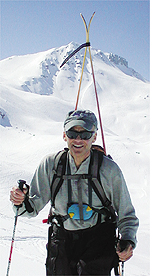
“I personally have known more than 20 people who have died in avalanches, from one of my very closest friends to acquaintances,” said Doug Abromeit, director of the U.S. Forest Service National Avalanche Center, based in Ketchum. “So it’s much more than a perceived risk to me. It’s pretty real.”
 Photo
by Doug Abromeit
Photo
by Doug Abromeit
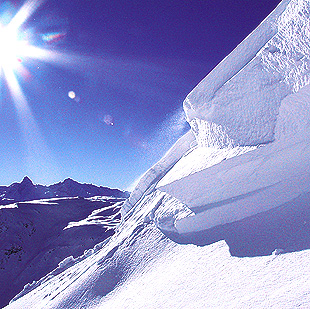
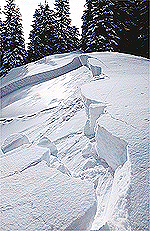
Every winter across Western North America, snows pile deep as Pacific-born storms pummel the sky-scraping mountains of the Rockies. As successive storms paste the mountains with layers of snow, the snowpack eventually succumbs to gravity. The resulting slides are called avalanches, and every year dozens of Americans are killed in them.
It is the National Avalanche Center’s job to coordinate the forecasting of possible avalanches, to educate people about the danger and to govern the arsenal of surplus military weapons used throughout the mountains to shoot avalanches down in a predictable and timely way.
“I love it. A lot of people tell me I have the best job in the Forest Service, which I sometimes dispute,” Abromeit said. “Running a local avalanche center would probably be the only thing better.”
With a name like the U.S. Forest Service National Avalanche Center, one might imagine a NASA-like complex brim full of computers and stiffs who banter about the latest weather forecasts and snow science.
The reality of the situation is significantly more romantic—or maybe less, depending on how you look at it.
The National Avalanche Center is little more than a desk in a U.S. Forest Service ranger station on a typically scenic street in downtown Ketchum. Two people share the office, the local avalanche center director and Abromeit. A few skis, winter hats and jackets are stuffed into corners, but there’s little to set the place apart from almost any office in America.
“We like to call ourselves the little center with the big name,” Abromeit said.
He is the only director the National Avalanche Center has had since its inception in the early 1990s. The center has moved with Abromeit, and when he took a job as a snow ranger on the Sawtooth National Forest’s Ketchum Ranger District in 1995, the center moved with him. Two years later, he stepped out of the snow ranger duties and took the helm of the National Avalanche Center full-time.
For mountain town snow geeks, it’s easy to dream about the sexy life of the avalanche forecaster: early-morning sunrises after a night of dusty snow, steaming coffee and an old pickup barreling down an ice-crusted road, hours of backcountry labor rewarded with stunning views and exhilarating turns in untracked snow.
Well, yes and no, Abromeit said.
For one thing, as the coordinator for all of the country’s avalanche centers, Abromeit is chained to his desk more than many of the center directors who work under him. The job entails a significant amount of paper work. Practically everything dealing with avalanches within the purview of the Forest Service in the entire country crosses Abromeit’s desk, plus everything dealing with artillery stockpiles used to fight avalanches at ski areas and along highways and railroads.
“It’s huge,” he said. “Somehow we’re able to do most of it and do a darn good job with it.”
But Abromeit still manages to get back to his roots fairly often. Last fall, while local skiers were still waxing their boards and looking to the skies in hushed anticipation of another winter, Abromeit boasted about the powder stashes he discovered in a remote mountain range north of town.
He’s been skiing since he was 15, and he’s been skiing in the backcountry since his early 20s.
“I don’t think there’s just one attraction to the backcountry,” he said. “The attraction to the backcountry is almost like exploring why a rose is beautiful or a woman is beautiful. It’s just a magical thing.”
Though it has broadened its focus to include education, coordination, research and management of all of the country’s Forest Service avalanche centers, the National Avalanche Center had innocuous beginnings in management of an arsenal of surplus military weapons.
In approximately 1948, ski areas, highway departments and railroads started using military weapons to trigger avalanches from far-off locations. Once an avalanche is triggered, its path is generally considered safe from immediate threat.
 Doug
Abromeit. Courtesy photo
Doug
Abromeit. Courtesy photo
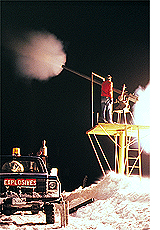
In ski towns and along highway passes throughout Western North America, the morning after a big snowstorm is filled with echoing booms as ski patrols and transportation departments fire shells into the snowpack to try to trigger slides from a safe distance.
The surplus military weapons program started in 1948, but there was no real coordination of it until about 1986, when a large explosion at a weapons cache in Kentucky rocked the very foundation of the program.
The U.S. Army immediately implemented a moratorium on civilian use of the weapons, primarily recoilless rifles and howitzers.
“Without military artillery, places like Snoqualmie Pass in Washington, Alta and Snowbird in Utah, they’re just hosed,” Abromeit said. “People were scrambling.”
The army investigated the explosion and determined the bunker had no real link to the avalanche program. Avalanche controllers breathed a collective sign of relief when the moratorium was lifted just prior to the fall storm season, but Abromeit was appointed to begin supervising.
“That is a huge component of this. It’s dealing with military artillery for users throughout the United States and Canada,” he said. “Then, over time, around 1990 or 1991, the job just kept expanding, and they turned it into the National Avalanche Center.”
The center coordinates all of the Forest Service’s national avalanche centers, facilitates research, provides training within the Forest Service and coordinates all of the national public avalanche education.
But a lot of the job
still includes management of the old weapons, which herald from World
War II, Korea and Vietnam. And the road has been rocky at times.
Avalanche controllers used to use recoilless rifles almost exclusively
in their control work, but a man was killed in 1996 while firing the
weapon at Alpine Meadows Ski Resort in California.
“That was kind of the end of innocence for us. When that happened, it was an incredible shock to all of us.”
The National Avalanche Center responded by instituting rules that required the guns to be fired remotely, but during a 13-day period in December 2002, there were two more explosions inside the barrels of the recoilless rifles, and avalanche controllers switched exclusively to howitzers.
 Photo
by Doug Abromeit
Photo
by Doug Abromeit
“The howitzers are actually a much better weapon. They’re quieter. They have better range, and they can be shot from a protective shelter, so the gunners can get out of the weather. They recoil, but they’re just a much nicer weapon. It’s working very well, but there’s no heir apparent in the army arsenal that we could replace this with. Everything is either too big or too sophisticated. There’s no real backup, other than using a helicopter, which you can only use in good weather.”
The snag is that there are only enough howitzer shells in the army’s stockpiles to last another 10 to 15 years. As things stand, when those run out, the program is over.
“It’s hard to project. If the army decides there’s a more pressing need for these howitzer rounds than avalanche control, then off they go,” Abromeit said. “And if there’s an accident with the howitzers, we’re probably finished. There’s no backup.”
Abromeit is from Sandpoint, Idaho, a small resort community in the state’s northern panhandle. A former ski patroller at Schweitzer Mountain Resort, he graduated from the University of Idaho with a degree in English, but began working for the Forest Service as a smokejumper. Not long after, he landed his dream job, a position with the Wasatch National Forest’s Salt Lake Ranger District as a snow ranger.
“That was like going to Mecca for me,” he said. “I was so psyched when I got that job. That’s also when I started to get serious about avalanches.”
The Salt Lake Ranger District includes Little Cottonwood Canyon, where Alta and Snowbird ski areas are nestled among 13,000-foot peaks. It was the birthplace for avalanche study in America, and, with more than 500 inches of snow each winter, it is a scalding hot spot for avalanches.
“In Little Cottonwood Canyon, there are just so many avalanches that there’s no better training or classroom in the world,” he said. Little Cottonwood Canyon was also the only place Abromeit was ever buried by an avalanche.
It was 1991 on a typically busy morning rush to the ski areas when it started to snow, really dump. A car got stuck, clogging the two-lane road that threads the canyon, and the snow started coming down in torrents.
“It was snowing 4 inches an hour, or even 5 inches per hour, which is just ridiculous, and the canyon was gridlocked. We couldn’t do control work because all the cars were on the road. We just had to sit there and watch the avalanche hazard go up, up, up. Finally it hit this critical threshold, and we had multiple avalanches, like 27 avalanches in a 20-minute period. It was total anarchy.”
Abromeit drove down the canyon to survey the situation and determined rescue gear was needed. As he started driving his Forest Service issue pickup back up the road, an avalanche roared across the road in front of him. He looked uphill and saw another careening toward him. He threw the pickup into reverse to attempt to flee, but the white cloud swallowed him and completely buried the truck. Despite the uncomfortable and potentially deadly predicament, he emerged relatively unscathed.
“I just stayed in the truck until these guys came with a front loader to dig me out,” he said.
But that event, along with several others including the avalanche death of one of his best friends, reinforced the importance of the work he does.
“When I talk with other people who have been in the avalanche world for quite a while, it’s not uncommon for a number of people to have known 10 or 20 people who have died. It’s actually, statistically, a lot more dangerous than climbing. Avalanches kill many more people than alpine climbing or rock climbing.”
Last year in North America, avalanches killed 32 people, 21 of those in the United States. The previous year, 58 people were killed in avalanches in North America, 30 of those in the United States. So far this decade, prior to the start of this season, 183 people were killed in avalanches in North America, according to Forest Service statistics.
The single most important key to reducing the number of avalanche fatalities and incidents is education, and snow is a mercurial medium at best to try to understand.
“Snow, in general, is very fascinating because it’s such a dynamic solid,” Abromeit said. “It’s the most unstable solid on earth, which means it’s the most fickle solid on earth.”
Avalanche centers throughout the country teach classes geared toward snowmobilers, skiers, snowboarders and anyone else who might get outside in the winter. In general, those who attend the classes learn that slope angle, snow stability and weather are the key factors to consider when evaluating avalanche danger, though it’s a lot more complicated than that.
But in the end, risk in the backcountry is a result of personal decision making.
“Just knowing about an avalanche isn’t enough. You need to know more. You need to translate that into good decisions,” Abromeit said. “It’s as dangerous as we choose to make it. Our decisions, for the most part, determine whether it’s going to be dangerous.
“What happens with decision making in the backcountry is once you get in avalanche terrain, which is typically steeper than 30 degrees, you’re managing the risk. You not only need to know about the mechanics of avalanches and recognize danger, but you need to be able to transmit that knowledge into good decision making. I think so much of our decision making is emotionally based, rather than objectively based. I think that’s how most knowledgeable people get caught.”
The main point avalanche educators try to relay to their students is that the odds of getting in an avalanche, regardless of conditions, are determined by the decisions people make in the field. According to Janet Kellam, director of the Sawtooth National Forest Avalanche Center, based in Ketchum: “In more than 90 percent of avalanche accidents, the slide is triggered by the victim or someone in their party.
“I don’t want people to think they should always ski on low-angle slopes. That’s just the best way to avoid getting caught. Once you get on slopes steeper than 30 degrees, it becomes risk management. You have to figure out what your level of acceptable risk is, and you should base that on observations and stability tests.”
Despite the inherent dangers of traveling in avalanche country, the benefits outweigh the risks, Abromeit said.
So long as
backcountry travelers learn how to analyze snow stability and to execute
good decision making, safe and rewarding experiences await.
So when you head into the backcountry this winter, you just might find
Doug Abromeit toiling up a snow-swept ridge or carving his signature on
a fluffy white mountainside. In the uncrowded backcountry of Idaho, a
mountain’s worth of adventures await, and there’s a pristine line on an
isolated ridge waiting to be signed. •
Avalanche 101
Avalanches kill more people in the country’s national forests than any other natural disaster, including floods, fires or weather, and nearly every avalanche fatality in the United States occurs in national forests and parks.
But there is information people can arm themselves with to help reverse the trend.
“Avalanche conditions are predicable, and these avalanche accidents are preventable,” said Janet Kellam, director of the Sawtooth National Forest Avalanche Center, based in Ketchum. “In more than 90 percent of avalanche accidents, the slide is triggered by the victim or someone in their party.”
What that means is
people—the triggers—can make decisions that could keep them out of
harm’s way.
There are several stages of avalanche preparedness. One is knowing how
to recognize avalanche conditions and terrain. Another is knowing how to
travel in avalanche country. Still another is being prepared and knowing
what to do if someone in your group is buried in an avalanche.
Kellam offered the following tips for diagnosing snowpack stability:
· The most significant signs are recent natural avalanches or avalanches triggered by people.
· Cracking, collapsing or “whoomphing” (you’ll know it if you hear it) of the snowpack is a sign of instability.
· New snowfall, especially rapid accumulations, can increase avalanche conditions.
· Wind, whether there’s a lot of snow to blow around or wind during a storm, can increase avalanche conditions.
· Rapid warming can increase danger. “It doesn’t have to be melting temperature, but just a temperature spike is an indicator that avalanche conditions are most likely increasing,” Kellam said.
· Finally, rain on new snow can cause a spike in avalanche conditions.
Kellam also said backcountry travelers should know how to travel and know what to take along.
“Carry proper winter gear and proper avalanche rescue gear, which is a beacon, shovel and probe,” she said. “And be well practiced at performing a rescue.”
If someone is buried in an avalanche, it is essential to dig them out immediately.
“Use everyone to search, and don’t go for help,” Kellam said.
Of avalanche victims who are completely buried, 92 percent can be revived if thy are dug out in the first 15 minutes.
“The scary part of that is that after 35 minutes, only 27 percent of those people will survive,” Kellam said. “That just emphasizes that you have to use everyone to search then and there.”
Also, when push comes to shove, reading an article is not enough for aspiring backcountry travelers.
That’s why the Sawtooth National Forest Avalanche Center offers free Avalanche Basics classes each winter. This year’s classes are scheduled for Dec. 7 and Jan. 4.
“Those classes are good for basics, or for a refresher, but for more advanced information, we usually refer people to the local outfitters,” Kellam said.
Sun Valley Trekking and Sawtooth Mountain Guides both offer advanced avalanche classes.
Reports on local avalanche conditions are available by calling 622-8027 or by logging on to www.avalanche.org.
Also, information and an online tutorial are available at www.avalanche.org/~nac/.
Kellam summarized:
“Know the conditions and the weather. Pay attention to slope angle. Spread out, but in sight of each other. Expose only one person at a time to potential avalanches. Communicate well with your group, and watch for changing conditions.”