| click here for the |
| front page |
| features |
| proctor,ruud+dollar |
| beyond boarding |
| bell,odmark+puchner |
| trinity springs water |
| arts |
| black+white photos |
| jack burgess |
| r.l. rowsey |
| living |
| yoga |
| decorative concrete |
| recreation |
| vO2 workouts |
| snowshoeing |
| dining |
| scotch |
| stews |
| calendar |
| winter 2003-2004 |
| to-do |
| sun valley essentials |
| listings |
| galleries |
| dining |
| fitness |
| equipment rentals |
| outfitters + guides |
| lodging |
| maps |
| ketchum + sun valley |
| local art galleries |
| the guide |
| last summer |
| advertising |
| about us |
| copyright |
|
Copyright
© 2003 Express Publishing Inc. All Rights reserved. Reproduction in whole or in part in any form or medium without express written permission of Express Publishing Inc. is strictly prohibited. |
|
Produced
& Maintained by Express Publishing, Box 1013, Ketchum, ID 83340-1013 208.726.0719 Voice 208.726.2329 Fax info@svguide.com |
|
The
Sun Valley Guide is distributed free twice yearly to
residents and guests throughout the Sun Valley, Idaho resort area
communities.
Subscribers to the Idaho Mountain Express will receive the Sun Valley Guide inserted into the paid edition of the newspaper. |

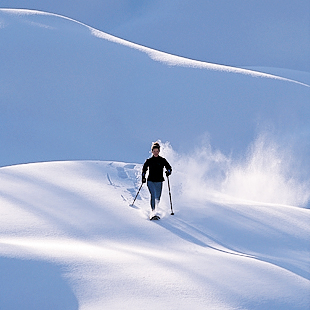
photo by David Wheelock
walking on water
by Greg Stahl
"If you can walk, you can snowshoe.”
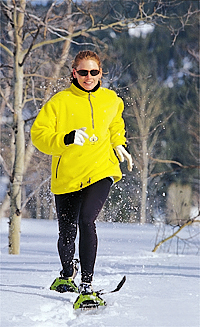
Modern innovations for an ancient necessity make this aspiring snowshoers’ mantra truer now than when the funky over-the-snow walking contraptions were first conceived.
Despite mixed reports about when and where showshoeing began, the functionality of these tools of winter travel have survived the test of time. Today’s snowshoes use the same physical properties employed by the early contraptions, only they’re lighter, easier to use and a lot more fun.
“I really got into it. I really enjoyed it,” says Peter Heekin of Hailey, who started snowshoeing with his family several years ago when his children were born. “It’s more fun than it seems for me and my family. It’s good to get the kids out there and show them the mountains.”
Heekin, a Hailey sporting goods store owner who typically straps on skis for winter backcountry trips, says he was skeptical about snowshoeing at first. But, particularly for family outings, the sport has proved exceptional.
It’s a good form of exercise in the winter,” he says. “Otherwise, you might just be in a gym on one of those rat wheels. It’s easy to get a good burn (snowshoeing) on a lunch break or after work.”
Sun Valley is blessed with winter terrain suitable for a myriad of sports, and snowshoeing is certainly among them.
 photo
by
photo
by
David Stoecklein
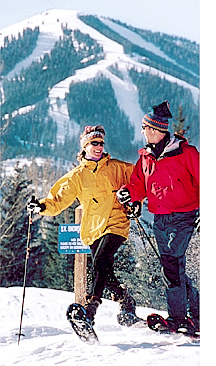
Sun Valley Company, owner of the resort, maintains snowshoe trails on Bald Mountain and at the Sun Valley Nordic Center along with its ski runs, and the Blaine County Recreation District maintains several snowshoe trails near Galena Lodge, the northern Wood River Valley’s Nordic ski center. But the use of snowshoes isn’t limited to these designated trails.
Where there’s snow, one can snowshoe.
In stride with walking, snowshoeing technique employs a natural motion with common sense. A few quick tips can help get the first-timer on his or her way.
When climbing a slope, kick the front of the snowshoe into the snow and push down to compact the snow into a step. Make sure each new step is far enough above the previous one to avoid a collapse.
When going downhill, use the shoes’ heel cleats to maintain traction. Keep knees slightly bent, lean back and keep weight on the heel to maintain control through the cleats.
When hiking across a slope, use edging to prevent the snowshoes from sliding downhill. Kick the side of the snowshoe into the hill, engaging the cleats and keeping the uphill edge underfoot.
When breaking trail, it is helpful to be traveling in a group and to take turns at the front of a single-file line. When leading, take consistent, even steps that are easy for everyone to follow.
Ski poles are helpful, though not necessary, components of a snowshoe outing. Poles help with balance when a snowshoer is carrying a large backpack or walking across a slope, Heekin points out.
Snowshoeing was one of the fastest growing winter sports through the late 1990s, and has continued to experience respectable growth through the last four years. Part of the reason for its popularity may be the ease with which people can pick up the sport. Another reason may have to do with the efficient workout one gets enjoying a snowy walk through the woods.
In a 2001 report in Health and Fitness Journal, people snowshoeing were shown to burn more calories per hour than those running, cycling or cross-country skiing. The research showed that snowshoers traveling over moderate terrain with reasonable snow depths burned 600 to 800 calories per hour.
Research has shown that snowshoeing provides a moderate to strenuous workout and raises the heart rate to within American College of Sports Medicine guidelines to improve cardio-respiratory endurance and positively alter body composition,” the report states.
Though there doesn’t seem to be any consensus on when or where the first snowshoes were constructed, archeological findings show that ancient inhabitants of the world’s frozen regions used showshoes.
Evidence indicates snowshoes may have first been used in Mongolia or Scandinavia about 6,000 years ago. Others discoveries have led to the theory that the first settlers of North America about 13,000 years ago may have used snowshoes when crossing a land bridge between Asia and North America.
“I do know the (native inhabitants) of the Arctic world did use various forms of over-the-snow transportation, but they probably didn’t look much like today’s snowshoes,” says Pat Butterfield, director of the Ketchum-Sun Valley Ski and Heritage Museum. “It was eventually adapted by the mountain men who were trying to survive the winters around here.”
Today’s snowshoe designs are the result of thousands of years of evolution. It is believed that Native Americans improved snowshoes in several ways. They primarily built two designs still in use today: the beavertail, or teardrop, and the bear paw.
The early French Canadian settlers adopted the functional footwear, and snowshoes quickly became essential equipment for fur trappers tending trap lines in winter. A battle of the French and Indian War is said to have been fought on snowshoes in 1758.
By the late 1800s, recreational snowshoeing clubs had formed in eastern parts of Canada, New England and the Great Lakes area of the United States, but it wasn’t until the advent of aluminum and plastic snowshoes in the later half of the 20th century that the popularity of snowshoeing began to rapidly increase.
Today, more than 20 manufacturers produce modern, high-tech snowshoes. In addition to wood and aluminum-frame shoes, several models are made from impact-resistant plastics.
 photo
courtesy
photo
courtesy
Sun Valley
Nordic Center
Snowshoe design is relatively simple, consisting of a frame, decking, cleat and binding system. Shapes may be symmetrical or asymmetrical, diamond, oval or hourglass. Ovals provide the most floatation for soft snow, but diamond and hourglass shapes are considered easier to walk on, because there is less shoe area to get in the way.
If more encouragement is needed to prompt a Sun Valley snowshoe outing, remember the words of Elliott Merrick in his 1933 novel, “True North”:
“A snowshoe trail on a sunny day after a light fall of snow is a lovelier thing than I can describe. I often look back at it streaming from our heels, flowing astern … A darker serpentine ribbon, scallop-edged, filled with tumbled blue shadow markings. And every print is a beautiful thing. It is like sculpture and like painting, endless impressions of an Indian craftsman’s masterpiece.”
where to go
Maintained
snowshoe trails are quite a new development for a rapidly growing sport.
Sun Valley Company maintains a trail on Bald Mountain, and two at the
Sun Valley Nordic Center. The North Valley Trails (Blaine County
Recreation District) offer three areas with snowshoe trails, including
Galena Lodge. The Sawtooth Valley, over Galena summit, has snowshoe
trails at Alturas Lake and at Park Creek. Snowshoers are not allowed on
groomed trails.
SUN VALLEY NORDIC
(S.V. Company)
From the Nordic Center a snowshoe trail (5 km) leads to Trail Creek
Cabin, which is open for lunch. A more strenuous snowshoe trail (3 km
loop) is maintained across Sun Valley Road above the Gun Club. Snowshoe
trails are free. No dogs.
BALD MOUNTAIN
(S.V. Company)
For $14/day, snowshoers
can access a trail on top of Bald Mountain by taking the chairlift to
the top (on Baldy) and snowshoeing to the Seattle Ridge Lodge for lunch.
NORTH FORK LOOP
(North Valley Trails)
A 4 km loop runs alongside the ski trail from the SNRA headquarters
to the north, partly following the North Fork of the Big Wood River.
Dogs allowed. Cost: $2/day.
BILLY’S BRIDGE
(North Valley Trails)
A 8 km loop weaves through
the ski trails and also along the Big Wood River with the Boulders
towering above. Unbelievable views, dogs allowed. Cost: $2/day.
GALENA LODGE
(North Valley Trails)
Nine snowshoe trails for a total of 30 kms radiate out from Galena
Lodge, 24 miles north of Ketchum. The longest is a 7.6 km loop,
ascending close to the headwaters of the Big Wood River. The yurt trail
leads to three yurts, that can be rented for overnight use. Dogs are
allowed on three of Galena’s snowshoe trails. Cost: $3/day.
ALTURAS LAKE AND PARK CREEK
(Sawtooth Valley)
Driving over Galena summit, the Alturas Lake trails can be reached at 34
miles. Park Creek’s trails are 65 miles away on Hwy 21, west of Stanley.
Both areas offer Nordic and snowshoe trails, and ask for a $3 donation.
Dogs are allowed.
Maps of the Nordic and Snowshoe Trail system are available free at
sporting goods stores, lodging establishments and at the Sun
Valley/Ketchum Chamber & Visitor Bureau.