| click here for the |
| front page |
| features |
| proctor,ruud+dollar |
| beyond boarding |
| bell,odmark+puchner |
| trinity springs water |
| arts |
| black+white photos |
| jack burgess |
| r.l. rowsey |
| living |
| yoga |
| decorative concrete |
| recreation |
| vO2 workouts |
| snowshoeing |
| dining |
| scotch |
| stews |
| calendar |
| winter 2003-2004 |
| to-do |
| sun valley essentials |
| listings |
| galleries |
| dining |
| fitness |
| equipment rentals |
| outfitters + guides |
| lodging |
| maps |
| ketchum + sun valley |
| local art galleries |
| the guide |
| last summer |
| advertising |
| about us |
| copyright |
|
Copyright
© 2003 Express Publishing Inc. All Rights reserved. Reproduction in whole or in part in any form or medium without express written permission of Express Publishing Inc. is strictly prohibited. |
|
Produced
& Maintained by Express Publishing, Box 1013, Ketchum, ID 83340-1013 208.726.0719 Voice 208.726.2329 Fax info@svguide.com |
|
The
Sun Valley Guide is distributed free twice yearly to
residents and guests throughout the Sun Valley, Idaho resort area
communities.
Subscribers to the Idaho Mountain Express will receive the Sun Valley Guide inserted into the paid edition of the newspaper. |

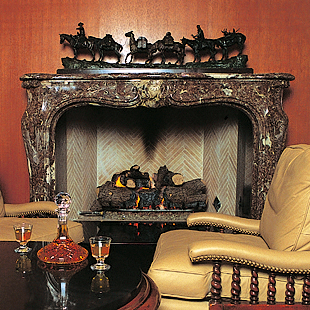
The lobby of the Sun Valley Inn. photo by David
N. Seelig
simply scotch
scotch sippin’ ain’t that simple
by Greg Stahl
Squeezing an overview about Scotch whisky into a 1,000-word story is kind of like trying to cram European history into a glossy tourist brochure.
Scotch is an incredibly complex drink with a rich and storied past. And, not coincidentally, it is a popular drink during the cold months of winter.
“There’s definitely a winter, making-you-warm feeling associated with it,” says Darren Lee, bar manager of the Roosevelt Tavern in Ketchum.
But there’s much more to it than a snuggling-by-the-fire-after-a-cold-day-of-skiing feeling.
As with wine connoisseurs, scotch drinkers use a vast array of adjectives to describe their beverages: buttery, peaty, spicy, minty, sweet, aromatic, gingery, crisp, oaky, toffeeish, brittle and, perhaps most common, smoky. This lengthy list of modifiers, which is by no means complete, is just a hint of the incredibly complex variables that go into the making, and drinking of Scotch whisky.
“It sounds so simple—having a scotch—but it’s nowhere near that easy,” says Brian Sutton, co-owner of the Cellar Pub in Ketchum. “It’s so in depth. The air, the mist, weather, climate, geology—all of those things affect the final taste.
“It’s probably one of the most complex, if not the most complex, spirits out there.”
As the name indicates, whiskey cannot be called scotch unless it is made in Scotland, and this is one of the reasons scotch is distinguished among other similarly made whiskeys. Scotland’s unique weather, geology, geography and plant communities are some of the things that make Scotch whisky unique.
“Excellent whiskeys are made by similar methods in other countries, notably Japan, but they cannot be called scotches. Nor do they taste the same,” writes Michael Jackson in his book, “Michael Jackson’s Complete Guide to Single Malt Scotch.”
“The best Scotch whiskies taste of the mountain heather, the peat, the seaweed. They taste of Scotland, more obviously than even Cognac tastes of its region or the best tequila of its mountain soil.”
Scotch comes in single and blended versions, but the single malt scotches have caught on in the last 40 years, similar to the beer industry’s more recent uprising of micro-breweries, only scotch is a good bit more complicated than beer.
Single malt scotch, the connoisseur’s preference, is made entirely within one distillery, even though most bottles of single malt scotch contain whiskey from several casks, a process known as vatting. Blended scotch, as the name indicates, includes whiskies from multiple distilleries. Near the turn of the 19th century multiple distillers combined forces to sell branded whiskey in bottles, which gave rise to the practice. Today, upward of 20 distilleries might be used in a bottle of blended scotch.
“The best of the blends have great character and complexity, but it is a shame that so many are so similar, and that for so many years orchestrations drowned out the soloists,” Jackson writes.
For years, blended scotch was the norm outside Scotland, but in the late 1960s and 1970s, a handful of independent scotch makers, fearing isolation in an otherwise consolidating market, began seriously to advertise their whiskies as single malts.
“What seemed like a long gamble became an inspiration to others,” Jackson writes. “Blended scotch is still dominant in volume, but single malts are gaining in sales and commanding far higher prices.”
 photo
by
photo
by
David N. Seelig
The widely varying tastes of scotch are derived from a myriad of influences, like the place it was made, the water used to make it, the barley from which it was derived, the shape of the still used to distill it, the kind of wooden cask it was stored in and even the microclimate of the room in which it was aged.
As with wine, there is an art to enjoying scotch.
“It’s a drink for someone who’s not really interested in getting drunk. The scotch drinker takes anywhere from 15 minutes to more than an hour to have a drink,” says Lee, who, until recently, worked at a scotch bar in Boise.
Scotch can be enjoyed “on the rocks,” with a slight mix of water or straight up.
Those who know what they’re doing generally order it up, at room temperature, but a little water can take the “bite” away.
“The appeal, for me, is that there are so many different kinds,” Lee says. “It’s usually an expensive night on the town. And don’t be fooled. It’s usually better to spend the money on the expensive stuff.”
And as with most wines, Scotland’s single malt whiskies are grouped by regions, which helps define taste. The traditional regional divisions are the Lowlands, the Highlands, Campbeltown and the island of Islay. At the Cellar Pub, which Sutton said boasts the best Scotch selection in the area, the regions are divided into Lowlands, Highlands, Speyside (a sub-region of the Highlands) and Islay.
According to Jackson, the Lowlands produces relatively few whiskies. The best Lowlands whiskies “have suggestions of lemon grass and maltiness, untempered by Highland heatheriness or coastal seaweed and brine.”
The Highlands are the largest region in Scotland’s scotch country, and the region’s whiskies vary. “If their whiskies have anything in common, it is a firm, dry character, with some peatiness and saltiness,” according to Jackson.
Speyside, a region within the Highlands, sweeps from granite mountains to fertile fields, where barley is grown. “The granite mountains give rise to soft water, which often flows over heathery moorlands. Distillation and maturation tend to be in cool locations,” Jackson writes. “The Speyside single malts are noted in general for their elegance, flowery, heather-honey notes and sometimes a restrained, fragrant peatiness.”
Islay, a small island, is famous for producing whiskies with maritime flavors and for having so many distilleries on an island only 25 miles long. Jackson points out that the island character is strongest where malt is made with local peat, as it is on Campbeltown, which produces “distinctly briny” whiskies.