| click here for the |
| front page |
| features |
| proctor,ruud+dollar |
| beyond boarding |
| bell,odmark+puchner |
| trinity springs water |
| arts |
| black+white photos |
| jack burgess |
| r.l. rowsey |
| living |
| yoga |
| decorative concrete |
| recreation |
| vO2 workouts |
| snowshoeing |
| dining |
| scotch |
| stews |
| calendar |
| winter 2003-2004 |
| to-do |
| sun valley essentials |
| listings |
| galleries |
| dining |
| fitness |
| equipment rentals |
| outfitters + guides |
| lodging |
| maps |
| ketchum + sun valley |
| local art galleries |
| the guide |
| last summer |
| advertising |
| about us |
| copyright |
|
Copyright
© 2003 Express Publishing Inc. All Rights reserved. Reproduction in whole or in part in any form or medium without express written permission of Express Publishing Inc. is strictly prohibited. |
|
Produced
& Maintained by Express Publishing, Box 1013, Ketchum, ID 83340-1013 208.726.0719 Voice 208.726.2329 Fax info@svguide.com |
|
The
Sun Valley Guide is distributed free twice yearly to
residents and guests throughout the Sun Valley, Idaho resort area
communities.
Subscribers to the Idaho Mountain Express will receive the Sun Valley Guide inserted into the paid edition of the newspaper. |

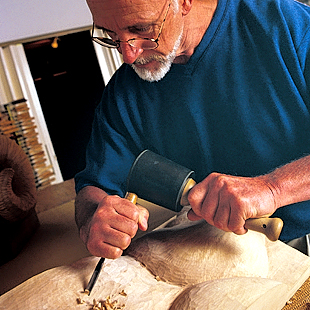
photo by David N. Seelig
a natural sense
of balance
Jack Burgess creates
stylized images of nature
by Greg Moore
When Ketchum woodcarver Jack Burgess turned 40, a friend threw a surprise birthday party for him. Part of the surprise was that everyone invited to the party was given platforms for their shoes to make them taller than the guest of honor. Since Burgess is a muscular 6 feet, 4 inches, that was no easy task. Though the room was full of his good friends, Burgess said, when he first walked in he was utterly bewildered. Who are all these people, he wondered.
The sensation was not lost on the artist, who today strives to induce that same sense of bewilderment in viewers of his carvings by presenting the familiar in an unconventional perspective.
Burgess may, for example, scan a photograph of two interlocking torsos, searching for the most interesting point of connection, and carve only that segment.
“You can change the forms and find something that’s a new picture that you don’t usually see,” he said. “I have to make it interesting so you’ll be drawn into it and make it whatever you want it to be.”
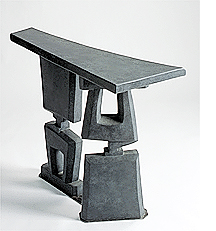 Burgess’
stylized human figures, inspired by African art, support this table made
of acrylic cement. photo by Kirk Anderson
Burgess’
stylized human figures, inspired by African art, support this table made
of acrylic cement. photo by Kirk Anderson
Experimenting with
new forms has been a life-long passion for Burgess, who began drawing at
age 3.
“I had the blessings of my parents to go ahead and be a creative
person,” he said. “They just let me run.”
Growing up in a rural part of Northern California, most of his images were drawn from nature. When he turned his artistic energies to wood carving in 1980, his first subjects were animals and fish, particularly salmon. He still finds inspiration in nature, but his current work is more stylized.
“There are some really excellent wood carvers out there,” Burgess said, “but they’re all doing the same thing—imitating something. I get more joy out of not doing something exactly. A lot of people want something that reminds them of nature.”
Eldridge French, owner of Sagebrush Gallery in Ketchum, which carries some of Burgess’ pieces, agrees that he interprets things in his own way.
“He’s certainly one of the best woodcarvers I’ve ever seen,” French said. “He’s also a very good artist. He has a very good eye.”
A love of the natural world played a major role in Burgess’ relocation to Central Idaho. He came upon the Sawtooth Mountains near the end of a three-month road trip in 1974, in search of a new place to live.
Like many other new arrivals, Burgess paid his bills through construction work. He spent 14 years as a carpenter and builder before deciding to become a full-time artist. He started by telling local architects, “If there’s anyone who wants something really unique, just keep me in mind.”
I told myself, ‘If there’s a way to stay close to this, I’m going to stay here.’ And I’ve been here ever since.”
He did, and the commissions began to trickle in. However, Burgess said, he spent seven years making about $4 an hour.
Now, in his 15th year as a full-time artist, most of his commissions are for projects costing at least $10,000. Some go for as much as $70,000.
The high prices reflect the many hours involved in a complex carving. For example, Burgess said, he spent seven and a half months building a large living room table whose legs were life-sized, carved bighorn rams’ heads. Woodcarving, he points out, requires a patient temperament. He estimates that after a day’s work, his studio floor is covered with between 2,000 and 3,000 wood chips.
Every large item in Burgess’ Ketchum studio is on wheels, including an interior wall. That way, it can all be rearranged to accommodate the size of his pieces, which have been up to 22 feet long. It also allows him to keep his tools, which include a set of 300 chisels, close at hand.
“If things get messy, and I have to go looking for something, it takes me out of the creative zone,” he said.
The studio’s second floor houses a small gallery, containing about 20 pieces, and an office.
“I realized early on that I needed my own gallery—a place where people can see my work and then commission a piece.”
The pieces on display suggest the range of Burgess’ artistic interests. In addition to his basswood carvings, they include point drawings of the weathered faces of two Native Americans, a thickly daubed, almost three-dimensional oil painting titled “End of the Storm” and cast bronze “balance” sculptures, which suggest one long twig balanced on the point of another.
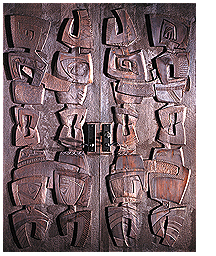 photo
by
photo
by
Kevin Syms
To create his stylized sculptures, Burgess said he has to give himself permission to do what most people would consider a waste of time.
“I’ll go through the studio and I’ll grab all sorts of things, something that has an interesting shape or an interesting texture. Then I put on some music and sit and stare for hours. Then I move things around, for two or three days. I’m in a total state of unknowing, until something pops up and I think, ‘Wow, that works!’”
Burgess said he spent three days finding just the right branch for a new “balance” sculpture. If he still likes it in two weeks, he said he’ll get it cast.
He said the “balance” sculptures, which have sold well, evoke the sense of balance he sees in nature and feels when he immerses himself in the natural world.
“If you turn off the TV and just go for a walk, you get back in touch with what’s real.”
Art, Burgess contends, is not the object itself but the process of expressing one’s feelings in creating it. He said he has done some of his best work when in a state of conflict and confusion.
“There’s a lot of opportunity in being stuck, if you know how to use it. You trust that you’re going to squeeze through and get to the other side, and in the process reveal something of your inner nature.”
Burgess put those and similar ideas into two local classes he taught on creativity.
“I want to give people a chance to understand their chaos in a creative way. Can you change yourself to match what’s going on?”
His next major project is to publish some writings on the subject.