| click here for the |
| front page |
| features |
| proctor,ruud+dollar |
| beyond boarding |
| bell,odmark+puchner |
| trinity springs water |
| arts |
| black+white photos |
| jack burgess |
| r.l. rowsey |
| living |
| yoga |
| decorative concrete |
| recreation |
| vO2 workouts |
| snowshoeing |
| dining |
| scotch |
| stews |
| calendar |
| winter 2003-2004 |
| to-do |
| sun valley essentials |
| listings |
| galleries |
| dining |
| fitness |
| equipment rentals |
| outfitters + guides |
| lodging |
| maps |
| ketchum + sun valley |
| local art galleries |
| the guide |
| last summer |
| advertising |
| about us |
| copyright |
|
Copyright
© 2003 Express Publishing Inc. All Rights reserved. Reproduction in whole or in part in any form or medium without express written permission of Express Publishing Inc. is strictly prohibited. |
|
Produced
& Maintained by Express Publishing, Box 1013, Ketchum, ID 83340-1013 208.726.0719 Voice 208.726.2329 Fax info@svguide.com |
|
The
Sun Valley Guide is distributed free twice yearly to
residents and guests throughout the Sun Valley, Idaho resort area
communities.
Subscribers to the Idaho Mountain Express will receive the Sun Valley Guide inserted into the paid edition of the newspaper. |

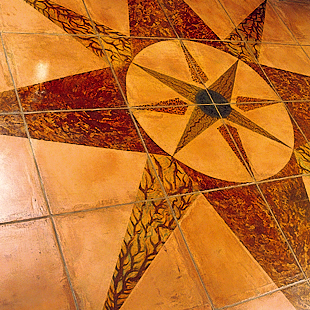
photo by David N. Seelig
art beneath
our feet
decorative concrete
explodes in the valley
by Megan Thomas
Take a look at your feet. No, not your Snow Clogs or Manolo Blaniks. Look a little further, the stunning marbleized stone, terracotta tile or intricate Southwestern inlays under your toes may not be what you think. The floor may be plain, old, ordinary concrete.
In the Wood River Valley, concrete has become sought after decorative art. Indoor concrete graces homes and businesses throughout the valley, capitalizing on beauty, durability and environmental advantages.
Endless artistic possibilities emanate from concrete. The material transforms to appear as tile, stone or brick and metamorphoses into art. Wood River Valley architect Michael Doty believes the “amazing amount of things possible” account for decorative concrete’s rise in popularity.
John Nasvik, a master of architectural concrete and owner of Cliffhangers Inc. in Hailey, has created concrete floors with everything from a traditional wood flooring look to a more cosmic design.
Nasvik and Hailey’s recently self-taught concrete artist Don Yeager express their talents on floors throughout the valley. Each brings an artistic background and eye for design to the effort. Yeager calls his business “Floor Art,” expressing that those who work with decorative concrete are nothing less than artists experimenting with a new, expansive and functional medium.
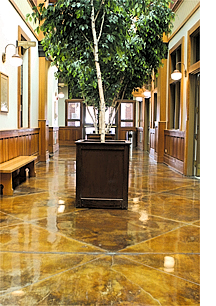
Designers like Nasvik and Yeager manipulate concrete to look like traditional materials such as tile, slate or brick. Nasvik’s work at Hailey’s E.G. Willis building incorporates varying rustic earth tones, a glossy finish and grout inlays to achieve the look of marbleized tiles.
 The
foyer of the E. G. Willis Building in Hailey features concrete art by
John Nasvik. photo by David N. Seelig
The
foyer of the E. G. Willis Building in Hailey features concrete art by
John Nasvik. photo by David N. Seelig
The hallways of the nearby Pine Street Station also appear as stone, though they are strikingly different from those in the Willis building. Nasvik stamped the monochromatic hallways with a rough stone texture and a systematic grouted pattern, which disguises the floor as brick walkways.
The spectrum of finishing possibilities opens the door to endless design possibilities. Nasvik once installed a complex, deep space design complete with sprinklings of starry gold dust. Yeager, for his part, recently completed a massive eight-point starburst on the studio floor of Jim and Evelyn Phillips’ Hailey home with colors inspired by Jackson Pollock. In a West Ketchum home, Yeager created a Southwestern motif to match a piece of furniture.
Stamps enhance concrete art by adding texture and detail. The grout patterns of tile, the texture of flagstone or the grain of wood become reality with stamps. The textured corridors in the Thunder Spring complex in Ketchum contribute to the rustic appearance and overall beauty of the flooring. Stamps may also be used to create images such as animal footprints or Native American petroglyphs.
Recent trends embrace the natural coloring potential of concrete. According to Doty, trends in decorative concrete are moving to “let it be,” utilizing the organic palette of colors possible with the acid stain coloring technique.
Acid staining capitalizes on the chemical composition of concrete to produce a spectrum of colors. The metallic salts within the acid stain solution react with concrete’s hydrated lime (calcium hydroxide) compounds. Because concrete composition varies with each pour, concrete artists adjust colors according to the differing chemical gradients of the material. Essentially, decorative concrete is an alchemist’s art.
Yeager emphasizes the artistic approach to coloring. Colorists “build from light to dark, because you can never go dark to light, just like a painting.”
Nasvik works with concrete’s natural unpredictability by “bringing color in slowly,” adjusting the tones carefully and slowly.
In the context of decorative concrete, “slowly” is a relative term. Artists usually apply stains to cured concrete, severely limiting their time to experiment. Essentially, the concrete is poured from the truck, stamped, taped, colored, grouted, and then sealed. “When doing a design you must think of the end product, four or five steps ahead, and then work backwards,” Yeager explains. Designers have one shot to perfect the color and design. Nasvik describes installation as a “one step process.” The process leaves marginal room for error.
During the installation process architects and designers team to prevent excessive cracking. Doty explains that scoring or intentionally cracking concrete in control joints before the concrete settles into place limits spider cracking. Some cracking is inevitable, but then the effect may also be desirable. The cracks in the concrete floor at DiVine, a Hailey wine business, demonstrate how nature’s imperfections can contribute character. The cracks in the deep burgundy floor appear as if Nasvik intentionally installed them as a custom, heritage finish.
Though concrete floors attract consumers for their beauty alone, the durability, maintenance and energy advantages attract potential customers.
Foremost, concrete is durable, essentially, “bombproof” according to Doty. Concrete fails to show the wear and tear of carpet, wood or vinyl. The busy concrete corridors of the Marketron building in Hailey continue to resist heavy office traffic patterns. Durability makes for easy maintenance. Simply, the floors must be swept and washed; there is no need for waxing.
Attractiveness, durability and maintenance sell the floors themselves, and the environmental advantages solidify the decision. The floors conserve resources by eliminating extra building materials and conserving energy. With a large thermal mass, concrete holds heat for hours, making it an effective material for passive solar and radiant heating systems.
The striking beauty and functionality of decorative concrete floors has made way for the use of concrete throughout interior design. Nasvik has expanded his specialty to concrete countertops, vessel sinks, bathtubs, fireplaces, molding and doors. Now, concrete adorns homes from corridors to countertops.