| click here for the |
| front page |
| features |
| proctor,ruud+dollar |
| beyond boarding |
| bell,odmark+puchner |
| trinity springs water |
| arts |
| black+white photos |
| jack burgess |
| r.l. rowsey |
| living |
| yoga |
| decorative concrete |
| recreation |
| vO2 workouts |
| snowshoeing |
| dining |
| scotch |
| stews |
| calendar |
| winter 2003-2004 |
| to-do |
| sun valley essentials |
| listings |
| galleries |
| dining |
| fitness |
| equipment rentals |
| outfitters + guides |
| lodging |
| maps |
| ketchum + sun valley |
| local art galleries |
| the guide |
| last summer |
| advertising |
| about us |
| copyright |
|
Copyright
© 2003 Express Publishing Inc. All Rights reserved. Reproduction in whole or in part in any form or medium without express written permission of Express Publishing Inc. is strictly prohibited. |
|
Produced
& Maintained by Express Publishing, Box 1013, Ketchum, ID 83340-1013 208.726.0719 Voice 208.726.2329 Fax info@svguide.com |
|
The
Sun Valley Guide is distributed free twice yearly to
residents and guests throughout the Sun Valley, Idaho resort area
communities.
Subscribers to the Idaho Mountain Express will receive the Sun Valley Guide inserted into the paid edition of the newspaper. |

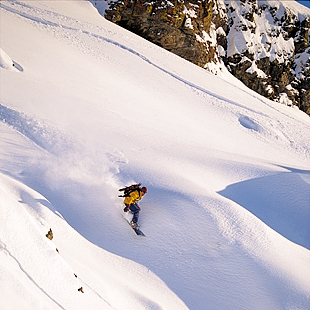
photo by David Wheelock
the next great wave
winter recreation moves
beyond snowboarding
by Elizabeth Sullivan
Despite its regal air, Sun Valley has always been on the cutting edge, if a more refined one, of winter recreation fun. Imagine the daring of those first intrepid skiers who ventured to the wilds of Idaho to ski in 1936. They first entrusted their lives to a chairlift—the first of its kind in the United States—then descended the slopes on long wooden skis fixed firmly to their feet with leather straps.
Sixty-seven years later, the feats of daring and fun have moved way beyond skiing, even beyond what used to be considered the hippest thing around: snowboarding.
Give a kid—even a big kid—some snow, gravity and a little bit of time and astounding things can happen. Some of those astounding things comprise the next great wave of winter fun. The never-ending search for more fun and daring snowboarding feats, along with other newly discovered activities such as snowskating, kiteboarding, and snowbiking, are just a few examples of what the younger generation brings to the sports world of Sun Valley.
Believe it or not, snowboarding is almost 40 years old. It was 1965 when the first “Snurfer” was built by Sherman Poppen, a chemical gases engineer from Muskegon, Mich. After his daughter Wendy had made many attempts to “surf” her backyard hill on her sled, he bound two skis together and tied a rope to the nose so the rider had some stability. With much demand from his daughter’s friends to have more made, Poppen licensed his new-fangled product and sold more than half a million in 1966.
Snowboard designs have come a long way since their inception and, because of the advanced technology, riders are able to perform an incredible variety of tricks. The evolution of terrain parks has also raised the level of boarding skills.
The level of skill snowboarders achieve today is beyond what their predecessors imagined possible, and the terrain snowboarders ride is far from the old slalom style common in the beginning.
Boarding terrain design has evolved in step with improvements in equipment.
Mark Anolik discovered the Tahoe City Halfpipe at the town’s dump back in 1979, and from that raw snow-covered structure Super Pipes with walls 15 feet high have gracefully evolved.
In 1990, Vail opened the first snowboard park that was “in-bounds” with a variety of snow-packed jumps, hips and spines challenging riders to attempt ever more complex moves. However, in recent years, many are realizing that riders are only able to push the limits so far.
 photo
by Karl Weatherly
photo
by Karl Weatherly
Up to now the progression of snowboarding as far as tricks are concerned has been rather cliché,” Pat Bridges, editor of Snowboarder magazine points out. “Let’s add another 180 degrees to a spin or let’s go higher and farther etc ... With the physical boundaries quickly becoming evident, a refinement of style and the use of creativity is becoming the defining factor.”
Many youngsters are aspiring to achieve the tricks viewers witnessed Ross Powers, Danny Kass, JJ Thomas, Kelly Clark and others from the U.S. Olympic team pull off at the Salt Lake City 2002 Games. And many want to mimic what the pros are doing in terrain parks with jumps and hips, as well as jibbing (sliding on rails and other edged structures on/off the slopes).
“What tricks aren’t the kids aspiring to?” asks Bridges. “1080s, 30 stairs, 70-foot tables … if it is being done on a snowboard, odds are it is probably being done by a kid. Riders who are younger than 8 years old are lining up for the biggest jumps to do the most technical tricks alongside veteran pros.”
Many tricks seen today are derived from skateboarding and combined with surfing styles. The basics begin with stance or positioning on the board—regular foot (if left foot is forward) or goofy foot (right foot forward).
 The
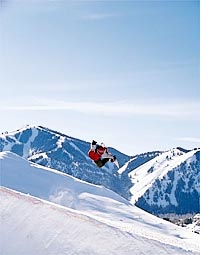
Sun Valley Company built its first halfpipe on Dollar Mountain in 1999.
However, in response to increasing demands from snowboarders on its
bigger mountain, Baldy, the company has built a new halfpipe on the
Lower Warm Springs run. photo by David Wheelock
The
Sun Valley Company built its first halfpipe on Dollar Mountain in 1999.
However, in response to increasing demands from snowboarders on its
bigger mountain, Baldy, the company has built a new halfpipe on the
Lower Warm Springs run. photo by David Wheelock
Ollies (hopping over objects), jumping frontside and backside 180 airs, an alley-oop (spinning in the air, the opposite direction from your takeoff), and going fakie to forward are some of the fundamentals to the more difficult tricks. Eventually, riders hone in these skills to graduate to tricks such as a rodeo flip (an inverted corkscrew flip), a McTwist (a backside 540-rotation/spin invert on the backside or heelside wall of the halfpipe), or a 1080 (three full rotations, spinning). Most of the more difficult acrobatics are performed in the halfpipe but many are achieved off of jumps at “in-bounds” terrain parks or in the backcountry.
But tricks are not for every boarder.
Many crave the deep power and naturally challenging terrain of the backcountry.
The backcountry, accessed by car, hiking and snowmobile, opens vast expanses of terrain locally in the Sun Valley area and over Galena Summit in the Sawtooth Mountains near Stanley. The next wavers seek first tracks and no crowds. And given the roots snowboarding has in surfing, both culturally and technically, it is no wonder boarders learned a trick or two from surfers. It couldn’t have taken very long for boarders watching big wave video clips with Jetskis towing surfers on to waves for them to realize the same could be done in the backcountry with snowmobiles.
And so began snowboard towing into the untouched Idaho backcountry powder.
“Snowmobiling access for skiing and snowboarding is the best-kept secret in all of winter sports,” states Mark Sullivan, former editor of Snowboarder magazine. Sullivan also emphasized the importance of learning avalanche safety for anyone venturing out of bounds.
If aerials and powder boarding don’t get your heart rate up, how about snowskating, kiteboarding or snowbiking?
“Snowskating is great because it’s something someone can do while either on or off the slopes. It’s cool since you can skate around your neighborhood, too, as long as there’s snow,” says Evan, a 16-year-old skateboarder/snowboarder.
The snowskate design, similar to a skateboard, has a single ski attached underneath the board. Many companies, including Premier Snowskates, Bideck, Burton and Mervyn, have developed improvements in their snowskate designs and their popularity is spreading rapidly.
At the last Winter X Games IV in Aspen, Colo., the Premier Snowskate Team, including pro-snowboarders such as Jeremy Jones, JP Walker and Jason Borgstede, gave daily demos in the park in addition to competing in the EXPN Snowskate Best Trick contest. And the first-ever U.S. Open of Snowskating was held July 5 at Mount Hood in Oregon.
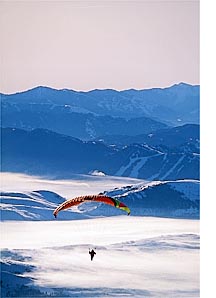
Sailing anyone? Kite-snowboarding is a new sport literally taking off around the country.
“Kite-snowboarding is the perfect crossover from kite boarding, for winter,” according to Wind Warriors Web site. “There are more snow-covered lakes and fields in North America than ski slopes. And best of all they’re free. By using a para-foil or an inflatable kite as a sail to pull you, you can snowboard on any snow-covered area providing you have space and wind. The direction of travel is just like sailing, traveling 90 degrees to the wind direction, tacking and jibing as needed and ending where you started.”
This may not be for the faint at heart, but for those thrill-seekers, it is a great sport to try.
Still another next wave activity is snowbiking. The sport allows mountain bikers to continue their rides throughout the season utilizing permitted snow trails and downhill terrain park courses.
“It’s getting more popular,” says Bart Davis of Backwoods Mountainsports in Ketchum. “There’s no reason to put your bike away for the winter. It’s beautiful and a great way to ride. You need the right tires for your bike, but we have studded tires for the slick conditions.”
You may also need more layers of outerwear, but for those unwilling to give their bikes a winter respite, it’s another way to take in the winter beauty.
Wheels, wind, skates, halfpipes and terrain parks: These are just the tools of the industry these days. What really moves it forward is imagination and, of course, the allure of adrenaline. Every year it seems improbable there could be something new to do in the snow. But then the first snow falls. Little minds start to dream. And a world of possibility opens up.
sun valley's new
halfpipe debuts
With more than 17.1 million snowboarders strong in the United States, this market is no longer ignored but rather embraced by retailers and resorts across the country. Sun Valley is no exception.
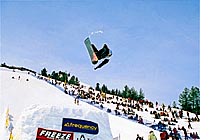 SolFest,
held in March on Bald Mountain, draws thousands who watch skiers and
snowboarders take big-air tricks to a new level. The event draws not
only the most daring youngsters from the valley, but also a contingent
of professionals who seem not to flinch at launching off a house-size
jump. photo by David N. Seelig
SolFest,
held in March on Bald Mountain, draws thousands who watch skiers and
snowboarders take big-air tricks to a new level. The event draws not
only the most daring youngsters from the valley, but also a contingent
of professionals who seem not to flinch at launching off a house-size
jump. photo by David N. Seelig
Focused on being the destination of choice, Sun Valley Resort introduces its first halfpipe for the 2003-’04 season. The halfpipe on Lower Warm Springs is about 400 feet in length, 12 feet high and 40 feet wide.
The growing number of youngsters who snowboard can drive visitor counts for a resort, since many families’ vacation decisions depend on what’s most suitable for the kids. A terrain park is key.
“It’s an attraction and (it) will draw people here,” says Andy Gilbert, snowboard director of the Sun Valley Ski Education Foundation. “Parents use their kids’ happiness as a deciding factor when making a decision on where to vacation.”
Don Wiseman, director of the Sun Valley Ski Education Foundation, agrees.
“It’s moving in the right direction,” says Wiseman. “That’s the market that needs to be tapped and kids are a big part of it.” However, winter sport sales and its economic impact on the community depend on the amount of visitors drawn to this area during a season.
SolFest, held in March on Bald Mountain, draws a larger crowd every year. More than 2,000 people gather to witness the big-air tricks riders put on display with the help of Snow Park Technologies’ terrain builders. Many more sponsors are expected to participate this coming season.