| click here for the |
| front page |
| features |
| proctor,ruud+dollar |
| beyond boarding |
| bell,odmark+puchner |
| trinity springs water |
| arts |
| black+white photos |
| jack burgess |
| r.l. rowsey |
| living |
| yoga |
| decorative concrete |
| recreation |
| vO2 workouts |
| snowshoeing |
| dining |
| scotch |
| stews |
| calendar |
| winter 2003-2004 |
| to-do |
| sun valley essentials |
| listings |
| galleries |
| dining |
| fitness |
| equipment rentals |
| outfitters + guides |
| lodging |
| maps |
| ketchum + sun valley |
| local art galleries |
| the guide |
| last summer |
| advertising |
| about us |
| copyright |
|
Copyright
© 2003 Express Publishing Inc. All Rights reserved. Reproduction in whole or in part in any form or medium without express written permission of Express Publishing Inc. is strictly prohibited. |
|
Produced
& Maintained by Express Publishing, Box 1013, Ketchum, ID 83340-1013 208.726.0719 Voice 208.726.2329 Fax info@svguide.com |
|
The
Sun Valley Guide is distributed free twice yearly to
residents and guests throughout the Sun Valley, Idaho resort area
communities.
Subscribers to the Idaho Mountain Express will receive the Sun Valley Guide inserted into the paid edition of the newspaper. |


photo courtesy Sun Valley Company
(above: “Betty Weir Bell, Omaha, Neb., races for home in the downhill heat of Sun Valley’s 1951 Harriman Cup. Miss Weir went from beginner to Olympic team member in four years’ skiing at the Union Pacific Resort.” — Steve Hannagan, director, Sun Valley News Bureau.)
at home in
the mountains
Betty Bell, Leif Odmark & Phil Puchner
by Tina Cole
This is not an accolade about age. Age is not a factor as far as these individuals are concerned. They are true mountain legends and comprise our history and connection with skiing and climbing in Sun Valley. They are recognized not for their longevity but their wealth of spirit and experience in the mountains they have called their home for decades. Each one has shared his or her passion and knowledge with more individuals than either could ever imagine.
If you have spent any amount of time in Sun Valley and have not heard about Betty Bell, Leif Odmark and Phil Puchner, you have probably seen them numerous times and just didn’t know it. They might have been downhill skiing on Baldy, cross-country skating the Galena trails, telemarking on Durrance Mountain or climbing in the Sawtooths.
Let me formally introduce them:
Betty Bell
Betty Bell is possibly the most elusive of a very evasive group. She is a no-nonsense, to-the-point and out-the-door to go do something kind of person.
Bell has long been applauded for her rather unusual contribution to the Sun Valley Ski Education Foundation’s “A Cook’s Tour of Sun Valley” printed in 1972. Amidst the lavish recipes one can find Bell’s “non-cook” recipe for cornflakes. This is good reading and important for understanding the essence of what makes Bell tick. She is hands down, one of the wickedest wits alive on or off her skis, bike or feet.
Bell, unlike her four children, was not born in Sun Valley. Betty Weir grew up in Omaha, Neb., where she played any sport that was available to her. In December 1946, she arrived in Sun Valley determined to learn how to ski after seeing a movie or reading a book about it. She worked in the Sun Valley Drugstore as a soda jerk and was taught how to ski, she says, “by at least a million people.”
Six years after her arrival in Sun Valley, Bell was selected for the U.S. Alpine Ski Team and went to Oslo, Norway, to compete in the 1952 Winter Olympics where Andrea Meade Lawrence won two gold medals. Bell’s specialty and favorite event was, of course, the downhill.
While in Oslo, Bell had her first exposure to Nordic skiing and thought it a “stunning thing.” She remained heavily involved in Alpine racing and skiing until 1960 and then spent three to four years perfecting her form on Nordic skis. By the early 1970s, Bell, always a few steps ahead of the times, started the cross-country ski school at what is now the Bigwood Golf Course. She was the first person to charge money for setting tracks for cross-country skiing in Sun Valley. Some people were incensed at the $1 per day fee, but Bell insists it was a whale of a deal. She considered it, “The worst job I ever had,” single-handedly” operating a Neanderthal snow machine” that hauled a luggish 75-pound tracker famous for keeling over and getting stuck.
When ski season ended Bell mastered other sports like golf and tennis and then settled into trail running in the 1970s just before the huge running craze hit. Bell started exploring new running trails and measuring their distances. In 1984, Bell’s “Big Little Trail Book” appeared in local bookstores and sports shops, and is still a wonderful reference book with accurate directions and wry advice for local runners, hikers and mountain bikers. It is also very funny.
In 1983, Bell traveled to Nepal with several ski patrol and skiing friends from Sun Valley to trek the Annapurna circuit before it became a popular adventure trek. Undaunted by sacred cows used for the most unimaginable ablutions, funeral pyres roaring amidst a party atmosphere and a covert friendship with a stray dog that loyally followed her along a vast majority of the trek, Bell endeared herself to the toughest of the Sherpa staff: Mr. Nawang and his cook boys. These hardy souls would be the first up and out of camp in the early morning and the first to reach the next lunch spot or campsite. Their pace was blistering and it suited Bell just fine. She was the first up and over the Thorong La Pass at 18,000 feet and the first to arrive in camp at Muktinath, after a steep 6,000-foot descent.
Bell remains a proponent of cross-country skate skiing. For several years she got into skate skiing without poles and could do the hilly, Sun Valley Gun Club loop at a steady pace. Until this past winter, she enjoyed getting up early to hike Baldy on her trusty Fischer randonnée skis and descend via a perfectly groomed run. Last season was the first time she couldn’t skate or randonnée ski due to a sore leg. But this did not keep her off skis entirely. Bell jumped back into using classic diagonal tracks and double poled her way through the entire winter. She said it made her “really strong and was a really great upper body workout.”
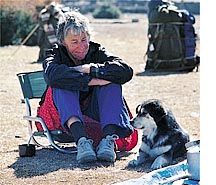 Bell
on the Annapurna circuit in Nepal in 1983.photo by Tina Cole
Bell
on the Annapurna circuit in Nepal in 1983.photo by Tina Cole
Bell continues to lead a Renaissance existence. She has always been a writer and great reader. She would modestly insist that she just “dabbles” at it, but if you ever read her “Small Potatoes” column in the Mountain Express, you might find yourself getting hooked and becoming a fan of her prose, looking forward to the next article with great glee.
Oh yes, Bell is also a professional pilot and flew light, twin engine aircraft for Sun Valley Aviation and private clients for 25 years, but that is another story.
Saying Betty Bell or any of the others mentioned here like to be outdoors is an understatement verging on laughable. Bell does not have an agenda or special sports program or tally of what she does and how much. She simply does something every day. She considers this the best physical and mental health prevention plan around.
“People wouldn’t have to take all those little pills if they got out more,” she says. Bell is amazed “how little people in our country get out and move around and recreate,” especially as they age. No worries about Bell, she is out going for it on a daily basis. Should you catch a glimpse of her, it just might inspire you to go out and ride your bike to work or try skiing something more challenging or try something new and adventuresome like she has inspired many others to do over the years.
Leif Odmark
“Mr. Sun Valley,” as he has been called, is the highest profile of this distinguished assemblage. It would take a book to describe all of Odmark’s adventures and experiences. Luckily, Odmark wrote and published his memoirs, “Sun Valley Memories,” in 2002. It is well worth the price for its incredible collection of vintage Sun Valley photographs and stories.
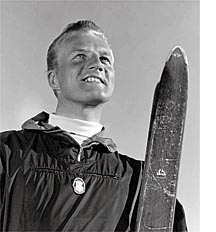 Shortly
after he arrived in Sun Valley in 1949, Leif Odmark went from ski
patrolman to ski instructor to coach for the U.S. Alpine Ski Team in the
1952 Winter Olympics. photo courtesy the Community Library, Regional
History Dept
Shortly
after he arrived in Sun Valley in 1949, Leif Odmark went from ski
patrolman to ski instructor to coach for the U.S. Alpine Ski Team in the
1952 Winter Olympics. photo courtesy the Community Library, Regional
History Dept
Odmark was born in Sweden, the son of a textile manufacturer. After World War II, Odmark arrived in the United States circa 1948 to play semi pro soccer and ice hockey for the Swedish Viking Club in Chicago. One night, Odmark watched the movie “Sun Valley Serenade,” and soon after made his way to Idaho. Nelson Bennett, the director of the ski patrol, hired Odmark on the spot and within the year Sepp Froelich from Sun Valley’s Ski School coaxed Odmark to switch over and teach alpine skiing, which he did for the next 22 years.
In 1951, Odmark was selected to coach the U.S. Ski Team in preparation for the Oslo Winter Olympics. Odmark arranged for three months of dry-land and on-snow training in Sun Valley. Odmark was later a Goodwill Ambassador to the 1972 Winter Olympics in Sapporo, Japan, where he introduced a revolutionary new ski pole of his design for cross-country skiing, manufactured by Scott USA.
In 1970, Odmark started the Sun Valley Nordic Ski Center on the Sun Valley Golf Course and was director and principal owner until 1988. When Odmark sold the center to Sun Valley Company, current owner of the Sun Valley Resort, he was awarded the first and highly coveted “Lifetime Gold Pass,” good for all recreations in Sun Valley for the remainder of his life. Odmark is the perfect recipient for a lifetime ski, Nordic, golf, tennis and swimming pass. It has been well utilized.
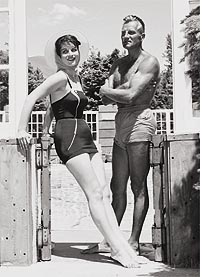 Odmark
in 1960 poses with Mrs. Paul Gregoire outside the Lodge pool in a
publicity photo for Sun Valley Company. photo courtesy Sun Valley
Company
Odmark
in 1960 poses with Mrs. Paul Gregoire outside the Lodge pool in a
publicity photo for Sun Valley Company. photo courtesy Sun Valley
Company
Odmark ran seven marathons during his long sports career. The first was in Sun Valley in 1980 and, in 1982, he ran his best time of 2:57:11 and set the course record in the St. George, Utah, marathon. He won his 60 to 64 age group in that race and was made an All American for his effort. In 1983, Odmark was invited to Greece to run in the original marathon, first held in 1881, and placed an impressive third.
Well into his 70s, Odmark continued racing in the Masters Alpine Skiing Championships and finally decided to have both knees replaced simultaneously, with great success.
“A positive attitude is a key ingredient to happiness and success in life,” says Odmark.
In 1990, the Sun Valley Ski Club initiated “Leif’s Race,” a combined format of giant slalom racing on Baldy in the morning followed by a 5K cross-country race in the afternoon. The race is open to men and women of all ages.
Odmark thinks it is important to reward young athletes for good sportsmanship. Each year, a boy or girl from the Sun Valley Ski Education Foundation and the Hailey Ski Team is selected as the most inspirational athlete with a positive attitude by coaches who have worked with them during the winter. It is a great honor to receive the Leif Odmark Sportsmanship award presented to its recipients at year-end ski team banquets by Odmark.
In October 2002, Odmark was inducted to the Northwest Ski Hall of Fame for his remarkable lifetime of achievements and contributions to the sport of skiing. He continues to inspire others with his great will, determination and love for life.
Phil Puchner
Phil Puchner was born in Wisconsin, where he says he “learned to ski a little bit,” and went on to college at Dartmouth, where he learned how to ski a lot more. He first skied Sun Valley while racing with the Dartmouth team in the 1941 Collegiate Championships. He won a third place in jumping.
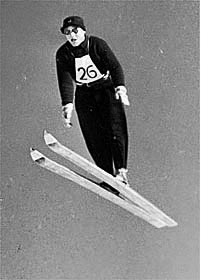 Phil
Puchner in 1941 on Ruud Mountain. photo courtesy Phil Puchner
Phil
Puchner in 1941 on Ruud Mountain. photo courtesy Phil Puchner
During World War II, Phil was a member of the 10th Mountain Division and went to Camp Hale, Colo., for his training. The war over, Puchner finished his schooling and tried out for the 1947 U.S. Olympic Team. He didn’t make the squad, but he did spend two summers climbing in Wyoming’s Teton Range—getting up everything except Mount Owen.
One summer following a Salmon River float trip with an uncle, Puchner visited Sun Valley. He never left. He stayed and worked on trail crews with Nelson Bennett, helping to widen the College ski run and cut the cat track to the Roundhouse on Bald Mountain. The logs from his trail crew work on College were hauled to the top of Baldy to build the ski patrol shack, which is still in use.
Puchner spent that first winter of ’47 working on ski patrol primarily, he claims, “to ski behind Daryl Zanuck (head of the Twentieth Century-Fox Studios in the 1930s) carrying a big box of cigars lest they get crushed when Mr. Zanuck took a crash.” Puchner went to Europe the following winter to ski, climb and explore the Alps and returned to the patrol in Sun Valley in 1950. From 1951 to 1959 he was a ski instructor.
Puchner’s background was in engineering, and in 1959 he went to Nepal to oversee construction of a tramway, set up like a ski lift, for hauling freight from the Terai Plain to Kathmandu. He spent a year working on the Nepal project based out of a company in Twin Falls. He worked overseas on various projects in Thailand and East Pakistan until 1968. By 1969 he was back in Sun Valley teaching skiing and working for Jim Patterson’s engineering firm. In 1976, Puchner started Puchner Engineering and lived in a house on Warm Springs just above and to the west of the North Face Warming Hut, which served as the Warm Springs base access for Baldy.
That year was the “year of the drought,” so Puchner took up cross-country skiing and competed in his first American Birkiebiner, a 50-km race in Hayward, Wis., that is part of the esteemed Worldloppet International FIS Marathon Cup circuit. By 1977, Puchner had made the prestigious 25% Club with his speedy race times and went on to compete in 16 to 17 “Birkies.” His last race was in 1998; he came in third in his age class.
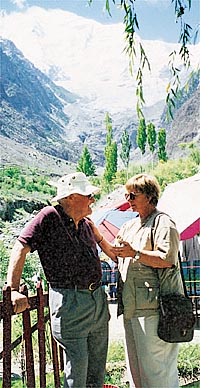 Phil
and Anne Puchner in the Karakorum region of Pakistan in the fall of
2000. photo courtesy Anne Puchner
Phil
and Anne Puchner in the Karakorum region of Pakistan in the fall of
2000. photo courtesy Anne Puchner
Puchner is an avid hiker and mountaineer. He spent many summers exploring the local mountains and found numerous remote areas he revisited over the years. He climbed in his early years and found special spots from reading Dick Durrance’s 1940 ski journals. Puchner remains active in the mountains and continues to travel frequently.
Last season, Puchner participated in the National Masters Cross Country Ski Championships in Anchorage, Alaska. In March 2003, just as the Iraq war started, Puchner went to Peru and visited the Incan ruins of Machu Picchu, Ollantaytambo, Moray and other sites with his wife Anne and a Peruvian guide familiar with the engineering principles of the ruins. This past autumn the Puchners were back in Europe traveling and, upon Phil’s return, most likely he will be out skiing the North Valley and Galena Trail systems again this winter.