| click here for the |
| front page |
| features |
| mountain goats |
| disabled skiers |
| ski bums |
| arts |
| dogsled queen |
| encaustic painting |
| art glass |
| living |
| small spaces |
| spas in the home |
| recreation |
| hallway of stars |
| nordic skiing |
| ski boots |
| winter from a to z |
| dining |
| martinis |
| organic beef |
| calendar |
| winter 2002-03 |
| listings |
| galleries |
| fitness |
| equipment rentals |
| lodging |
| property mgmnt. |
| outfitters & guides |
| maps |
| ketchum+sun valley |
| north valley trails |
| art galleries |
| the guide |
| last summer |
| advertising |
| about us |
| copyright |
| Copyright
© 2002 Express Publishing Inc. All Rights reserved. Reproduction in whole or in part in any form or medium without express written permission of Express Publishing Inc. is strictly prohibited. |
| Produced
& Maintained by Express Publishing, Box 1013, Ketchum, ID 83340-1013 208.726.0719 Voice 208.726.2329 Fax info@svguide.com |
| The
Sun Valley Guide is distributed free twice yearly to
residents and guests throughout the Sun Valley, Idaho resort area
communities.
Subscribers to the Idaho Mountain Express will receive the Sun Valley Guide inserted into the paid edition of the newspaper. |

Small
spaces,
big ideas
by Gregory Foley
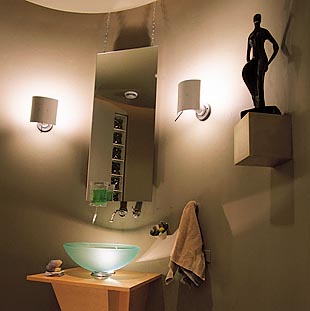
Every home has at least one small, remote space that beckons to be brought to life.
These spaces, all shapes and sizes, hide in varied locations of each home, hillside mansion or quaint Victorian. These corner closets, foyers and other nooks and crannies, often a leftover of design and construction, may seem at first estimation too small or too awkward to be genuinely useful.
With the help of discerning architects and designers, more and more homeowners are discovering that bigger is not always better, and a concealed garret or a leftover slice of a stairwell can become one’s chosen spot to relax, read or tackle a pile of paperwork.
Professional architects and interior decorators are the first to say that these extra niches offer a bounty of opportunity.
“Many times there are these odd little spaces that are left over in a design, and they can be considered problems or, as I prefer, opportunities in disguise,” says architect Stephen Pruitt, owner of Architecture + in Ketchum.
 While some architects and designers may be content to relegate a home’s leftover hollows to
unremarkable storage areas, Pruitt says it is part of his mission to see each homeowner make the best use of even the smallest spaces that come as a product of a larger design.
While some architects and designers may be content to relegate a home’s leftover hollows to
unremarkable storage areas, Pruitt says it is part of his mission to see each homeowner make the best use of even the smallest spaces that come as a product of a larger design.
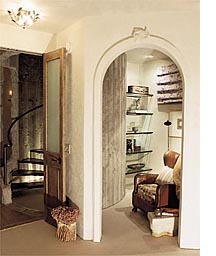
In drafting a remodel of the north Ketchum home of Alan and Wendy Pesky, Pruitt helped the homeowners design a cozy, quiet reading room out of an odd-shaped alcove adjacent to a stairwell. Accented with a single lounge chair, wall-mounted shelves adorned with artifacts and a combination of ceiling- and floor-mounted lighting, the room has become a favorite place in the home for quiet relaxation, Wendy says.
Given the project’s success, Pruitt was later commissioned to design an addition to the house that included a unique room set into a seemingly unusable space below an expansive deck overlooking the Big Wood River. Pruitt planned a fully functional office, separated from the rest of the home, which is now Alan’s preferred place to work and contemplate ideas.
“It provides the perfect amount of privacy,” Alan says. “It’s part of the house, but it’s not part of the house.”
Pruitt believes the best uses of small spaces are those focused on a particular function, and in some cases, dual functions that are compatible. He notes that small spaces, unlike their larger counterparts, can by their shape and design dictate how they will be used.
“The functional needs of the homeowners, in some cases, adapt to the physical spaces,” Pruitt says. “Normally, it’s the other way around.”
 Indeed, function is the most important element to consider in turning a small space into an attractive, integrated part of the home.
“Keep it simple, uncluttered and functional,” notes Eldridge French, co-owner of Sagebrush Interiors and Gallery in Ketchum. “You can certainly strive to do something you haven’t done in the rest of the house, but it should serve some function.”
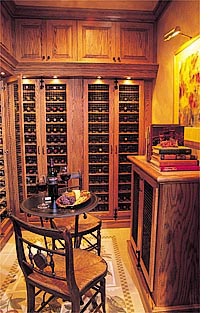
The most successful renditions, in their simplicity, boldly put forth their purpose, inviting the guest inside to take part in a particular activity. They include not only reading rooms and offices, but sewing rooms, play areas for children, entertainment centers, galleries, libraries, fly-tying rooms, finely appointed wine caves, ski-storage closets, exercise spaces and game rooms.
Traditionally, interior designers have held that a certain set of guidelines should apply when remodeling or decorating small spaces. Conventional wisdom has dictated that “less is more” when decorating a small area, demanding that homeowners limit the use of accessories and clutter. Typically, it also suggested that decorators employ small patterns, install soft, even lighting to eliminate shadows and avoid using furniture or decorations that do not satisfy some primary function.
Interior designer Nanci Warren, proprietor of Ketchum-based Collage Interior Design and a professional member of the American Society of Interior Design, agrees that furnishings for such spaces must serve an obvious purpose, but otherwise believes that commonly cited rules need not always apply.
“The best advice I can give anybody for a small space is to have pieces of furniture that serve a dual purpose,” she says. “But I wouldn’t say that everything has to be light. If it’s appropriate, it can be dark, cozy and warm.”
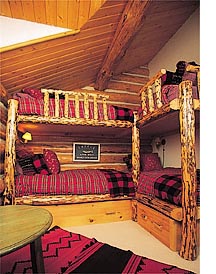 Warren recommends that homeowners employ small pieces of furniture that can be easily moved around or “folds up and goes away.” She particularly likes to integrate modern office furniture and Murphy beds that can add an extra function to a small room when needed.
Furthermore, sofas should be convertible, to double as a bed, and tables should have drawers to double as a nightstand for overnight guests, Warren suggests.
“Everything should have a purpose in a small space,” she says. “Avoid clutter, and keep things organized.”
Warren advises that homeowners look for ways to incorporate storage into empty spaces, and not be afraid to get creative.
“I wouldn’t hesitate to use a lot of color and fabric. It’s already small, so it’s not about making it look bigger,” she says. “Perhaps even paint the walls a color you wouldn’t want to paint anywhere else in the house.”
Warren warns against using furniture that has long legs (it wastes space), oversized furniture and heavy draperies or window coverings. Otherwise, homeowners should not feel bound to follow certain rules.
Like Warren, architect Tobin Dougherty, founder of Ketchum-based Tobin Architects, also maintains that small spaces are best used when they employ more than one function.
“Particularly in smaller homes, it’s best to have a floor plan with rooms that double-up for different uses,” he says.
Dougherty, who focuses on designing elegant but practical homes, many of which are small, says the best uses of small spaces conform to the ranging needs of the homeowners, as well as their families and guests. A house in Capitola, California, designed by Dougherty and featured in Better Homes and Gardens magazine, includes a diminutive 64-square-foot loft bathed in natural sunlight, which serves as a multi-purpose office, library and reading room.
In the same house, Dougherty designed a luxurious cold-storage pantry out of a supplementary space under the stairway.
Dougherty said he always looks for chances to create interesting, small spaces in a home design and particularly likes incorporating rooms that allow one family member to work privately without being completely isolated.
Good design, Dougherty says, does not mandate the use of big spaces or the expenditure of big bucks.
“You don’t have to have lots of money to have good design. It doesn’t necessarily cost more money; it just takes more thought.”•