| click here for the |
| front page |
| features |
| mountain goats |
| disabled skiers |
| ski bums |
| arts |
| dogsled queen |
| encaustic painting |
| art glass |
| living |
| small spaces |
| spas in the home |
| recreation |
| hallway of stars |
| nordic skiing |
| ski boots |
| winter from a to z |
| dining |
| martinis |
| organic beef |
| calendar |
| winter 2002-03 |
| listings |
| galleries |
| fitness |
| equipment rentals |
| lodging |
| property mgmnt. |
| outfitters & guides |
| maps |
| ketchum+sun valley |
| north valley trails |
| art galleries |
| the guide |
| last summer |
| advertising |
| about us |
| copyright |
| Copyright
© 2002 Express Publishing Inc. All Rights reserved. Reproduction in whole or in part in any form or medium without express written permission of Express Publishing Inc. is strictly prohibited. |
| Produced
& Maintained by Express Publishing, Box 1013, Ketchum, ID 83340-1013 208.726.0719 Voice 208.726.2329 Fax info@svguide.com |
| The
Sun Valley Guide is distributed free twice yearly to
residents and guests throughout the Sun Valley, Idaho resort area
communities.
Subscribers to the Idaho Mountain Express will receive the Sun Valley Guide inserted into the paid edition of the newspaper. |

To Live and Ski
in Sun Valley
Is there anything else?
by Greg Stahl
The ski bum is a mythic figure, a mountain-town archetype representing a passion for adventure, a flare for the outdoors and a desire, above most anything else, to ski. For decades, Sun Valley’s famously consistent slopes and legendary status among ski areas has attracted ski bums from around the world. Some, like Warren Miller (Warren Miller Entertainment) and the late Ed Scott (Scott USA), went on to become major forces in the ski industry.
But the ski bum’s perch in ski country is becoming increasingly tenuous. As the cost of living, lift rates and ski equipment price tags continue to rise, the number of people able to afford the lifestyle outright is melting like spring corn under a hot, May sun.
“The days are over,” lamented longtime Sun Valley ski bum Mike Brunetto, who owns Wolf Ski in Ketchum. “We used to be able to have three or four guys in a house that cost $400 a month. Those guys skied 120 days a year. They had enough money to pay the rent, buy a season’s pass and put food on the table. Now, it simply won’t work financially.”
But Miller, not to mention some of Sun Valley’s existing ski bums, disagrees.
“I don’t think that era will ever close,” Miller said. “How did you feel when you made that first turn? You’re smiling aren’t you? You remember it clearly, don’t you? Any experience that monumental, that easy to remember, has to be connected deep in your psyche. I personally believe that was your first taste of freedom. The search for freedom burns in every human being.”
Sun Valley has always been a magnet for young skiers anxious to take a semester off school or to buck society’s push to seek “real jobs.” The mountain-town alternative to societal norms, complete with 100-day ski seasons, can be very attractive.
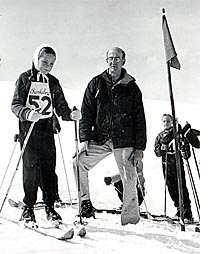 “I went up there (Sugar Bowl, Calif.) and I fell so in love with skiing and the entire way of life in a ski resort that I figured, ‘Well, that’s it for the rest of my life.’ And if I were going to do that, I thought the best thing to do was go to the top resort. In those days, it was Sun Valley with the possible exception of Aspen,” remembered Scott in an oral history on file at the Ketchum Community Library. As it turned out, that wasn’t it for Scott, as he would go on to become founder of Ketchum-based Scott USA and one of the first to make aluminum ski poles for popular use.
Scott, who was raised an Easterner and spent his first ski days in New England, was smitten with the Wood River Valley. He didn’t make it to Sun Valley until the late 1940s, but, once here, contributed significantly to the shaping of the sport and of the Sun Valley community.
“My only regret is that I didn’t get here before World War II, because that, I think, was the real marvelous time,” Scott recalled.
Sun Valley’s aura hasn’t changed much since its early days, during which Scott considered the place “a fairyland ... like Shangri-La in the middle of nowhere,” but its price tag has, agreed some of the area’s most long-standing ski bums.
“To me, it’s the ski area if you’ve got the money,” said longtime ski bum Bobbie Burns, founder and owner of The Ski and more recently the owner of Bobbie Burns women’s fashion stores in Ketchum and Park City. “It’s a country club. We’re spoiled.”
Despite cost obstacles, the devoted ski bum always seems to find a way to make ends meet while continuing to notch skis with 100-day seasons.
Miller, of ski movie fame and one of Sun Valley’s most well known ski bums, said his days spent living out of a camper in the resort’s parking lot were “arguably some of the best times in my life.”
To fulfill his part in the ski bum’s constant quest for minimal work and maximal ski time, Miller, in the winter of 1974, conjured one of the strangest successful business ventures of his career.
“I had found some Army surplus parachute shroud and discovered I could use it for my ski boot laces. One pair lasted all winter long. Cotton laces in those days would last two weeks at the most. I realized I was on to something revolutionary.”
Improvising with grocery store Rit dye and hiring friends to help burn ends and dye cord, Miller converted an $11 roll of nylon into nearly $4,500. “I think the word ski bum, in my particular case, means more of a winter entrepreneur,” he said. “I’ve always had my hand in something.”
Scott USA had similar beginnings and a drastically different ending.
In 1958, after 11 years working as a ski technician in Sun Valley, Scott, a self-avowed ski bum, created a hollow, tapered aluminum ski pole shaft with a wide diameter and thin walls. At the time, ski poles were made from wood and were comparatively heavy.
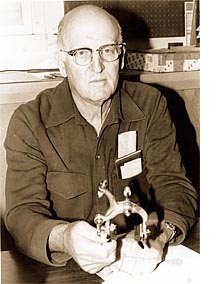 “And then I realized I was on to something good,” he said. “And I thought, ‘Well, what can I do? I have no money, no experience in manufacturing, and no experience in really running a large-scale business. But if I sit and do nothing, sooner or later one of the biggies in the ski business will see a pair of these poles and realize how easy it is to make them. And they’ll start making them. And then it’ll be too late for me.’”
Scott drove all over the West selling and marketing his lighter, metal poles, which came complete with molded rubber grips, another Scott innovation. In 1960, he painted his poles gold and sold pairs to competitors at the Squaw Valley Olympics for $17.95.
“And almost every shop I walked into, as soon as I handed them a pair of poles and spoke for about two minutes about them, why they just ordered a dozen, two dozen, four dozen. It was an instant success, marketwise.”
Despite rough beginnings, in which the company netted only $25,000 after 10 years of hard work, Scott USA has gone on to become an international success and a major force in the domestic ski and motocross industries. The company’s United States headquarters are still in Ketchum, and, though the ski pole market has shrunk in recent years primarily because of snowboarding’s rise in popularity, winter sports products continue to make up the bulk of the company’s sales.
One of the unfortunate pitfalls with Scott’s success, however, was that it severely limited the time the ski enthusiast was able to spend on the mountain.
“Yes, well, once I got in the ski pole business, forget the skiing. I did so little it was a joke. But it was an interesting business to be in.”
•
For other longtime Sun Valley ski bums, skiing is both the foundation of successful business ventures and a continuing lifestyle.
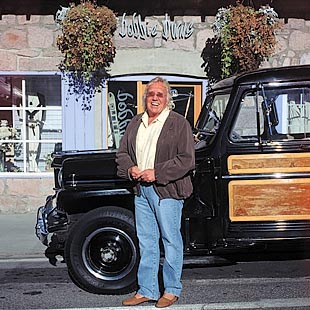
With a wild blond mane and a distinctive skiing style, Bobbie Burns has been a trendsetter, a fashion statement and a man ahead of his time in the world of skiing for nearly 40 years. And despite his 67-year-old knees, he continues to log 100-day ski seasons each winter.
He doesn’t only stand out on the hill. He shines in the business side of the sport, too.
His The Ski:
“It’s a conversation starter: ‘What kind of skis are those?’ ‘It’s The Ski.’ ‘The ski?’ ‘Yes. You know, The Ski.’”
The Ski was a staple in the freestyle skiing world in the 1970s.
 In his early years, Burns was a champion springboard diver and a ski racer. In the 1960s, no one could thread bumps like Bobbie Burns. His runs down Exhibition for the audience on the old single chair lift were “improvisational exhibitions of grace, precision and velocity in terrain where the three had not been combined before,” another longtime Sun Valley skier, Dick Dorworth, later mused. “His high-held hands, heel-swiveled turns and body gymnastics violated the tenets of traditional ski technique, and it is not too much to postulate that violating tradition was (and is) part of the fun for Bobbie Burns.”
It is also not too much to say that Burns essentially invented freestyle mogul skiing as it is now practiced and performed at the Olympic and World Cup levels.
“Bob Burns started freestyle, and I started the freestyle contest,” chuckled famed 1970s ski filmmaker Dick Barrymore during a recent visit to Burns’ Ketchum store. “The guy who looked most like Bob Burns won.”
In the late 1960s, Burns became the chief designer of racing skis for K2, and, by 1974, he knew enough about the process to build his own ski in his Ketchum garage. He called it The Ski and contends it was the first ski ever built in the Wood River Valley. With its presence in the winner’s circle in virtually every freestyle competition in America during the late 1970s, The Ski changed the face of freestyle bump skiing.
“We became a big deal in freestyle when freestyle first started,” he said. “But any more, we’re tiny. We do more research and development than anything else.”
These days, Burns designs skis and clothes in his office above the Bobbie Burns store on Sun Valley Road in Ketchum, where he sells both. The Ski
is made in Ketchum’s industrial park where special care is put into about 1,000 pairs a year. Each ski comes complete with sagebrush embedded in the clear P-Tex bases. It’s an attractive and imaginative touch.
Reflecting on his successes in skiing and in life, Burns said it’s easy to fall into things.
“Skis—I never dreamed I’d design a ski. Jogging clothes—I couldn’t find any baggy jogging shorts, so I designed some,” he said. “It’s hard to make a living here. You have to figure out how to make a living, and, maybe, leave a lot.”
And that is exactly how Burns has played the game. Since arriving in Sun Valley for the first time at the age of 14, he has left for college and to work in Seattle, New York, New Zealand and South America.
But, for now, Sun Valley is where he hangs his hat while making money from the clothes business and tinkering with skis. And he still skis every day on Bald Mountain, which he terms “the best mountain in the world.”
“I have to test skis, you know.”
•
For the truly devoted ski bum, skiing is an addiction that shapes a life’s course. When winter arrives, the ski bum has been known to drop everything, including professional or financial success, to heed the season’s call. Renowned ski designer and Sun Valley ski bum Mike Brunetto, 64, has learned the lesson repeatedly.
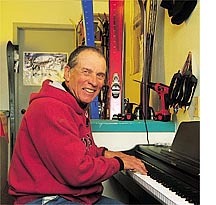 Brunetto arrived in Sun Valley multiple times, first in the mid-1960s after dropping out of college to pursue a career as a Sun Valley busboy. Later he arrived after landing a successful job for the Shell Oil Co., and still later after moving to Baltimore to build skis for Howard Head.
“I stayed one week,” he said of the Baltimore experience. “I said ‘Where are the mountains?’ I went in Monday morning and told Howard I couldn’t do the job.”
He worked for a spell for Head Durafiber in Carson City, Nev., “but that wound down to where it was kind of a regular job, 9 to 5, you know. So I wandered around the country some more, did nothing, and then ended up in Sun Valley.”
Still later, Brunetto moved to Ogden, Utah, to work for Burns’ The Ski, which had temporarily expanded. “Once again, I really couldn’t stand prosperity and came back to work for Sun Valley Co.,” he said.
And so the story goes for this man who can’t put Sun Valley or skiing in his past. Now, rather than fight Sun Valley’s magnetic pull, Brunetto is embracing it through his most recent business venture, Wolf Ski, which is based in Ketchum’s industrial area.
“I’m for sure a ski bum,” he said. “I only did this ski business thing so I could ski.”
Wolf is a small company that out-sources and markets about 800 pairs of skis a year. The company’s headquarters in Ketchum’s industrial park is open in the morning and evening. During afternoons, the Wolf Ski staff is busy testing products. But Wolf isn’t the first ski company Brunetto started.
After working a dizzying number of jobs, while skiing as much as possible, he eventually started Research Dynamics skis from his Ketchum garage. The company experienced dramatic growth through the 1980s, but the boom also drove him from the business.
“I suffered a bad case of the I wannas,” he said. “I wanted an airplane. I wanted a huge house. I wanted more and more success. I lost my way is what I did.”
Brunetto eventually sold his shares to one of his two partners. The company closed in the mid-1990s.
Brunetto’s reputation is that of being among the best, most respected ski designers and manufacturers in the world. He knows what he is doing, and good skiers seek out his skis, even though he downplays the significance of modern ski engineering.
“As long as you’ve got something on your feet that turns up at the front, it works,” he said.
Brunetto, who is one quarter Cherokee, has an abiding interest in Native Americans and named his first ski Makwai, the Blackfoot word for wolf. A later ski was named the Cold Smoke, a translation of the Blackfoot term for powder snow.
He is a Renaissance man whose interests and knowledge range from skiing and engineering to farming, physics, horses and music. He is an accomplished pianist and composer. He has worked as a wildcatter in oil fields, as a schoolteacher and as head of Sun Valley’s race department.
But in the end, the story goes full circle for Brunetto, returning to a man’s love of skiing.
“Out there in the ski world, there
are two kinds of people these days,” he said.
“There are lots of people who like to go skiing but don’t really like to ski. They don’t particularly like the event. I like skiing. I like it in bad weather, fog, rain, anything.”
•
For men and women who, despite economic obstacles, still flock to ski country each winter, the rewards are greater than the material world can possibly know, Brunetto said, recalling a recent encounter with an old friend.
He said his friend, who had recently retired from a successful city job and moved to Sun Valley to relax and ski, had mentioned how incredible mountain life is.
“I win,’” Brunetto said he told the old friend. “You can’t catch me. Even if you ski every day from now until the day you die, I will still have skied more days.”
“Here I am. I’m 64 years old now. I’ve got no money, but I’ve got a great life.” •