| click here for the |
| front page |
| features |
| mountain goats |
| disabled skiers |
| ski bums |
| arts |
| dogsled queen |
| encaustic painting |
| art glass |
| living |
| small spaces |
| spas in the home |
| recreation |
| hallway of stars |
| nordic skiing |
| ski boots |
| winter from a to z |
| dining |
| martinis |
| organic beef |
| calendar |
| winter 2002-03 |
| listings |
| galleries |
| fitness |
| equipment rentals |
| lodging |
| property mgmnt. |
| outfitters & guides |
| maps |
| ketchum+sun valley |
| north valley trails |
| art galleries |
| the guide |
| last summer |
| advertising |
| about us |
| copyright |
| Copyright
© 2002 Express Publishing Inc. All Rights reserved. Reproduction in whole or in part in any form or medium without express written permission of Express Publishing Inc. is strictly prohibited. |
| Produced
& Maintained by Express Publishing, Box 1013, Ketchum, ID 83340-1013 208.726.0719 Voice 208.726.2329 Fax info@svguide.com |
| The
Sun Valley Guide is distributed free twice yearly to
residents and guests throughout the Sun Valley, Idaho resort area
communities.
Subscribers to the Idaho Mountain Express will receive the Sun Valley Guide inserted into the paid edition of the newspaper. |

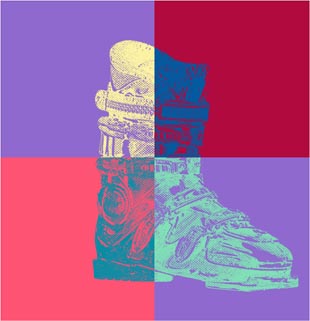
Finding
the
ultimate ski boot
The search for painless performance
by Greg Moore
Most people I talk to when I ride the lift say their feet hurt!” says Brent Hansen, owner of Ski Tek and Hansen Orthotics in Ketchum.
It is pain we need not suffer.
With manufacturers putting more emphasis on comfort, the ability of ski shops to re-contour boot shells and the availability of custom liners and foot beds, skiing can be a pain-free experience.
“All skis now are fantastic,” he says, “you can’t find a bad one. But boots need a custom fit.”
And, says Formula Sports owner Bob Gordon, for those searching for more comfort this is a good year to buy a pair of boots. Manufacturers across the board have added two innovations to their lines: soft boots and easy-entry boots. Even high-performance boots are getting more comfortable, with a little softer forward flex and more room in the toe area.
Olin Glenne, hard goods and service manager at Sturtevants in Ketchum, admits, “Boots are kind of a scary purchase.”
The first step in choosing a new pair of boots, he says, is to decide which models best suit your skiing style. Generally, the faster you ski, the stiffer forward flex you’ll want. The proliferation of ski boot models is mind-boggling—the catalogue of one manufacturer picked at random offers 33 models—but any one shop carries only a few of each brand.
Go to a ski shop that can provide you with an experienced boot fitter and describe your level of skiing and foot shape.
“Trusting the boot fitter is a big part of it,” Gordon says. “They’ll narrow it down to just a few boots to try on. It really isn’t as hard as many people think.”
Glenne adds that just because you didn’t fit well in a particular brand of boot a few years ago, it doesn’t mean you won’t now. “Fits change almost yearly for everybody,” he says.
Hansen says he begins the fitting process by removing the boot’s liner and making sure his customer’s foot closely follows the contours of the shell. That has become more difficult as manufacturers have reduced the number of sizes they offer: an effort to save money on expensive manufacturing molds.
Once a good match is found, fine-tuning is done with a custom foot bed and perhaps custom liner. Hansen, a certified pedorthist, builds foot beds from a plaster cast of his customer’s foot.
“If you have a good cradle in the bottom of the boot, it’s less important to have a liner that fits you like a glove,” he says.
A custom liner, however, can provide a better fit and more warmth.
“It has important insulating qualities, but what really makes it warmer is that it improves circulation by removing pressure points,” says Steve Ashburn, who imports Intuition Thermoflex liners from Canada. The foam liners, which are sold in most local ski shops, initially look like a limp Christmas stocking. They’re warmed in a special oven, then dropped into the boot. The owner inserts his or her foot while the liner cools around it. The liners cost between $160 and $180.
The last resort in fitting, says Mark Deffé, a salesman at Sun Summit Ski and Sports in Ketchum, is to heat and punch out the shell.
Deffé says other innovations are making boots easier to wear. For one, shaped skis don’t require as firm a forward flex as do the older skis. Then there are buckles that are more adjustable, some with extendable levers, that make getting in and out easier. Especially helpful in this regard are the new easy-entry models, which have a bigger opening and allow their sides to be pulled out of the way more easily. That little innovation alone should add years of skiing for older people whose joints have stiffened, Gordon says.
Probably the most important piece of advice offered by all the boot fitters interviewed is: Take your time choosing, and if the boots don’t feel right after skiing on them for a while, take them in for some fine tuning. Comfort is worth it. Good boots can last up to 10 years. Bad boots will seem to last an eternity.•