| click here for the |
| front page |
| features |
| mountain goats |
| disabled skiers |
| ski bums |
| arts |
| dogsled queen |
| encaustic painting |
| art glass |
| living |
| small spaces |
| spas in the home |
| recreation |
| hallway of stars |
| nordic skiing |
| ski boots |
| winter from a to z |
| dining |
| martinis |
| organic beef |
| calendar |
| winter 2002-03 |
| listings |
| galleries |
| fitness |
| equipment rentals |
| lodging |
| property mgmnt. |
| outfitters & guides |
| maps |
| ketchum+sun valley |
| north valley trails |
| art galleries |
| the guide |
| last summer |
| advertising |
| about us |
| copyright |
| Copyright
© 2002 Express Publishing Inc. All Rights reserved. Reproduction in whole or in part in any form or medium without express written permission of Express Publishing Inc. is strictly prohibited. |
| Produced
& Maintained by Express Publishing, Box 1013, Ketchum, ID 83340-1013 208.726.0719 Voice 208.726.2329 Fax info@svguide.com |
| The
Sun Valley Guide is distributed free twice yearly to
residents and guests throughout the Sun Valley, Idaho resort area
communities.
Subscribers to the Idaho Mountain Express will receive the Sun Valley Guide inserted into the paid edition of the newspaper. |

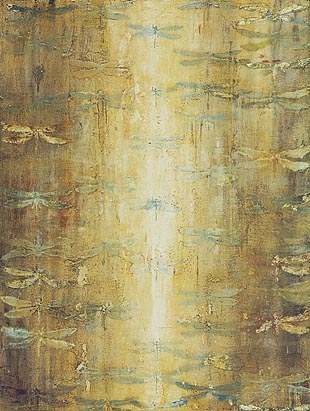
The Alchemy of Encaustic Painting
by Tony Evans
Artists have for centuries tinkered with forms of matter in an attempt to conceive their artistic visions and make them reality. One such form, dating back to ancient Greece, is encaustic painting.
Encaustic painting, known for its luminous depth and sublime versatility, involves a layering process of beeswax, pigments and other ingredients. The word encaustic comes from the Greek “enkaustikos,” meaning, “to burn in.”
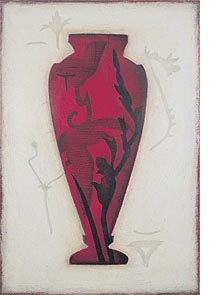 The process is thought to have originated with the ship builders of ancient Greece who prepared their vessels for battle by sealing the hulls with layers of beeswax. The layers were fused with charcoal braziers and decorated with intimidating motifs in hopes of unsettling their foes.
Essentially unchanged after 2,000 years, the process of encaustic painting has been revived numerous times by Renaissance chemists, modernists like Jasper Johns and a great many school children melting crayons on cookie sheets. What these artists all share in common is an affinity for pigment, wax and fire.
Encaustic painters work from a heated palette of molten mixtures of beeswax, pigment and a hardening agent known as Demar, which is the crystallized resin of a fir tree native to the East Indies. Encaustic will take to any rigid, supported and porous surface.
 Wood panels have been a choice ground for the medium since at least the time of Christ. In fact, a series of idiosyncratic encaustic portraits made in an Egyptian outpost of the Roman Empire in 100 A.D. were painted on veneer-thin layers of wood and attached to the faces of embalmed mummies. The Fayum Portraits, as they are called, were discovered in the early 19th century, a testament to the archival quality of encaustic. Still lustrous and intact after nearly 2,000 years, they provide art historians with a unique view on the figurative perspectives of antiquity.
The results of my own first experiment with encaustics lasted only two days this summer after leaving it on the dashboard of my car in the sun. After reaching 142 degrees Fahrenheit, wax melts. At 220 F it breaks down and gives off formaldehyde and other toxic gases. If the wax ever actually catches fire ... well, for this reason, it is a good idea to enroll in an encaustics workshop before trying to develop a feel for this medium.
Eve-Marie Bergren, a Boise-based artist represented by the Ochi Gallery in Ketchum, offers encaustic painting workshops independently and through the Sun Valley Center for the Arts. With proper ventilation and attention to palette temperatures, the process of encaustic painting is quite safe and very engaging.
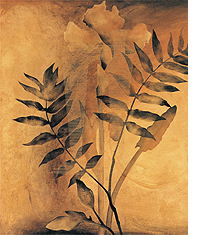 The modern encaustic painter may use a heat gun, hot plate, butane torch and an assortment of brushes, scrapers and spatulas, among other tools, to create a layered surface of wax and pigment with an enamel-like finish. The layers are burnished and fused, one into the next, with a heating element. An encaustic painter develops a feel for the thermal properties of wax. After heating the medium and pigment, paint is stroked on layer after layer, each one burnished again with a heating element.
The painters use heat-friendly, natural bristle brushes when working in encaustic. Color pigments are blended with wax and hardener to hold everything together. Oil is a close enough chemical cousin to wax to be mixed with encaustic medium, but only in small ratios of 1-to-5 or 1-to-6.
Encaustic paint sticks are a ready combination of the encaustic medium and color pigment, milled together without the use of toxic solvents. R&F Handmade Paints is a leading supplier and a storehouse of encaustic history and information (www.rfpaints.com).
Pigments can be mixed lightly with the medium for a translucent, ghostly effect that encaustic is known for, or applied as an opaque surface to produce transparencies.
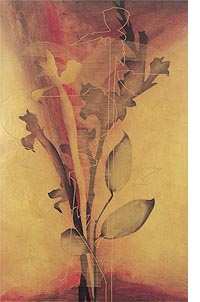 Encaustic layers are often applied into topography of distinct levels or built into sculptural relief. An artist who becomes adept at controlling the physical and visual depths of these layers can explore new dimensions in visual tension and composition.
Encaustic can take collage to a whole new level of expression. For the sculptor it is like building dribble castles on the seashore.
Encaustic layers are often applied into topography of distinct levels or built into sculptural relief. An artist who becomes adept at controlling the physical and visual depths of these layers can explore new dimensions in visual tension and composition.
Encaustic can take collage to a whole new level of expression. For the sculptor it is like building dribble castles on the seashore.
Finished encaustic pieces not only can withstand but even demand polishing on a regular basis. They cure slowly and need to live in a reasonable environment, ranging from about 40 to 110 F. Low temperatures can be as detrimental to encaustics as high ones.
Several Ketchum galleries show encaustic work. They have unusual depth and physicality, often described as luminous. They also look strangely organic. Gail Severn Gallery carries the textured works of Chris Reilly and Michelle Hagland. Mark Rediske’s series of vessels at Friesen Gallery have a background that looks and feels like old ivory. Hiro Yokose’s waterscapes on linen at Anne Reed Gallery put you into a trance.
“You just want to go up and take a bite out of ’em,” one of Marie-Bergren’s workshop participants observes.
L’Anne Gilman assures Reed’s clients the pieces are as durable as any medium.
“Just don’t leave them on the dashboard of your car,” she says.•