| click here for the |
| front page |
| features |
| mountain goats |
| disabled skiers |
| ski bums |
| arts |
| dogsled queen |
| encaustic painting |
| art glass |
| living |
| small spaces |
| spas in the home |
| recreation |
| hallway of stars |
| nordic skiing |
| ski boots |
| winter from a to z |
| dining |
| martinis |
| organic beef |
| calendar |
| winter 2002-03 |
| listings |
| galleries |
| fitness |
| equipment rentals |
| lodging |
| property mgmnt. |
| outfitters & guides |
| maps |
| ketchum+sun valley |
| north valley trails |
| art galleries |
| the guide |
| last summer |
| advertising |
| about us |
| copyright |
| Copyright
© 2002 Express Publishing Inc. All Rights reserved. Reproduction in whole or in part in any form or medium without express written permission of Express Publishing Inc. is strictly prohibited. |
| Produced
& Maintained by Express Publishing, Box 1013, Ketchum, ID 83340-1013 208.726.0719 Voice 208.726.2329 Fax info@svguide.com |
| The
Sun Valley Guide is distributed free twice yearly to
residents and guests throughout the Sun Valley, Idaho resort area
communities.
Subscribers to the Idaho Mountain Express will receive the Sun Valley Guide inserted into the paid edition of the newspaper. |

Queen
of the Dogsleds
Nell Shipman
by Dana DuGan
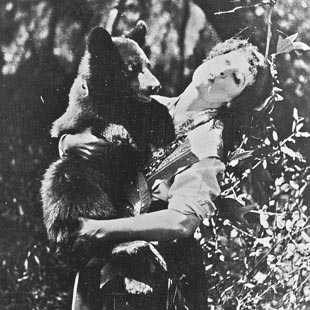
Actress Nell Shipman was a pioneer both in her career and in her sensibility.
She also loved Idaho, where she built a zoo and the Lionhead Lodge on Priest Lake in Idaho’s Panhandle from which she made several movies, often serving as writer, director, producer and star.
“Did you ever come to a place and instantly recognize it as your Ultima Thule, the one spot in God’s world where you belonged?” she wrote later in her life. “Such a spot, so it seemed to me, was Priest Lake, in Idaho. Seeing it for the first time was not a case of love at first sight, it was the reuniting of self with homeland.”
In 1905, at the age of 13, Canadian-born Helen “Nell” Barnham left her middle-class Seattle home to become an actress. Related by way of her English family members to the great Gilbert and Sullivan producer D’Oyle Carte, she chose instead to work in vaudeville, with road companies, stock and repertory.
In 1911 she married Ernest Shipman, many years her senior, moved to Southern California and became a mother.
Ernest was a rising entrepreneur in the fledgling motion picture business. In her 1968 autobiography “The Silent Screen and My Talking Heart,” Nell wrote, “Men like Ernie Shipman made the ‘90s gay. He had the bounce of a rubber ball. Not immoral but amoral, not lascivious but lusty.”
He promoted the business, while Nell wrote screenplays, eventually parlaying her talents, education and experience into several purchased scripts for the Universal, Selig and Vitagraph studios. By 1914 she had written, directed and played the lead in three films for Universal.
But it was the Shipmans’ 1915 joint venture “God’s Country and the Woman” that made her reputation. It was the first full-length, outdoor adventure film ever made and was largely shot on location.
Nell Shipman was not alone as a female pioneer in the business. In fact, prior to the mid-20s when Hollywood became industrialized amidst the studio system, she was one of many women working behind the camera. Many other major stars of the day, including America’s sweetheart Mary Pickford, Mabel Normand and Corinne Griffith, owned and operated their own production companies. They were also the main scriptwriters and film editors of the era.
The Shipmans made a string of similar outdoor adventure movies during the 1920s. Their biggest hit was based on a James Curwood story in Cosmopolitan magazine, “Back to God’s Country” in 1919. A nude swimming scene in this movie predates Hedy Lamarr’s infamous 10-minute nude swimming scene in the 1933 Austrian-Czech film “Ecstasy,” which was banned in the United States.
Though “Back to God’s Country” grossed over $1.5 million in its run, Shipman expropriated his wife’s salary, which, not surprisingly, led to the dissolution of their marriage and partnership. Soon after divorcing Shipman in 1920, Nell left Hollywood to make her own films.
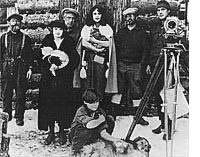 In the Panhandle of northern Idaho, Shipman’s base camp, Lionhead Lodge, was on Mosquito Bay at the northern end of Priest Lake. It was here that she formed her own production company, Nell Shipman Productions, with Bert Van Tuyle as co-director.
Together, both in business and romantically, they produced four films at Lionhead Lodge with future Frank Capra cameraman, Joseph Walker, as the director of photography.
Shipman Productions had quite a menagerie of actors and animals on hand, including Bobby Newhard; Dorothy Winslow, the second female lead in several of the movies; Daddy Duffill, who lived on the lake in a house boat; Winslow’s brother, Donald; and Nell’s son, Barry, though he was often away at school.
“The Trail of the Arrow” and “Something New,” a two-reeler co-starring Van Tuyle, was made during these years. Hysterically using a Maxwell automobile to run from Mexican banditos over extremely unaccommodating terrain, it was shot in the Mojave Desert in 110-degree heat. There were also several shorts made known under the title “Little Drama of the Big Places,” and another short, “A Bear, a Boy and a Dog.”
In “The Girl from God’s Country” released in 1921, Nell played two roles—twin sisters, one evil and one good. Nell did her own stunt work in all her films, from mushing a dogsled—which led to her being known as “Queen of the Dogsleds”—to rock climbing, snowshoeing and falling into freezing lakes.
Always featured in Nell’s films were plenty of animals and snow. Rarely was the area portrayed at any other time than during the winter. In fact, based on Nell’s films, one might get the idea that summer never came at all to Priest Lake.
Her movies were not the only times that adventure ensued. In fact, in her autobiography she readily admits that some of their wildest adventures had the feel of movies but in fact were real life calamities. Toward the end of their time there, Van Tuyle became sick, both physically and mentally. Nell attempted to take him down the partially frozen lake to a hospital. She described chipping through the ice, one small section at a time and then rowing the boat inches.
“Have you ever traveled two miles by inches?” she asked in her autobiography. “With a passenger bound for the hospital to whom speed meant life or death? Chip-chip—bit-by-bit. Drive ahead a foot and back up three. What does it matter? It’s all a nightmare anyway and we shall wake up soon, or the movie will flicker to a fade out and a happy ending! Another heave-crack-plunge.”
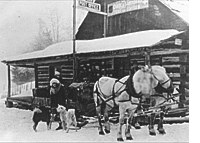 After nearly two days, she eventually abandoned the stuck boat in the ice, and trudged through slush-ice for miles to Coolin, a town at the southern end of the lake. Friends were sent to fetch Van Tuyle, who was taken directly to the hospital where he had several toes amputated.
The animals in her films were members of the family and part of a zoo she created at Priest Lake. Rarely was anyone rescued in her movies without the help of Brownie, a bear she’d raised from a cub, or by her son’s Lassie-like dog, Laddie. Other animals in the zoo included horses, a coyote and a wolf, wildcats, an elk, an eagle, porcupines, raccoons and skunks.
Her communication with animals was legendary, and in her movies these wild animals come and go freely, often crawling into her lap or walking up her chest as she sleeps. She was also a wit. Her dialogue, in captions silent screen-style, was often tongue-in-check or flat-out silly. “Dumb as an oyster, but still sometimes an oyster hides a pearl,” was one such self-deprecating caption.
“Come this way. Can’t you understand dog-English?” is another classic subtitle, coming after a scene where Laddie, the dog, is desperately trying to get help for his young master and mistress who are stranded in a snowstorm without their dogs and sled.
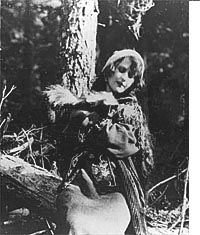 Despite tromping around in the snow in dresses early on, Nell was a serious feminist. The parts she wrote for herself were never timid or vulnerable waifs. The men, rather, were the ones who needed rescuing. And before long, Nell was
— shockingly — wearing trousers and a jacket made from a Hudson’s Bay blanket.
Despite tromping around in the snow in dresses early on, Nell was a serious feminist. The parts she wrote for herself were never timid or vulnerable waifs. The men, rather, were the ones who needed rescuing. And before long, Nell was
— shockingly — wearing trousers and a jacket made from a Hudson’s Bay blanket.
“It was Luella Parsons who once objected to my appearance at an Algonquin luncheon in my tam and Hudson’s Bay blanket coat,” Nell wrote in “My Silent Screen & My Talking Heart. “
In 1923, the team made “The Grub-Stake,” at Lionhead Lodge and in Spokane, Washington, at the Minnehaha Studio. Despite their high hopes, it ultimately proved to be their downfall, financially and personally. Dejected, slightly mad and bitter, Van Tuyle went back to Hollywood.
Broke, Nell sold her beloved animals to the San Diego Zoo in California and moved temporarily to Old Lyme, Connecticut, with Charlie Ayers, an artist she later married. In 1926, at the age of 33, she gave birth to their twins, Charles and Daphne, while the couple was living in Spain.
In 1934, she wrote the story upon which “Wings in the Dark,” with Cary Grant and Myrna Loy, was based. And in 1947, she tried one more independent production, “The Clam-Digger’s Daughter,” also known as “The Story of Mr. Hobbs,” but the film was not successful.
Shipman’s son, Barry, called her a “strange, hungry, brassy, courageous girl, bravest of Mamas.” At his urging she wrote her autobiography, which was published posthumously by Boise State University.
Nell Shipman died on January 23, 1970. The day she was buried her house was looted and all the films, photographs, memorabilia and papers were stolen. The only print of “The Grub-Stake” was eventually recovered from a source in the British Isles. Some films were found in their original tins in the back of thrift shops.
Barry Shipman gave these and other recovered items to the Idaho Film Collection at Boise State University. Founded in 1985, the collection includes more than 25 silent and talkie films made in Idaho, including the complete holdings of Shipman’s films.
The companion volume to her autobiography, “Letters from God’s Country: Nell Shipman’s Selected Correspondence 1919-1970,” will be available through BSU this spring.
In 1977 the state of Idaho dedicated the point where Lionhead Lodge once stood as Shipman Point.•