| click here for the |
| front page |
| features |
| return of the wolf |
| bethine church |
| olympic downhill |
| arts |
| profile
of a sculptor: marjolaine renfro |
| profile
of a painter: john horejs |
| dining |
| original draft |
| fondue |
| living |
| winter skin care |
| building luxury |
| the trend to tile |
| recreation |
| peace pact |
| north valley trails |
| the roundhouse |
| unauth. baldy guide |
| winter A to Z |
| calendar |
| winter 2001-2002 |
| listings |
| galleries |
| equipment |
| outfitters |
| lodging |
| property mgmnt. |
| fitness |
| dining |
| maps |
| xc+snowmobile |
| ketchum+sun valley |
| bald mtn ski trails |
| KART bus map |
| the guide |
| back issues |
| advertising |
| about us |
| copyright |
| Copyright
© 2001 Express Publishing Inc. All Rights reserved. Reproduction in whole or in part in any form or medium without express written permission of Express Publishing Inc. is strictly prohibited. |
| Produced
& Maintained by Express Publishing, Box 1013, Ketchum, ID 83340-1013 208.726.0719 Voice 208.726.2329 Fax info@svguide.com |
| The Sun Valley Guide is distributed free twice yearly to residents and guests throughout the Sun Valley, Idaho resort area communities. Subscribers to the Idaho Mountain Express will receive the Sun Valley Guide inserted into the paid edition of the newspaper. |


Return of the Wolf
by
Greg Stahl
photos by Jim Dutcher
Winter in central Idaho is a time when most of the region is serenely ruled by the forces of Mother Nature. Deer and elk migrate to valley floors. Black bears settle into winter-long slumbers. And gray wolves, North America’s most efficient predators, roam frigid mountains looking for cover from approaching storms or for another meal. Their piercing howls in this silent land are a clear and poignant reminder of the predators’ successful return to the state seven years ago.
Winter is
a time when wolves escape inevitable summer clashes with people and
livestock. It’s when they rely on one another for cooperation in the
hunt or for survival, and when the pressures of the political storm that
returned them here is a season in their past and a season in their
future.
Winter, in short, is when wolves can be wolves.
After being virtually annihilated by government predator control programs by the 1930s, gray wolves have been helped by the same government to successfully return to their former range in the northern Rocky Mountains.
In Idaho, more than 200 wolves roam in at least 17 confirmed packs, with several more pairs poised to begin new families. In a three-state—Idaho, Wyoming and Montana—federal gray wolf recovery area, more than 600 wolves live in at least 30 confirmed packs.
During the time of the much publicized return of gray wolves to Yellowstone National Park in 1995, 15 wolves were quietly released into central Idaho along the banks of the Salmon River as part of an effort by the U.S. Fish and Wildlife Service to reintroduce them to the northern Rocky Mountains ecosystem.
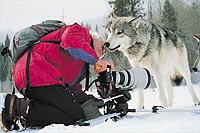
Emmy-winning filmmaker Jim Dutcher spent six years filming and living with the Sawtooth Wolf Pack in the shadow of the rugged Sawtooth Mountains. The animals' intimate social behavior and genuine concern for one another impressed him more than anything, he said. Photo courtesy Jim Dutcher.
An additional 20 wolves were relocated from the wilds of British Columbia to Idaho the following year. Since then, the number of wolves in Idaho has risen almost exponentially, and packs now inhabit almost every region of the state, including the nearby White Cloud and Pioneer mountain ranges.
The success of reintroduction, however, has become largely seasonal. Each spring and summer, as sheep and cattle are turned out to graze mountain pastures, wolves find the livestock easy prey. In response, and much to environmentalists’ chagrin, federal officials have broken suspect wolf packs apart.
Winter, on the other hand, is a season when the mountains are blockaded by snow and ice, and only the wild creatures, and a few rugged people remain.
At the top of the food chain, wolves live their winter lives as they have for thousands of years.
Biologically, returning wolves to the U.S. Rocky Mountains has not been difficult. Socially, the issue is vastly different.
Since reintroduction, several wolves have been poisoned and others illegally shot, despite enjoying protection under the federal Endangered Species Act.
“Save an elk—Kill a wolf,” proclaim bumper stickers in the central Idaho hamlets of Stanley, Clayton, Challis and Salmon. “Kill all the goddamn wolves and the people who put them here,” reads a sign in a storefront window in Clayton. Such warnings are a testament to the deep-seated controversy sparked by the wolf’s return.
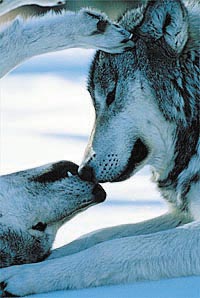
Photo by Jim Dutcher.
"I don’t see wolf recovery as a biological challenge at all,” Roy Heberger, a retired Fish and Wildlife Service wolf recovery coordinator, said. “As long as people tolerate the wolves, we’re going to make it. What’s going to be the real challenge is the social capacities. Wolves are going to be limited by human tolerance, not by habitat or food.”
Wolves are, perhaps, the most misunderstood predators in North America, Emmy-winning filmmaker and Ketchum resident Jim Dutcher said. Though he lacks formal wildlife education, Dutcher became intimate with wolf habits and behavior when he spent six years in the early 1990s observing and documenting a captive wolf pack in the Sawtooth Mountains for his films, “Wolf: Return of a Legend” and “Wolves at Our Door.”
Dutcher said he began the project in an effort to inform the public about animals that are seldom seen and even more rarely understood, but he developed a connection with the predators that he’ll carry with him the rest of his life. Part of that connection is an understanding of wolves’ predatory instincts and social behaviors and of humans’ determined damnation of an animal they don’t fully understand.
“Our fear of wolves is almost pathological,” he said. “We’ve killed so many of them. When wolves feed, they defend their food among themselves, and they growl at each other. They don’t have the equipment to eat in a tidy way, so they basically eat the animal alive. The deer or elk goes into shock and is just devoured. This is something that frightens human beings, because the wolves do it in such an odd fashion. It disturbs people a great deal, so we just have this appetite for going out and trying to kill this beast of our dreams and nightmares.”
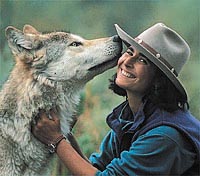
Dutcher's wife Jamie with the full-grown wolf that they named Wahots. Photo by Jim Dutcher.
Dutcher said he didn’t know what to expect when he began the Sawtooth wolf project, but he gradually became enchanted by the Sawtooth Pack’s social hierarchy and intimate emotional behavior.
“You
hear wolves have a hierarchy and that they have this social structure,
but what I wasn’t prepared for is how deeply emotional these animals
are and how they seem to care for each other,” he said. “A pack of
wolves is not just a group of predators that gather together to roam the
forest. Unlike the coyote, wolves stay together as a family unit for
their entire lives. In general, the family structure from the alpha to
the omega stays together—aunts and uncles, brothers and sisters,
parents and grandchildren. They communicate and they coordinate their
efforts to capture food.”
Wolf packs vary in size from about two to 30 animals, more commonly
numbering between five and 10, but they are consistent in social compo-sition
from one pack to the next.
Alpha wolves are pack leaders, and omega wolves occupy the bottom rungs on packs’ social ladders. In between, betas, subordinates and juveniles fill out different ranks.
Qualities of leadership are imperative to a pack’s success and survival. Packs led by confident, compassionate wolves are more harmonious and efficient than packs led by nervous or repressive wolves, and a pack’s ability to work as a unit enables it to kill large prey that would pose serious threats to a lone wolf.
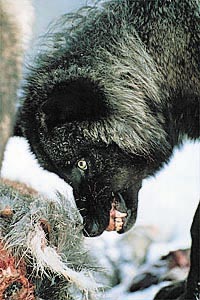
Wolves share a complex language of dominance and submission in which growls, howls, whimpers, postures and even facial expressions take on specific meanings. An example of this language is visible during feeding. Photo by Jim Dutcher.
A pack’s hierarchy, intangible to all but the most patient observers, translates into a complex language in which growls, howls, whimpers, postures and even facial expressions take on significant meanings. Subordinate wolves most always interact with their superiors using cowering body language. Examples include rolling onto the back with the tail curved over the belly while urinating and whining or, more subtly, ears flattened with downcast eyes. Expressions of dominance include standing over a subordinate with hackles raised, ears flattened and teeth bared or, more subtly, staring.
“It’s an incredible, amazing animal,” Dutcher said.
“It’s intelligent. It’s controversial. I didn’t think it was going to affect me, that I would become so connected to these animals.”
Despite becoming enamored with gray wolves and ultimately falling in love with the Sawtooth Pack, Dutcher adamantly opposes federal wolf reintroduction efforts.
The act of breaking wolf packs apart, both to reintroduce the animals and as part of federal lethal control actions in response to livestock kills, is not fair to wolves, which develop powerful bonds among one another, Dutcher said.
"I have a lot of respect for the people involved in wolf reintroduction, and I think they work really hard, but I’ve never been an advocate of bringing wolves back,” Dutcher said. “I’d rather see wolves come back on their own. That way, they’d be using corridors that are safe, and they’d be more likely to stay out of trouble. But saying that, I can’t say there hasn’t been a lot of success in wolf recovery.”
Success by the numbers, he qualified.
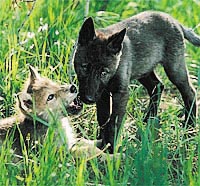
Play is an integral part of wolves' lives, but pups especially use play to develop strategies for social domination and submission, the hunt and the fight. Pups reach maturity at about one year of age, when they can weigh in at over 100 pounds. Photo by Jim Dutcher.
Each year, for the past three, wolves have preyed on sheep and cattle in the Salmon River corridor, which begins in the nearby Smoky Mountains and weaves north more than 100 miles through ranching and farming communities that are nestled in a vast mountain wilderness. The proximity breeds conflict.
“It’s not the wolves’ fault,” said Ron Gillett, a Stanley outfitter and the point man of an anti-wolf group called the Central Idaho Wolf Coalition.
“They’re just killers. They are the most cruel, vicious predator in North America. This wolf thing isn’t fair. They just dumped those wolves in here.”
The coalition’s concerns center on preservation of central Idaho’s deer and elk herds, although there has not been confirmation from wildlife experts that the herds have taken depletion beyond sustainability. In fact, the Alaska Department of Fish and Game states that the balance struck between wolves and their prey is completely sustainable, so long as deer and elk hunting permits are curtailed during lean years.
Many ranchers, on the other hand, have suffered significant setbacks from wolf reintroduction. Each year wolves kill dozens of sheep and cattle in central Idaho, and nowhere is this more apparent than in and around the White Cloud Mountains north of Ketchum.
In the spring of 2000, ranchers along the East Fork of the Salmon River east of the White Clouds scrambled to protect newborn cattle from invading wolves, and each spring for the past three years, wolves have killed sheep grazing in the Sawtooth Valley, west of the White Clouds.
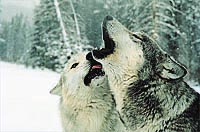
Photo by Jim Dutcher.
On April 8, 2000, in response to four confirmed wolf kills on ranches along the East Fork, the U.S. Fish and Wildlife Service authorized execution of the East Fork wolves, commonly known as the White Cloud Pack.
Shotgun blasts from a helicopter decimated most of the pack—a federal decision that followed an unsuccessful attempt to disband the wolves by relocating the pack’s alpha pair and two subordinates.
The East Fork story has become almost anecdotal to the wolf conflict since the animals’ reintroduction. As instinct prompts them to feed on easy prey, packs are broken apart and individuals killed to protect private interests.
These “control” actions outraged members of the environmental community who demanded that managers are bound by law to manage for wildlife before livestock—a pending court battle will tell. Nonetheless, conflicts between ranchers and environmentalists, livestock and wolves, and wolves and people are likely to continue.
“There’s so much livestock in the Sawtooth Valley, both on private and public land,” said Carter Niemeyer, Fish and Wildlife Service Idaho wolf recovery leader. “I think forever and ever, packs will consistently move into that area. Livestock is just one of the things on the menu out there, and wolves don’t know any better.”
Each year, as wolf populations grow, the animals are closing in on a “de-listing” threshold set by the Fish and Wildlife Service. In fact, 2001 is the second of a three-year countdown toward de-listing in which 30 breeding pairs of wolves must be sustained for Endangered Species Act protections to be lifted.
If
biologists document 20 breeding pairs at the end of 2001 and 2002, there
will be just one additional requirement to be met before the Fish and
Wildlife Service could recommend the species’ removal from federal
protection: adoption of state wolf management plans in Montana, Idaho
and Wyoming.
Idaho and Montana already have draft wolf management plans, but wildlife
officials in Wyoming have vowed not to write a management plan.
But the rules are clear and will be enforced, said Ed Bangs, Fish and
Wildlife Service wolf recovery coordinator, who is based in Helena,
Montana.
“If
Wyoming does not write a wolf management plan, the Fish and Wildlife
Service will not propose to de-list wolves,” Bangs said.
Horace Axtell was only a child when the last of Idaho’s gray wolves
were driven from their Rocky Mountain homeland some 70 years ago. And so
it was fitting that the Nez Perce tribal elder and spiritual leader was
there in 1995 when 15 gray wolves were released in the Frank Church
River of No Return Wilderness Area in central Idaho after an absence of
70 years.
Chanting an ancient, spiritual song of hope and strength, Axtell prayed for the wolves while rejoicing in their return.
“I blessed the wolves when they returned, like welcoming back a friend who’s been gone a long time,” he said.
To the Nez Perce people, the wolf symbolizes the “circle of life,” an ancient respect that has seen the tribe live in harmony with Mother Nature and wolves for thousands of years.
“The wolf has life and red blood and eyes to see and ears to hear just as we do,” Axtell said. “The wolf is our brother. We are all connected.” •