| click here for the |
| front page |
| features |
| return of the wolf |
| bethine church |
| olympic downhill |
| arts |
| profile
of a sculptor: marjolaine renfro |
| profile
of a painter: john horejs |
| dining |
| original draft |
| fondue |
| living |
| winter skin care |
| building luxury |
| the trend to tile |
| recreation |
| peace pact |
| north valley trails |
| the roundhouse |
| unauth. baldy guide |
| winter A to Z |
| calendar |
| winter 2001-2002 |
| listings |
| galleries |
| equipment |
| outfitters |
| lodging |
| property mgmnt. |
| fitness |
| dining |
| maps |
| xc+snowmobile |
| ketchum+sun valley |
| bald mtn ski trails |
| KART bus map |
| the guide |
| back issues |
| advertising |
| about us |
| copyright |
| Copyright
© 2001 Express Publishing Inc. All Rights reserved. Reproduction in whole or in part in any form or medium without express written permission of Express Publishing Inc. is strictly prohibited. |
| Produced
& Maintained by Express Publishing, Box 1013, Ketchum, ID 83340-1013 208.726.0719 Voice 208.726.2329 Fax info@svguide.com |
| The Sun Valley Guide is distributed free twice yearly to residents and guests throughout the Sun Valley, Idaho resort area communities. Subscribers to the Idaho Mountain Express will receive the Sun Valley Guide inserted into the paid edition of the newspaper. |

The
Real Genuine Draft
Small
Breweries Make It Big
by Travis Purser
I like beer. It is at the root of civilization.
Sometime during pre-history, when, sadly, there was no beer, a nomad’s harvested wild barley got wet. An unfortunate accident, since wet grain can rot. So, he spread it out to dry. Wet at first, it started to sprout. Then, soon dry again, it stopped. The result: the world’s first malt.
What a success. Malt was sweeter than barley. Soon, everyone was baking with the new ingredient and eating delicious malt cakes.
But the absentminded nomad then inadvertently left a malt cake in the rain, perhaps in a bowl, where wild yeast settled and fermented the wet mixture. Now, he had invented beer. Hallelujah! He tasted it.
And it was good.
The cultivation of barley for beer-making caused people to settle in one area, learn about selective seed propagation, study agriculture, develop calendars and make important historic discoveries that framed civilization.
I kid you not.
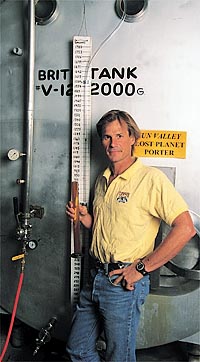
Gordon Gammel maintains that good brewing is all about the control process. Photo by David N. Seelig
Nine thousand years later, Gordon Gammell keeps his barley dry in a grain elevator that rises above Main Street in Hailey. In the eyes of Gammell and the other Wood River Valley microbrewer, Chris Harding, beer-making became just another soulless, corporate industry in the 20th century whose mediocre product hardly resembled the complex, deeply satisfying golden nectar that artisans had developed over millennia. What was lost with industrialization was control. And that’s what good beer-making is about.
Both breweries are monuments to do-it-yourself ingenuity. Harding built his River Bend Brewery from inexpensive, used dairy equipment in two converted bedrooms of his house, five miles south of Ketchum. Gammel’s Sun Valley Brewing Co., attached to a restaurant in Hailey, is larger but also a one-of-a-kind design.
Both men speak of beer-making as a rarefied art. They are products of the boutique beer revolution that began in the early 1980s when Fritz Maytag (yes, of Maytag appliances) bought the failing Anchor brewery in San Francisco, revived it, and showed Americans what good beer tastes like.
“I saw it happening,” says the middle-aged Gammel. He was working as an exploration geologist for a minerals company in Alaska. That market was failing, but beer was in. He found investors and went into brewing in Hailey. The group produced White Cloud Ale in 1986, then a German-style lager called Sawtooth Gold and Holiday Ale. “We sold beer from Alaska down to the border of Mexico” and as far east as Florida and Chicago.
“What I didn’t realize was everybody would want to get into the business,” he says. His investors, too, wanted to go big and pushed for high-end marketing and for an initial public offering. Gammel helped squelch the idea. “You go corporate and you lose control,” the master brewer says.
Today, he’s paying off his investors and, with a few assistants, annually brews and sells about 2,000 kegs of man’s oldest friend.
“It’s a labor of love” that is expensive and time-consuming, he says.
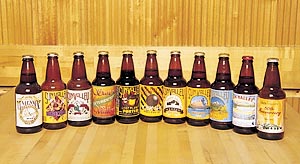
The fruits of Gammel's labor of love. Photo by David N. Seelig.
The different styles of beer—pale ale, extra special bitter, stout and others—are parameters that Harding, 40, endlessly interprets. That’s why he doesn’t want any employees—they might have their own interpretations, or worse, they might not care.
Harding makes about 125 kegs a year, an amount he says “Budweiser spills in one brew session.” Harding sells his kegs for $100 each to restaurants and for special events. The payoff for low volume, which equals low income, is control. He doesn’t filter, because it compromises flavor, even though perhaps only a small percentage of beer drinkers may appreciate the advantages of a cloudy beer.
And, he says, “I like lots of hop character,” referring to the fragrant, marijuana-like buds that impart a bitter flavor and act as a natural preservative. “There’s plenty of sweet stuff out there.”
Gammel’s personal grail is to create the perfect water for brewing. The mountain water in the valley is good, he says, but he makes it better by tweaking its acid content and adjusting other chemistry.
For Gammel, a geologist by training, and Harding, who studied biology in college, control is about increasing enjoyment.
What could be more civilized than that?
Prosit! •