| Current Issue : web |
| Current Issue : PDF |
| features |
| At home in the lodge |
|
The
art of collecting art |
|
23 days to rehab your habitat: A homeowner's diary |
| sections |
| Habitat Hits |
| Organize it |
| Know it |
| Fix it |
| Buy it |
| Grow it |
| Pick it |
| information |
| Spring calendar 2007 |
| Luxury Living |
| the guide |
| Last Winter |
| Last Fall |
| Last Summer |
| Editorial Submission |
| Calendar Submission |
| Advertising Submission |
| Advertising Rates |
| About Us |

|
|
Copyright © 2006 Express Publishing Inc. All Rights reserved. Reproduction in whole or in part in any form or medium without express written permission of Express Publishing Inc. is strictly prohibited. The Sun Valley Guide magazine is distributed free three times a year to residents and guests throughout the Sun Valley, Idaho resort area communities. Subscribers to the Idaho Mountain Express newspaper will receive the Sun Valley Guide with their subscription. |
grow
habitat
Tomatoes on the
edge
writer:
Dana DuGan,
photographer: Paulette Phlipot
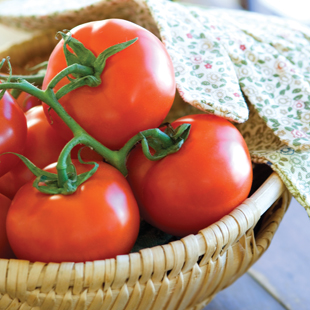
The tomato, America’s
favorite vegetable (or is it a fruit?), is native from Peru to Mexico to
southern North America. In the Wood River Valley’s high-desert climate
the tomato is a short-lived perennial plant grown as an annual, which
typically grows up to 3 feet in height, on a weak, fibrous stem.
So which is it: a fruit or a vegetable? Botanists say it’s a fruit,
classified as a berry. This is because tomatoes are a ripened mature
ovary containing seed, as are peppers, eggplants and cucumbers. On the
other hand, horticulturists insist the tomato is a vegetable, since it’s
a non-woody annual. Backing the horticulturists is the Supreme Court,
which, for trade reasons, classified it as a vegetable in 1893. Either
way, the tomato has progressed from being a tiny, watery, acidic fruit
to today’s delicious giant.
To grow or not to grow?
Growing tomatoes in the high-altitude climate of the Wood River Valley
is tricky, to be sure, but it is possible. The short growing season here
leaves many gardeners with still-green tomatoes just as the first frost
hits. If this happens, pick the orbs with stems intact, bring them
inside and place in a paper bag to ripen. Tomatoes can then be blanched,
frozen and used for sauces and soups through the winter months.
Gardeners in the know, and those with the right space and light, start
from seed and start early. “I always start my seeds in the house in good
light in February in little peat pots,” said Salomé Taylor, who lives in
old Hailey, on the sunnier east side of town. “By April, I have put them
in four-inch pots. Then I start hardening them off (taking the plant
outside for parts of the day to acclimatize it before finally moving it
into the garden for good) and they go into my garden, under UV-tolerant
polyethelene or with Wall O’ Waters (plastic teepees containing
individual tubes filled with water). I have tomatoes by the end of July,
through August and beyond, until the first frost.”
Taylor’s favorite varieties are Siberians such as Shasha’s Altai, the
yellow cherry Galina and the red Stupice, the Gem State and the
Sub-arctic Plenty. She orders them from Seed Trust High Altitude Gardens
(seedstrust.com), an Arizona-based company run by Ketchum native Bill
McDorman.
Location matters
Location plays a major role in the success of tomato gardeners. Ketchum
is a harder sell for tomatoes, but with a good greenhouse window or
south-facing, protected plot, it’s possible. In Bellevue and farther
south, the climate is even better than in Hailey.
Gardening is different on the prairie, according to Tona Backman
Stilwill, of Fair Mountain Farms in Fairfield. “I leave Wall O’ Waters
on (all season) so that if you have a freak frost, you’re ready,” she
said. “I’ve never had any fungus, and they also help keep the plants
upright and sheltered from high winds. With Wall O’ Waters you can get
them in the ground in May. The water absorbs the heat in the day and
radiates it at night.
“Staking tomatoes is really important,” continued Stilwill. “Use good
sturdy stakes. It’s essential to have good soil. I put generous compost
into the hole when I plant, and a handful of Epsom salts—I read once
that phosphorus is essential for root development. Also try not to
splash the plant when watering,” she said, as getting water on the
leaves can lead to disease. “You should be generous with the water in
the beginning, but once it starts to set with fruit, back off or you
will get watery tomatoes. Get them almost to a wilting point and then
give the plants a good soak.”
No matter how finicky it is about weather swings, this delicious fruity
vegetable is definitely worth your patience.
Tips for tasty tomatoes
-If space and light allow, start from seed, plant in pots indoors and
start early, ideally in February or March.
-If you must start outdoors, choose the sunniest spot available. Start
after the last frost. Buy small plants, available from local garden
centers, making sure they were started from hardy seeds appropriate for
the area.
-Plant tomatoes deeply, with the lowest set
of leaves at soil level, and press the soil down gently.
-Many gardeners remove the first flowers to allow roots to grow still
deeper.
-Always stake or cage the vines for healthy, productive crops.
-Mulch plants well with a layer of straw, leaves, dried grass clippings
or pine needles to keep the plants’ roots cool, prevent weeds from
sprouting around them and retain moisture in the soil. Do not apply
mulch until after the soil warms to 65 degrees Fahrenheit.
-Consider using Wall O’ Waters, available
at local garden centers, to keep your tomato plants warm and protected
throughout the growing season.
-Things to avoid: overcrowding, over-
fertilizing and over-watering.
-If you’ve tried and tried and tried again,
and are still left with tiny, hard, green things, consider a greenhouse.
If space doesn’t allow for a full-sized one, small greenhouse frames may
work. Check with a local
garden center to find the best one to suit local needs.
Which tomatoes will grow?
-Good growers for this area include various Siberians such as Shasha’s
Altai, Galina, Stupice, sub-arctic Plenty, Aurora and Perestroika.
-Early Girls, although not considered high altitude, will do just fine
in the south valley, and in south-facing gardens with ample protection
from the elements.
-Gem State matures the quickest, in just 58 days, and produces small, 2
oz. fruits. A cross between a sub-arctic and a larger, beefsteak tomato,
its compact, bush-type growth makes it excellent for containers and
patio gardens.
-Indeterminate varieties produce vines that keep growing. This also
means tomatoes continue to ripen over the entire season. The determinate
varieties will grow as a bush and ripen at once.