| Current Issue : web |
| Current Issue : PDF |
| features |
| At home in the lodge |
|
The
art of collecting art |
|
23 days to rehab your habitat: A homeowner's diary |
| sections |
| Habitat Hits |
| Organize it |
| Know it |
| Fix it |
| Buy it |
| Grow it |
| Pick it |
| information |
| Spring calendar 2007 |
| Luxury Living |
| the guide |
| Last Winter |
| Last Fall |
| Last Summer |
| Editorial Submission |
| Calendar Submission |
| Advertising Submission |
| Advertising Rates |
| About Us |

|
|
Copyright © 2006 Express Publishing Inc. All Rights reserved. Reproduction in whole or in part in any form or medium without express written permission of Express Publishing Inc. is strictly prohibited. The Sun Valley Guide magazine is distributed free three times a year to residents and guests throughout the Sun Valley, Idaho resort area communities. Subscribers to the Idaho Mountain Express newspaper will receive the Sun Valley Guide with their subscription. |
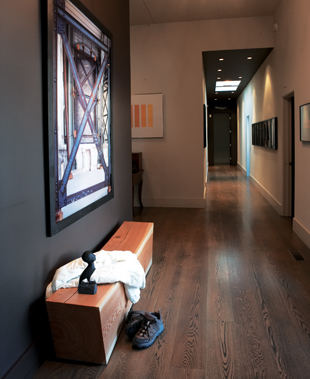
Fine art can easily be a part
of everyday life.
In this home, curator Jeanne Meyers chose a durable and beautiful
wood sculpture by Brent Comber to act as a bench. The metal piece,
created by Kiki Smith, is motion-activated, singing to those passing by.
And, simply for the joy of viewing it often, the painting by Stephane
Couturier hangs in the entryway.
the art of
collecting art.
Enhancing your habitat withfine art need not be a daunting nor expensive
prospect. Deb Gelet gathers tips from local experts on how to collect
art, no matter what your budget. Photos by David N. Seelig.
Whether we realize it or not, most
valley residents live with some form of art in their daily lives. The
landscape alone is a thing of great beauty and, in the spirit of Andy
Goldsworthy (a renowned contemporary British sculptor who works in and
with the natural landscape), we may carefully arrange on our hall table
the rocks we found while hiking, or keep the seashell from our last
vacation on the windowsill. This simple placement of objects brings
visual pleasure, but also evokes an emotional response, a good memory,
or sets a pleasant mood.
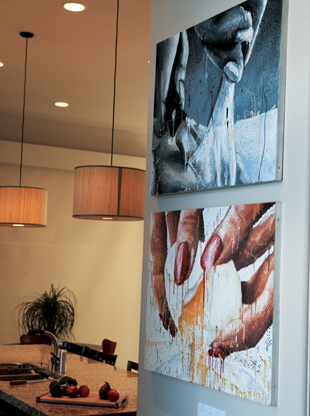
Culinary-themed
paintings by Marilyn Minter are a natural match for the kitchen.
Living with fine art is much the same, although collecting it well
requires more self-examination and homework. What it does not require is
a substantial bankroll. Nor does your art collection have to match your
home’s interior design.
A story from the world of contemporary art illuminates this point.
Herbert and Dorothy Vogel lived a quiet, working-class life in
Manhattan. He worked as a postal clerk, she as a librarian. In 1965,
they befriended Sol LeWitt, who would later become an important
conceptual artist. After LeWitt’s first show, they bought their first
piece of fine art. LeWitt was a new artist—“emerging” is the term used
in art circles—so his art was relatively inexpensive.
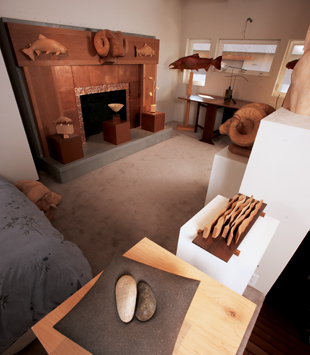
Sculptor Jack Burgess
edits his collection carefully in his small living space, selecting only
what “speaks on many levels” to him.
Over the years, on modest salaries and in a one-bedroom apartment, the
Vogels amassed a collection of more than 2,000 pieces by some of the
most important artists of the 1970s and 1980s, including Carl Andre,
Richard Tuttle, Will Barnet and Christo. They became the darlings of the
art world, partly because of their charming, unassuming natures, but
also because their collection reflected their intellectual journey into
art, and because they were not satisfied with simply purchasing.
The Vogels befriended the artists of the time, gave them unrelenting
emotional support, and created a collection that clearly reflects a
specific time period in contemporary art. The collection was deemed so
important that pieces of it went into an exhibition at the National
Gallery of Art in Washington, D.C., in 1994. Today, elements from the
Vogel collection continue to circulate through many important museum
exhibitions.
In the firestorm of publicity surrounding that first exhibition, Dorothy
Vogel said simply, “We don’t have any real advice for first-time
collectors. We buy what we like, what we can afford, and what can fit
into our apartment. But, we hope that this exhibition will encourage
others living on small incomes to buy art, too.”
fall in love with your art
Collecting and living with art should
be more than just shopping for and displaying pieces as though they were
trophies, ceasing as soon as all the walls are filled. Serious
collectors are unanimously clear on one point: Collecting art should be
a passion. And, as with all passions, it requires attention to nuance in
the partnership, a learning and growing self-examination.
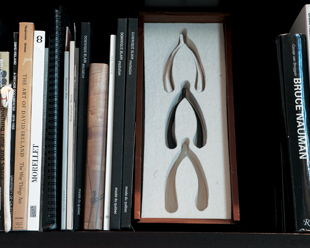
Artist Lorna Simpson’s mixed
medium work lives among books on a shelf.
“You never forget your first purchase. Everybody has a story about
theirs,” says Blaine County resident Jeanne Meyers. “It is remarkable
how often that first piece turns out to be unexpectedly life-changing.”
Meyers, a curator, consultant and self-proclaimed art addict, recently
curated Subversive Moves, a show on modern art held at Sun Valley Center
for the Arts.
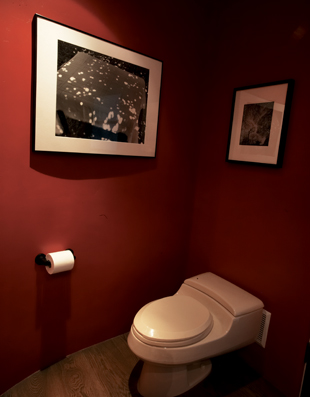
A collection of black and
white photography is displayed unconventionally in a powder room.
Selecting art for your home may feel intimidating. How do you choose the
right pieces for the style of your home? Is it necessary for art to
somehow match your décor? What constitutes a smart art purchase?
tips from the pros
“Living in an area that
experiences such drastic differences in seasons, many of our clients
rotate their artwork a couple of
times a year…This provides the opportunity to give a whole new look to
their home without the expense or inconvenience of redecorating.”
—Carey Molter
Director, The Kneeland Gallery
Wood River Valley residents are fortunate to have a variety of excellent
art galleries nearby. They are staffed by well-informed professionals
eager to share their knowledge and love for the works they exhibit.
Local galleries are far more relaxed—although not less
sophisticated—than many galleries in larger cities, and they provide
beginning collectors with the opportunity to learn more about particular
artists or media. They are also good resources for advice on displaying
art, including the important aspect of lighting it.
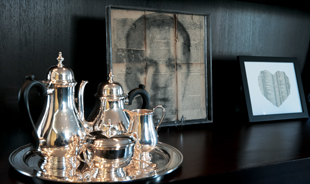
Oscar Muñoz’s dramatic
piece rests casually on a sideboard.
“As new collectors learn and surround themselves with the art of their
choice they make a statement about themselves and give themselves
permission to follow their own instincts and personal taste in a
potentially life-long dedication to collecting art,” said Barbi Reed,
owner of Ketchum’s Anne Reed Gallery. “The adventure of looking for the
right pieces is as worthy as owning the art.”
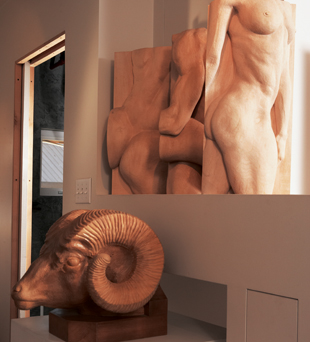
Jack Burgess’ sculptures
decorate his bedroom
Nearly all art dealers tell collectors, be they new or experienced, that
the most important factor in selecting artwork is to buy what you love—a
cliché, but true. “Upon acquisition, when asking a client ‘where will
you place it?’ an always refreshing reply is ‘I have no idea,’” said
Andria Friesen, owner of Friesen Gallery in Ketchum.
tips from the pros
“One of the great
advantages of collecting contemporary art is the artists are still
living! Many artists love to talk about their work.
Meeting and talking to the artists adds a special connection to
collecting contemporary art that makes the work an irreplaceable
treasure rather than just another possession.”
—Gail Severn
Owner, Gail Severn Gallery
Knowing what you love may not be clear in the beginning, but education
of the intellect informs the eye and heart. An important goal is to
trust your taste. As Meyers points out, “Good collections have either
knowledge or passion, but great collections have both.”
make up your own rules
Consider these questions in the process of editing or managing your
collection. Are you drawn to a particular medium, like works on paper,
watercolor paintings, photography? Is there a particular palette or mood
that draws you, such as dreamy landscapes or high-contrast abstract
paintings? Where will you place the artwork and how does that affect the
size of the works you can purchase? “Make up your own rules, as in ‘I
only buy prints’ or ‘I only buy what I can’t live without,’” advises
Meyers. “Change the rules as you need to, but do it consciously so that
you have some structure in your collection.”
tips from the pros
“There is a difference
between an interior that has been collected versus decorated. It is
always obvious. Good art doesn’t have to match your sofa! I believe it
is of paramount importance to collect art with both your head and your
heart.”
—Andria Friesen
Owner, Friesen Gallery
Hailey resident Mark Johnstone, writer, curator and a consultant for
public and private art, agrees. “Art that is important in your life will
provide new experiences over time. It’s similar to reading a really good
book or watching a great movie over and over and getting something
different out of it each time. Excellent art will provide that
experience for viewers upon repeated encounters.”
That presents a challenge to the new collector. It may take some time to
understand clearly how you respond to art and to refine the parameters
of the pieces you want in your daily environment over a length of time.
Take time to gain as much exposure to art as possible and do plenty of
research. The Internet is an excellent resource and art magazines offer
informative articles. A favorite is Artweek, available online and in
print.
“Try to spend enough time looking at a variety of art pieces to gain an
understanding of what you like and what you don’t like,” advises Gail
Severn, owner of Gail Severn Gallery. “Most people’s taste changes and
evolves as they look at more and more art. You don’t want to tire of a
purchase only months after acquiring it.”
a question of money
As with all romantic endeavors, there are many practical considerations.
When it comes to art, one of the most important is to respect your
spending limits and never purchase art solely for the investment. While
some art does increase in financial value over time, most art dealers
and collectors agree that should not be the primary reason behind any
purchase. “Often, but not always, prints and photographs are less
expensive than original paintings,” explained Severn. “Sculpture and
paintings can be more expensive than prints and photographs and often
require different types of space.”
For the first time art buyer, the pricing of art can be somewhat
bemusing. Severn attempts to shed some light on the process. “Although
artists and galleries try to establish prices based on the law of supply
and demand and what the market will bear, there are always extenuating
circumstances that contribute to the final price.”
tips from the pros
“No matter what our budget,
we only purchase work that stirs our emotions, work that is hard to put
out of our minds, and that we will enjoy living with for many years to
come.”
—Robin Reiners
Owner, Gallery DeNovo
Remember also that the safety of the artwork must be considered. When
you become the owner of an original artwork, you also become responsible
for its longevity and history. Again, galleries are excellent resources
for advice on protecting works from direct sunlight, moisture,
temperature fluctuation and seismic activity.
The old model of precise standards for displaying artwork has given way
to a more casual stance of personal preference. Most people are inclined
to hang framed works too high. Professional art installers can help, of
course, and are recommended for heavy or very valuable works. But if
you’re going it alone, ask a friend to hold your new acquisition at eye
level while you step back to assess any adjustments you may prefer. Ask
your art dealer for advice on appropriate hardware. Art can be clustered
in groupings on walls, shelves, or even in museum-quality display cases.
Framed pieces can also simply lean against the wall in protected areas.
Gone is the old concept of buying a painting that matches the sofa and
hanging it centered above.
open your mind
The process of collecting art, the introspection, the research and the
inspiration often leads to a more refined insight into self. And, that
insight naturally shows up in living environments. In an almost
contradictory way, the intimidation that may be felt at the outset of
researching art dissolves into educated opinion, or taste, which then
reveals itself in our home’s interior design. In the end, perhaps the
art does match our interior design although that wasn’t the intent. It
is a refining of personal statement.
Collecting and living with art can be accessible to anyone of any means
who appreciates the inherent value of surrounding themselves with beauty
of their own choosing. Follow the example of the Vogels. Open yourself
to all the possibilities of art. And, by the way, do you know the artist
who lives next door?
Online art resources
www.svgalleries.org
www.emoma.org
www.artadvice.com
www.markelfinearts.com
www.art-collecting.com
www.artweek.com