| Current Issue : web |
| Current Issue : PDF |
| features |
| At home in the lodge |
|
The
art of collecting art |
|
23 days to rehab your habitat: A homeowner's diary |
| sections |
| Habitat Hits |
| Organize it |
| Know it |
| Fix it |
| Buy it |
| Grow it |
| Pick it |
| information |
| Spring calendar 2007 |
| Luxury Living |
| the guide |
| Last Winter |
| Last Fall |
| Last Summer |
| Editorial Submission |
| Calendar Submission |
| Advertising Submission |
| Advertising Rates |
| About Us |

|
|
Copyright © 2006 Express Publishing Inc. All Rights reserved. Reproduction in whole or in part in any form or medium without express written permission of Express Publishing Inc. is strictly prohibited. The Sun Valley Guide magazine is distributed free three times a year to residents and guests throughout the Sun Valley, Idaho resort area communities. Subscribers to the Idaho Mountain Express newspaper will receive the Sun Valley Guide with their subscription. |
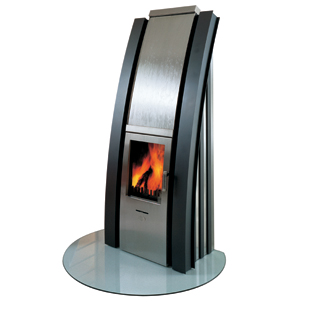
The Niagra from Max Blank is
one of a wide new variety of fireplace designs. With a built-in water
feature, this stainless steel wood burning flue stove features a
waterfall above the stove. Max Blank products available at Warming Trend
buy habitat
Fireplaces
writer:
Trevor Schubert
With countless
variations in style, a wide array of fuels, and prices from $600 to
upwards of $20,000, the multitude of options available to the fireplace
buyer make such a purchase a daunting task. “Very seldom does someone
come in knowing what they want,” said Travis Zerba, president of
Hailey’s Fireplaces Etc.
Terry Roth, who owns the Ketchum-based Warming Trend of Idaho with his
wife, Kathy, agrees. “We see customers seven or eight times before they
buy,” said Roth. “There is such diversity, so many brochures. One
fireplace may come in seven sizes with twelve different faces.”
In the simplest terms, however, your search should boil down to whether
you are looking for heat or ambiance. Following is a guide to help you
find the perfect fireplace.
Fueling the fire
Wood is tradition, wood is nostalgia, and wood can be a headache for
someone who doesn’t have the time or space to collect and store it. “We
see wood in living areas—in larger spaces. In bedrooms, it’s mostly
electric or gas.” Roth estimates 20 percent of his sales are wood and 80
percent are gas. “Of that 20 percent that are originally wood, about 10
percent of homeowners end up replacing wood with gas logs,” said Roth.
According to Zerba, the debate is often decided on whether the fireplace
is for a new or existing home. “For fireplaces we install in existing
homes, roughly 60 percent are gas and 40 percent are wood,” said Zerba,
but in new homes, the numbers flip to 60 percent wood and 40 percent
gas.
“Gas fireplaces allow more flexibility,” said Zerba. The direct-vent
technology employed by gas units allows a flue to be bent to fit the
space you want it in. Solid-fuel units must vent straight up. Direct
venting is efficient as heated room air is not wasted to fan the fire, a
problem wood units cannot avoid.
Installation of a gas fireplace in an existing home takes about half a
day, said Zerba. And, gas fireplaces turn on with the flick of a switch,
push of a button or by remote control. “Gas is much cleaner than wood,
and direct vents will not back-draft,” said Zerba.
Pellets are less cumbersome to collect and haul than wood, but Roth
warns his customers, “Pellets are a little more trouble than people
realize.” A byproduct of lumber mills, pellets are cost efficient: a
40-pound bag costs $3 to $5. However, heating a Ketchum home may require
up to two tons of pellets, or 100 40-pound bags a year—and pellets
cannot be stored outside. Also, according to Roth, “If your electricity
goes out, you are stuck without heat,” he added, because of the fans.
Go electric
Electric fireplaces are another option. “They are becoming quite a hit,”
said Kathy Roth. “They provide a little heat for someone who cannot
bring in wood or does not have natural gas.” Electric fireplaces are
easy to install and do not require a flue or chimney.
Art in your hearth
Lastly, one must consider the multitude of exterior options available.
“Everyone is looking for that custom look, and it seems everyone has the
trickle water-Zen thing going,” said Roth. Modern-day fireplaces have
evolved into fine art, employing aromatherapy, water features, swivel
mounts and a dizzying array of stylish and sleek casings.