

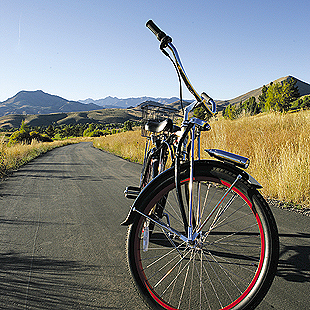
Photo by Chris Pilaro
The Cruiser Cometh
The stylish cousin of its road and mountain brethren, the cruiser bike has morphed into an essential element of valley life. Michael Ames investigates the rise of the beach-born phenomenon in our mountain town. Photos by Chris Pilaro.
In our landlocked
ski town, the beach cruiser has become a logical fit. It is summer’s
complement to winter’s well-worn pickup truck. It is at once a lifestyle
statement and a vehicle for everyday needs. The cruiser bike stakes a
bold claim to personal style, then brings home the milk and eggs.
In high-altitude villages such as Ketchum, Jackson or Telluride, where sprawl is no more than an abstract concept and the eccentric is the norm, the cruiser bike is a near necessity. Get one with a basket; have a picnic. Put chains on the tires; ride it all winter. In places where form and function vie for dominance, the cruiser bike rides the fence.
 Since
pedals were added to early prototypes nearly 200 years ago, bicycles have
undergone countless innovations. Throughout, engineers and hobbyists have
primarily addressed basic mechanics, creating a practical evolution.
Additional gears boosted racing bikes to higher speeds and greater
acceleration. Larger, high-traction tires and built-in suspensions pushed
mountain biking into extreme terrain. The cruiser bike marks a break with
this functional focus. It is not concerned with the nuts and bolts of
locomotion, but rather with a more individual issue: style.
Since
pedals were added to early prototypes nearly 200 years ago, bicycles have
undergone countless innovations. Throughout, engineers and hobbyists have
primarily addressed basic mechanics, creating a practical evolution.
Additional gears boosted racing bikes to higher speeds and greater
acceleration. Larger, high-traction tires and built-in suspensions pushed
mountain biking into extreme terrain. The cruiser bike marks a break with
this functional focus. It is not concerned with the nuts and bolts of
locomotion, but rather with a more individual issue: style.
Without style, a bike is just a bike, a means of getting from here to there. With it, the bike you straddle becomes a unique signifier, a defining stamp of who you are, how you ride. Or at least this seems to be the philosophy underpinning the recent cruiser resurrection. In the 10 years since the modern cruiser appeared at neighborhood bike shops, a nostalgic retro sensibility has been wed to chopper motorcycle mania to spawn a generation of smooth-riding, stylized bikes. Sales are booming and, throughout the West, hundreds of thousands of people are behaving like kids again, finding considerable happiness through the simple act of getting back in the saddle of a classic bike. The trend is straightforward. Just roll up your pant leg, get out of the car and rediscover the smooth rolling freedom of your American childhood.
 “The
cruiser bike represents a time in people’s lives that was free,” says Janet
Barton, co-owner of Vintage Homes, a south valley contracting company that
includes a red cruiser with the sale of each of its north-end Bellevue
properties. “When you buy an in-town type of house, we give away an in-town
type of bike. My philosophy of building is a lot more about the front porch,
your neighbors and the bike, and less about the car.” Barton’s vision has
new homeowners hopping on shiny bikes, peacefully pedaling from the
neighborhood grocer with stuffed paper bags standing upright in wire
baskets, baguettes poking flippantly outward.
“The
cruiser bike represents a time in people’s lives that was free,” says Janet
Barton, co-owner of Vintage Homes, a south valley contracting company that
includes a red cruiser with the sale of each of its north-end Bellevue
properties. “When you buy an in-town type of house, we give away an in-town
type of bike. My philosophy of building is a lot more about the front porch,
your neighbors and the bike, and less about the car.” Barton’s vision has
new homeowners hopping on shiny bikes, peacefully pedaling from the
neighborhood grocer with stuffed paper bags standing upright in wire
baskets, baguettes poking flippantly outward.
This vision, one absurdly idealistic throughout most of the nation, is, for many in the Wood River Valley, already a reality. Laura Higdon found her no-name cruiser at a Hailey Fourth of July antique sale. Like the ugly kennel dog that stole her heart, the abandoned, heavily rusted bike just wouldn’t let her walk away. She took it home and went after the rust with steel wool—“I got every little nook and cranny”—unveiling a dreamy, all-chrome machine. That summer, Higdon parked her ride outside a local store. She returned to find a bike aficionado ambling around her new toy, confounded by its lineage. There were no defining marks, he had never seen one similar to it, he told her. Of course, Higdon said, such anomalous mystique “was always the goal.”
With Everett, 10 and Kyra, 13, Higdon is the mom of a cruiser-bike family. “We do cruiser activities with other families with bikes. We all ride to dinner together or ride up the bike path during a full moon.” For her children, the cruisers are vehicles of independence. Unlike roving gangs of BMXers, cruiser packs tend toward the exploratory, rather than the competitive. “They move slowly through town. That’s the speed of old Hailey,” Higdon said.
 The
function of a cruiser, while secondary to form, is comfortable, low-effort
cycling—shirts and shoes are not required. Various elements contribute to a
smooth ride: oversized balloon tires (an invention first introduced in
Schwinn’s 1930s Aerocycles), heavy steel tubing and, in recent years,
shock-absorbing suspensions.
The
function of a cruiser, while secondary to form, is comfortable, low-effort
cycling—shirts and shoes are not required. Various elements contribute to a
smooth ride: oversized balloon tires (an invention first introduced in
Schwinn’s 1930s Aerocycles), heavy steel tubing and, in recent years,
shock-absorbing suspensions.
The ideal is what Jason Dykhouse, bike manager at The Elephant’s Perch in Ketchum, calls “that Cadillac-sort-of-ride.” Juan Delgadillo, a mechanic and cruiser collector at Valley Auto Body in Bellevue, pieces together vintage Indian brand bike parts for a ride so smooth, “it’s like walking in the clouds.”
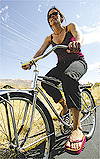
Schwinn’s Aerocycles, and later Phantoms, outfitted with tires wide enough to handle the sands of Southern California’s beach towns, were the likely ancestors of today’s tricked-out rides. Like Marilyn Monroe, these bikes are classics today not because of their talent, but because of their looks.
Introduced in 1949, the Phantom marked a pivotal moment in bike history when right-brained designers found a louder voice than machine parts engineers. In both cars and bikes, American post-war jubilation manifested in outlandish ornamental designs that, mechanical efficiency aside, became instant classics.
 The
modern cruiser renaissance did not start in earnest until the early 1990s.
In 1993, Schwinn retooled some of its classic models and officially
introduced a line of cruisers. “The retro boom of the early ’90s was in, and
we really rode that wave quite well,” said Chris Holmes, senior marketing
manager at Pacific Cycle, current owners of the Schwinn name. That same
year, Southern California’s Electra Bikes, a cruiser-only company, casually
rolled into existence, though it wouldn’t be truly competitive with Schwinn
for nearly a decade.
The
modern cruiser renaissance did not start in earnest until the early 1990s.
In 1993, Schwinn retooled some of its classic models and officially
introduced a line of cruisers. “The retro boom of the early ’90s was in, and
we really rode that wave quite well,” said Chris Holmes, senior marketing
manager at Pacific Cycle, current owners of the Schwinn name. That same
year, Southern California’s Electra Bikes, a cruiser-only company, casually
rolled into existence, though it wouldn’t be truly competitive with Schwinn
for nearly a decade.
In the Wood River Valley, the cruiser craze spread like a disease. In the mid-’90s, sales were gradual; the California-based movement was in its infancy and numbers were still low. Todd Byle, manager of Sturtos Bike Shop, recalls selling roughly 10 to 15 cruisers a year. Today, Byle’s annual sales have increased roughly 1,000 percent. At valley stores such as Sturtos, Backwoods and The Elephant’s Perch—shops once dedicated to mountain and road bikes—cruisers have become an economic linchpin, composing roughly a quarter of all bike sales. At the Perch, Dykhouse sells them like candy. “It’s kind of like the M&Ms by the cash register at the grocery store; it’s an impulse buy,” he said, pointing out that the majority of his cruisers retail between $250 and $350. “They are inexpensive enough and stylish enough that people come in and buy, like, three.”
In the last five years, as bike dealers around the Wood River Valley increasingly carried mass-produced cruisers, many local riders tired of the homogeneity. Enter the custom cruiser.
 The
custom can take on many forms. There are gems like Higdon’s rusted antique,
but also countless Frankenstein creations rolling out from behind spring’s
slowly rising garage doors. In this valley, there are fewer finer examples
of the depth and allure of the custom cruiser than those from Jonny Smith
and his C&C Bikes (Choppers & Cruisers). Bikes are a pastime for Smith,
whose “real” job is owner and founder of Dharma Design, a Hailey-based
advertising agency. Labeling Smith a mere hobbyist however, would be like
calling Leonardo da Vinci an enthusiastic doodler. Smith has been building
custom “chopped cruisers” in Hailey for five years, and while the hobby is
essentially a selfish one, through it he has attracted a growing number of
clients willing to spend thousands on something truly different.
The
custom can take on many forms. There are gems like Higdon’s rusted antique,
but also countless Frankenstein creations rolling out from behind spring’s
slowly rising garage doors. In this valley, there are fewer finer examples
of the depth and allure of the custom cruiser than those from Jonny Smith
and his C&C Bikes (Choppers & Cruisers). Bikes are a pastime for Smith,
whose “real” job is owner and founder of Dharma Design, a Hailey-based
advertising agency. Labeling Smith a mere hobbyist however, would be like
calling Leonardo da Vinci an enthusiastic doodler. Smith has been building
custom “chopped cruisers” in Hailey for five years, and while the hobby is
essentially a selfish one, through it he has attracted a growing number of
clients willing to spend thousands on something truly different.
C&C’s Hailey
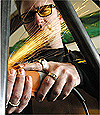
workshop brims with the tools and material of his craft. An old-fashioned
chrome tractor seat, shined to a luster, sits on a worktable, waiting to
become a saddle. Standing in the corner is the ominous roll bender, a huge,
medieval-looking device that shapes steel. A rough suede bag, filled with
175 pounds of lead shot, occupies a table on wheels. The bag is surrounded
by a wide array of hammers, each with its own shape and purpose.
In 2002, the Hellbent became Smith’s first design worthy of a name. He
created its plastic prototype using PVC pipe, duct tape, an electric stove
and hand-drawn sketches. He fired up his kitchen burners, warmed the pipe to
a malleable state and, after 70 hours of labor, had himself a life-sized
model. As for the fumes, “they are pretty deadly,” but such is the price of
passion.
 The
Hellbent’s pedals hang well in front of the seat, giving the bike a
quasi-recumbent feel, while the low-slung saddle permits riders to plant
their feet flat on the ground while seated. As Smith was building the
Hellbent, Electra introduced its Townie series based on the same
chopper-cycle concept.
The
Hellbent’s pedals hang well in front of the seat, giving the bike a
quasi-recumbent feel, while the low-slung saddle permits riders to plant
their feet flat on the ground while seated. As Smith was building the
Hellbent, Electra introduced its Townie series based on the same
chopper-cycle concept.
Today, Smith’s designs are created on computer software, from which he
prints out large-format schematics. Since going digital, he has conceived at
least a dozen bikes, but so far only one has made the leap from virtual to
tangible reality: The Hammerglide. Debuting this summer, this bike is so
freakishly odd that Smith was fielding commission requests before the
prototype ever left the shop.
“One guy wants me to build one with a sidecar for his baby.” Among a number of inventions he is certain exist nowhere else are the Hammerglide’s disc brakes, triggered by a twisting, motorcycle-style handlebar.
For Smith, the fundamental attraction to the cruiser bike is the same as it is for his clients, the same as for any cruiser fan. “People come in and say, ‘I want something that says me. I want something that reflects who I am.’”
As shops and bike racks continue to fill with mass-produced bikes, cruisers that once seemed unique could soon veer into the commonplace. For Smith, and countless hobbyists though, redundancy is an unlikely end to the ongoing cruiser story.