| current issue |
| features |
| The Salmon Nation |
| A Mid-Night Tragedy |
| Redfish Lake |
| arts |
| Kathy Wygle |
| Ketchum Arts Festival |
| SVSS Conservatory |
| living |
| Wedding Dresses |
| Kids' Rooms |
| recreation |
| The Paragliding Mayor |
| Climber Reid Dowdle |
| Croquet |
| dining |
| Farmers' Market |
| Art of Grilling |
| Summer Coolers |
| calendar |
| Summer 2005 |
| to-do |
| Sun Valley Essentials |
| listings |
| Art Galleries |
| Restaurants |
| Lodging |
| Fitness |
| Golf |
| Equipment Rentals |
| Outfitters & Guides |
| maps |
| Ketchum + Sun Valley |
| Local Art Galleries |
| the guide |
| Last Winter |
| Advertising |
| About Us |
| copyright |
|
Copyright
© 2005 Express Publishing Inc. All Rights reserved. Reproduction in whole or in part in any form or medium without express written permission of Express Publishing Inc. is strictly prohibited. |
|
The Sun Valley Guide magazine is distributed free twice yearly to residents and guests throughout the Sun Valley, Idaho resort area communities. |
|
|

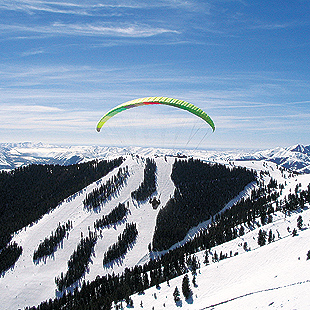
Photo by Peter Hammett
The flying mayor
Ketchum's Mayor Simon takes flight in the skies of Idaho
By Greg Stahl
While political paragliding has not yet taken off in the Sun Valley area, the city of Ketchum’s chief elected official has successfully managed to balance a busy schedule at city hall with his passion for flying.
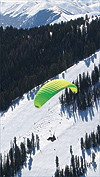
Ketchum Mayor Ed Simon has been flying since May 1989, notching nearly 700 flights on multiple continents in those 15 years. Paragliding photographs of himself on the wall at his Ketchum law office underscore his pride and passion for the sport.
“When you’re flying by yourself, you have total responsibility, and you have the opportunity to see sights and perspectives you couldn’t possibly see from any other vantage,” the flying mayor said. “I’ve been as high as almost 14,000 feet. At that height, I’m almost a mile above the top of Baldy. You really see what a small area we live in. We are really surrounded by mountains and wilderness, and the Ketchum-Sun Valley area is really just a dot on the landscape. You also get a perspective for how beautiful the land is around you.”
But beginning paragliders would do well to heed Simon’s advice: The sport is easy when things are going well, but when the flying gets dicey, experience will pay in spades.
“I have learned from experience the sense of: ‘Oh God, I wish I hadn’t taken off,’” he said. “Now I fly by the motto: when in doubt, don’t.”
Simon, a New York City native, is a local attorney who graduated a Nitany Lion from Penn State University, and arrived here in 1975. He was elected mayor in November 2001 and took office in January 2002. Of his flights, 90 percent have been local, but he’s tested the skies in California, Utah, Mexico, Germany and other locations in Idaho.
He has never been injured while flying, but, particularly during the first several years, he believes his clean bill of health was a matter of luck. He recalled several times he foolishly launched into poor conditions.
 On one
occasion, he retreated from the summit of Bald Mountain, where winds
lashed the mountaintop and prevented a safe launch. When he arrived at
Mid-Holiday, a typically mogul-riddled ski run on the River Run side of
the mountain, the winds felt calm. He launched and quickly got a
first-hand lesson about something paragliders call tree shadow.
On one
occasion, he retreated from the summit of Bald Mountain, where winds
lashed the mountaintop and prevented a safe launch. When he arrived at
Mid-Holiday, a typically mogul-riddled ski run on the River Run side of
the mountain, the winds felt calm. He launched and quickly got a
first-hand lesson about something paragliders call tree shadow.
The trees effectively blocked the wind from the launch location, but as soon as Simon was in flight, the gusts grappled with his parafoil wing, partially collapsing it. He managed to stay airborne long enough to make a safe landing on the south-facing slopes near Lower River Run, several hundred feet down the mountain, but the lesson stuck.
“That was really caused by ignorance of wind conditions and terrain conditions,” he said “That was my most harrowing flight. It can be very easy until you have a problem. You have to be prepared to deal with anything that might go wrong, and you always have to remember there’s another day for flying if it doesn’t look good.”
Simon said there are three things people should learn on the road to becoming a competent paragliding pilot: aerodynamics and functioning of the equipment, micrometeorology and judgment.
Understanding the weather events that can make or break a flight is no small task. Everything from the strength of the wind at launch site, anticipated wind at the landing zone, understanding thermal activity, understanding land features that can influence thermal activity, grasping cloud formations and understanding atmospheric winds are all part of the game.
On another occasion early in his soaring career, the flying mayor launched from a hill above the Sun Valley Golf Course. A large cloud generated a powerful thermal air current called “cloud suck” that rapidly slurped him high into the atmosphere.
“I started going up when I thought I should be going down,” he said. “I couldn’t help but go up.”
He was lucky enough to be near the edge of the uncomfortably strong upward current and flew into gentler conditions before landing near the base of Dollar Mountain.
 The third
and most important aspect of any flying is judgment,” he said.
“Judgment, number one, is knowing when not to take off. At best, knowing
all of these things, you can limit the risk, but you can’t eliminate
it.” He recounted the phrase, there are old pilots, and there are bold
pilots, but there are no old, bold pilots.
The third
and most important aspect of any flying is judgment,” he said.
“Judgment, number one, is knowing when not to take off. At best, knowing
all of these things, you can limit the risk, but you can’t eliminate
it.” He recounted the phrase, there are old pilots, and there are bold
pilots, but there are no old, bold pilots.
Sun Valley is home to a loose-knit community of paragliding pilots, tied a little tighter through a local school and tourist-oriented business called Fly Sun Valley, which offers tandem flights to visitors looking for a bird’s eye view of the Ketchum area.
The most popular launch site is at the top of Bald Mountain, which is some 3,000 feet above the surrounding valley and stands 9,000 feet above sea level. It also has the benefit of ski lift access during summers and winters, but Baldy isn’t the easiest place to fly, Simon said.
“This is one of the technically demanding areas to fly in because we are high desert flying and mountain flying,” he said. “Even at about 1,000 feet above sea level, you lose about 3 percent performance because the air is thinner.”
Each aspect on Bald Mountain can create its own thermal activity, but conditions are generally calmer during morning hours, especially in the summer when thermal and laminar air currents pick up in the afternoons.
On almost any given day during the peak summer and winter seasons, Ketchum pedestrians who keep an eye to the sky will see paragliders descending from Baldy’s lofty summit. Sometimes they drift serenely. Sometimes skilled pilots perform “aerobatic” maneuvers, spinning and spiraling toward the ground.
But the modern daredevils have benefited from years of trial and error, not to mention improvements in equipment.
 At the time
of Simon’s flight certification in 1989, paragliding was even more of a
fringe sport. Pilots flew in rock climbing harnesses and did not have
the benefit of backup parachutes, which are now a standard part of a
pilot’s flight equipment.
At the time
of Simon’s flight certification in 1989, paragliding was even more of a
fringe sport. Pilots flew in rock climbing harnesses and did not have
the benefit of backup parachutes, which are now a standard part of a
pilot’s flight equipment.
Today, pilots wear full-body harnesses and use two-way radios to communicate with each other or someone on the ground during flights.
Also in 1989, pilots learned on their own, rather than doing their first flights as tandems—that is, strapped into the same rig with a more knowledgeable, experienced pilot who can make corrections or take over if things get nasty.
“More was left to chance. Plus, the body of knowledge was less,” Simon said. “Today, we have much more knowledge.”
For aspiring paragliders, Simon suggested looking for a good instructor and being patient with the flying.
“Learn as much as you
can and always fly within the boundaries of your ability,” he said.
“Being humble is probably the most important lesson. There are too many
things you couldn’t possibly prepare for.”
Kind of like politics.
But the flying mayor said he prefers to leave his mayoral duties on the ground.
“Both are unpredictable,” he observed. But they’re also different because when the time comes to fly, “you certainly know you’re not going to be interrupted.” •