| current issue |
| features |
| The Salmon Nation |
| A Mid-Night Tragedy |
| Redfish Lake |
| arts |
| Kathy Wygle |
| Ketchum Arts Festival |
| SVSS Conservatory |
| living |
| Wedding Dresses |
| Kids' Rooms |
| recreation |
| The Paragliding Mayor |
| Climber Reid Dowdle |
| Croquet |
| dining |
| Farmers' Market |
| Art of Grilling |
| Summer Coolers |
| calendar |
| Summer 2005 |
| to-do |
| Sun Valley Essentials |
| listings |
| Art Galleries |
| Restaurants |
| Lodging |
| Fitness |
| Golf |
| Equipment Rentals |
| Outfitters & Guides |
| maps |
| Ketchum + Sun Valley |
| Local Art Galleries |
| the guide |
| Last Winter |
| Advertising |
| About Us |
| copyright |
|
Copyright
© 2005 Express Publishing Inc. All Rights reserved. Reproduction in whole or in part in any form or medium without express written permission of Express Publishing Inc. is strictly prohibited. |
|
The Sun Valley Guide magazine is distributed free twice yearly to residents and guests throughout the Sun Valley, Idaho resort area communities. |
|
|

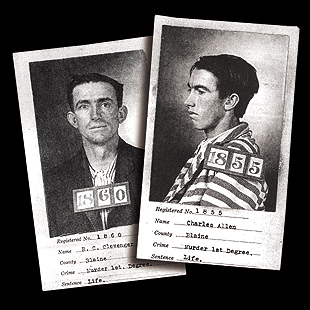
Photos courtesy the Community
Library, Regional History Dept.
A mid-night tragedy
The night the piano player was shot at Dot Allen’s place
By Tony Taylor
Hailey, Idaho, was riding a wave of prosperity in 1911.
Local agriculture, including the livestock industry, enjoyed high prices and high demand. Trainloads of processed ore from the mines and mills rolled out of the valley two or three times a day. The passenger trains that arrived in Hailey carried tradesmen, businessmen and job seekers who wished to share the prosperity in exchange for their hard work.
That was not the case in early September when four drifters, newly arrived by train, would be cast by the Fates to be partners in a terrible crime.
Born in Missouri and orphaned at 7, Charles Crawford spent much of his childhood in a Wyoming orphanage. In 1910, the 17-year-old Crawford traveled to Idaho to take a job as a herder for the Fletcher ranch near Fairfield. Moving from job to job for nearly a year after that, Crawford eventually made his way to the Wood River Valley. When he stepped off the train in Hailey, his first stop in town was to take a room at Rorem’s boarding house on North Second Street.
“Babe” Swift, another young drifter, was staying in the same boarding house and likewise had held a number of incidental jobs around the state. By chance the two young men ended up with rooms across the hall from each other.
Two older men, Charles Allen and Reece Clevenger, also newly arrived, had a room next door. Though of different last names, the two men were, in fact, brothers, separated in age by nine years. Allen, who had been adopted by a Texan woman when he was young, assumed her surname.
The day after arriving in Hailey, Crawford found work at the Smith Ranch two miles north of town. He offered Allen work there, too, but the available work—pitching hay, mucking in the mines and doing menial work for menial pay—did not particularly suit the older Allen. At the ranch gate he decided it wasn’t for him. He got out of the wagon and hoofed it back to town.
The week before, Allen had suggested to his brother that they stage a holdup. With no work on the horizon, the idea now seemed more pressing. The brothers agreed on a plan to rob somebody but had no idea whom to stick up.
Crawford spent that Monday and Tuesday working on the ranch. Swift had a small job unloading freight cars Monday and part of Tuesday. In the meantime, the older men prowled the town looking for a mark and easy money.
Tuesday night the four men ate together at the C.T. Café. Allen paid for dinner, and Clevenger paid for the movie afterward. The men then went for a drink at one of the bars in town. One drink turned into four and before long the men were touring the cathouses on River Street. After two whiskeys at Mabel’s place, the rowdy men were asked to leave. They crossed Bullion Street and went to Georgia’s on River Street. Halfway through the first round of drinks a fight broke out. Crawford pulled a knife on Swift, who wrestled him to the floor and disarmed him. They were asked to leave, but their exit was brief. Allen sent Swift back to the boarding house for a gun.
“I’m getting myself a pimp tonight,” he told him.
Swift returned with the two pistols he owned, firing shots into the Hailey night air at the entrance to Georgia’s. Then, to impress his friends, he rushed inside, feigning shots at the chandelier. The law was called, and the four drunks scurried back to the boarding house on North Second.
Wednesday all four men were hungover and idle all day. One of the patrons in Georgia’s had identified Swift as the shooter from the night before. City Marshal Wylie M. Blair came to the boarding house that afternoon and confiscated both of Swift’s guns.
Swift and Crawford went to the movies together Thursday evening. When they got back to their room at the boarding house about 10 p.m., Allen and Clevenger were waiting for them. They shared a hasty plan with the young accomplices. After casing both Georgia’s and Dot Allen’s, they decided there would be more $20 gold pieces at Dot’s.
The younger men were instructed to be lookouts. They were to protect the rear of the establishment, where the older men would make their escape. Swift tried to back out of the plan, but the others insisted he would not be caught if he ran home as soon the brothers came out the back.
Allen and Clevenger knocked on the front door of Dot Allen’s place. Sing Kee, the bartender, let them in. The men entered Dot’s, their heads low. Allen was wearing Swift’s coat and hat. Both men had bandanas on ready to cover their faces. The bar was empty but for the piano player, Mickey Crowley, and a woman from Georgia’s singing by the piano. Sing Kee went back to cleaning the bar. Dot Allen, the madame, walked down the hall from her bedroom to see who was there. She was wearing a “$1000 necklace” and it seemed to the impromptu bandits a worthier prize than a few $20 gold pieces from the help.
“Hands up!” Allen yelled.
Dot turned heel and
ran back down the hall toward her boudoir. Allen shot at her twice,
missing both times. The trauma of the event, however, overcame the
madame, and she fell in a swoon at the entrance to her bedroom. Allen
fired another wild round. It was then, out of frustration, surprise, or
perhaps panic that Clevenger shot Mickey Crowley in
the back.
Florence Moore, the singer, and the Chinese bartender Sing Kee, bolted from the scene. Kee locked himself in the wine room. Moore escaped through a side door screaming bloody murder all the way to the C.T. Café on Main Street. Three more shots were fired by the duo but all missed their mark.
City Marshall Blair, who was at the C.T. Café having some midnight coffee, drew his gun and followed Moore back to the crime scene. There they found the piano player dead on the floor in a pool of blood. Miss Dot was still unconscious in the hallway. Smoke from the gunshots was so thick that nobody was sure if the villains were still lurking about the establishment. Two of the startled patrons upstairs were nearly shot making their less than dignified exits.
Sing Kee kept the wine room door locked for several hours, ignoring all the pleas from outside to “open up!” He trusted no one.
Having heard the shots fired inside, the two young lookouts ran into the night. Crawford was so panicked that he ran the wrong direction. When he finally made his way back to the rooming house, he found Swift lying in bed with his shoes and clothes on, as if he’d been sleeping there all evening.
The brothers returned a half-hour later. Clevenger took Crawford aside and told him to pin the murder on his roommate Swift. Clevenger assured him that even if he got caught, the sentence would be light. Clevenger further claimed to have a ranch in Glendive, Mont., and he said he would take care of the 17-year-old for the rest of his life in exchange for his testimony convicting Swift.
No one knew at the time that Clevenger was wanted for murder in Glendive and was on the run posing as a land developer.
 The
headlines on the morning paper read: “A MID-NIGHT TRAGEDY—M.J. Crowley
Murdered in Cold Blood.”
The
headlines on the morning paper read: “A MID-NIGHT TRAGEDY—M.J. Crowley
Murdered in Cold Blood.”
Sheriff Hart swore to the now alarmed voters that he would find the murderers and put them all in jail.
By noon the next day, Allen was arrested in Jones’s Barber Shop on Main Street and Clevenger was apprehended in front of Keyes Harness and Saddle Shop on Croy Street. The men denied complicity in the crime and blamed it on the two young men, Swift and Crawford. The brothers had planted Swift’s coat and the two guns used in the fatal shooting behind the Jackson place on North Second. The sheriff soon found the evidence and noted its close proximity to the boarding house where all the suspects had been staying.
When Swift got wind that Allen and Clevenger were arrested, he hitched and walked to Ketchum, then found a ride in an empty ore wagon all the way to Mackay. From there he took the stage to Blackfoot. Several days later he was arrested for vagrancy.
Meanwhile, Crawford was questioned and released. He and a friend hopped a freight train to Richfield the next day. They attempted to burgle a hardware store and were arrested. Crawford was sent to the Blaine County jail. Swift, from his cell in Blackfoot, agreed to turn states’ evidence.
Sheriff Hart,
protecting his unblemished record for always getting his man, retrieved
Swift on Oct. 5
after a 15-hour drive to Blackfoot.
Hart pleaded with the County Commissioners to strengthen the walls in the jail to avoid any jailbreaks.
Angel and Lamme, a local law firm, represented both sides in the case. Angel was the mouthpiece for the defendants. The prosecution hired his partner Lamme.
The trial started on Nov.1 and lasted four days. Both younger men were convicted and got 1 to 10 years for involuntary manslaughter. Clevenger and Allen were both convicted of first-degree murder. The jury voted 9-3 to hang Allen, but as it wasn’t unanimous, he got life in prison instead. Clevenger, too, got a life sentence. •