| current issue |
| features |
| The Salmon Nation |
| A Mid-Night Tragedy |
| Redfish Lake |
| arts |
| Kathy Wygle |
| Ketchum Arts Festival |
| SVSS Conservatory |
| living |
| Wedding Dresses |
| Kids' Rooms |
| recreation |
| The Paragliding Mayor |
| Climber Reid Dowdle |
| Croquet |
| dining |
| Farmers' Market |
| Art of Grilling |
| Summer Coolers |
| calendar |
| Summer 2005 |
| to-do |
| Sun Valley Essentials |
| listings |
| Art Galleries |
| Restaurants |
| Lodging |
| Fitness |
| Golf |
| Equipment Rentals |
| Outfitters & Guides |
| maps |
| Ketchum + Sun Valley |
| Local Art Galleries |
| the guide |
| Last Winter |
| Advertising |
| About Us |
| copyright |
|
Copyright
© 2005 Express Publishing Inc. All Rights reserved. Reproduction in whole or in part in any form or medium without express written permission of Express Publishing Inc. is strictly prohibited. |
|
The Sun Valley Guide magazine is distributed free twice yearly to residents and guests throughout the Sun Valley, Idaho resort area communities. |
|
|

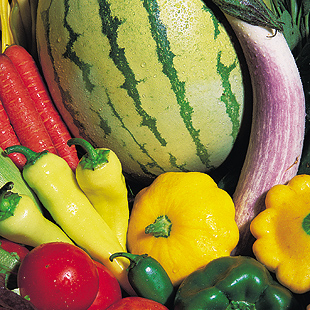
Photo by Paulette Philpot
Feasting on Tuesday's plenty
The Ketchum Farmers’ Market offers a weekly bounty
By Michael Ames
It’s a Tuesday afternoon in July and there are at least five people separating you from the last bunch of purple carrots. Across the open-air market, you barely discern the two remaining seedless Armenian cucumbers. Luckily, no one is biting on the beet greens. Or the white eggplants. The white eggplants are all yours.
You are surrounded by competitive and diverse shoppers, angling for their share of an organic produce cornucopia: meats, jams, desserts, wines, soaps, and dry goods displayed by the growers, mixers and makers of the Ketchum Farmers’ Market.
“Sometimes, you get to thinking about yellow beets and purple carrots and things like that,” says Clarence Stilwill of the farmers’ whimsies that, in turn, supply us, the endless stream of veggie-conscious shoppers, with an ever-changing lineup of locally grown foods.
Raspberries. Mustard greens. Fudge sauce. Shallots. White beets. Tea bread. Chutneys.
Stilwill and his wife, Tona, have owned and operated Fair Mountain Farm in Fairfield since 1998, the year they moved onto the century-old farmstead, run down, but replete with apple, pear, and plum trees, and seven rich acres of soil.
 For the
Stilwills, the move was not aimed towards leisure; it was a lifestyle
and career change with a primary focus on the land. Stilwill, 63, former
editor and publisher of Valley Magazine, Idaho Golf, and Heartland USA,
has lived in the Sun Valley area for “about 40 years.” In a past life he
owned Slavey’s, a former Ketchum saloon. The jump from magazine
publisher and bar owner to organic farmer was a surprisingly simple one.
For the
Stilwills, the move was not aimed towards leisure; it was a lifestyle
and career change with a primary focus on the land. Stilwill, 63, former
editor and publisher of Valley Magazine, Idaho Golf, and Heartland USA,
has lived in the Sun Valley area for “about 40 years.” In a past life he
owned Slavey’s, a former Ketchum saloon. The jump from magazine
publisher and bar owner to organic farmer was a surprisingly simple one.
“We were seeking self-sufficiency, in our personal and daily life,” he recalls, and “turned that, almost accidentally, into a thriving little business.”
Amazingly, to grow their weekly load of 100 pounds of lettuce, 75 pounds of arugula, 75 pounds of spinach and every other living, edible thing they pull out of the ground, the Stilwills use only one growing acre.
At the age of 55, with no experience in farming, Stilwill began what has now become the region’s standard-bearer organic farm. Fair Mountain Farm supplies a constantly changing selection of produce, prepared foods, and animal products such as eggs and honey to the Sawtooth Botanical Gardens “farm-share” program, local gourmet restaurants, Atkinsons’ Markets, and the Ketchum Farmers’ Market.
Still, the Tuesday farmers’ market is the focal point of their activity in the valley.
“The market turned out to be the cornerstone of our business, not only financially, but the interaction, in a way, it’s a social life for us,” says Stilwill. With a health-conscious population, the Wood River Valley provides farmers a grateful and curious clientele.
"We really like having a huge panoply of choice,” says Stilwill.
Walla Walla sweet onions Green beans. Rhubarb. Yellow beans. Basil. Purple Beans. Cabbage. Haricot verts.
 Jeanne Grant,
who together with husband Mick owns and operates Market Garden of
Gooding, feels the same appreciation for the Tuesday market.
Jeanne Grant,
who together with husband Mick owns and operates Market Garden of
Gooding, feels the same appreciation for the Tuesday market.
“One of the things I value the most about the market is the diversity of people, a broad range who come together, who believe in the local food and serving the community,” she says.
For the Grants, the return to the land was not dissimilar from the Stilwills. After years of living and working overseas in exotic locales such as India and Southeast Asia, the Grants returned to Idaho.
“After three years in India, I said ‘You know, I’d like to go home,’” says Jeanne, originally of Twin Falls. Mick is English and the couple met on the northside of Borneo, in Brunei, where they were both working.
Jeanne, who kept a roof garden atop a New Dehli apartment building, has always fostered a love for growing her own food. After a few seasons selling in a Twin Falls market and growing in Hagerman, the Grants found their permanent farm in Gooding. Since then, they have built a stone oven where Mick creates his market staple “Mick’s Breads,” organic artisan creations that have always been “his passion,” says Jeanne.
In 2002, the Grants joined three other farming couples they met through the Ketchum and Hailey Farmers’ Markets—the Stilwills, Fred and Judy Brossy of Shoshone, and Jeff and Carol Rast of Fairfield—in applying to the Idaho State Department of Agriculture for a Specialty Crop Grant. All four were approved and used the money to build season-extending greenhouses on their farms. Today, both the Grant’s Market Farm in Gooding and the Brossy farm in Shoshone can grow organic produce year round in a low-impact, no-heat, no-electricity greenhouse.
To the delight of their loyal clients, Market Farm offers an off-season delivery service in Hailey and Ketchum. By subscribing to a weekly email newsletter, the produce-deprived can find their summer favorites year round. Additionally, the Grants use the ethnic culinary skills acquired from years abroad in weekly meals, often of an Indian theme, always vegetarian and always fresh.
Baby squash. Grass fed beef. Yellow tomatoes. Japanese eggplant. Heirloom tomatoes. Morels. Kumquat soap.
To the farmers and buyers alike, farmers’ markets provide some of those basic, perhaps forgotten values: a return to the time and products of the land, community, and, of course, locally grown healthy foods.
“When in your life do you get to find a community that is this diverse?” asks Jeanne Grant. “You have everything from the Pagans to Mennonites here. The people have become dear to us,” she says.
 “In a small
way, we have tried to work our way back to face to face communication
and the land,” says Stilwill.
“In a small
way, we have tried to work our way back to face to face communication
and the land,” says Stilwill.
These farmers have achieved what remains just a dream to many. For Stilwill, that dream is being able to “step off your porch and go to work.” He and Tona have found that on the farm they “live their lives a little bit more in the present.”
On Fair Mountain Farm, a full day’s work has immediate dividends, delivered weekly to the Tuesday market.
The Stilwills return to that market, week after week, with an unwavering message: “Present healthy, good stuff to people and teach them how it’s grown.” •