| current issue |
| features |
| The Salmon Nation |
| A Mid-Night Tragedy |
| Redfish Lake |
| arts |
| Kathy Wygle |
| Ketchum Arts Festival |
| SVSS Conservatory |
| living |
| Wedding Dresses |
| Kids' Rooms |
| recreation |
| The Paragliding Mayor |
| Climber Reid Dowdle |
| Croquet |
| dining |
| Farmers' Market |
| Art of Grilling |
| Summer Coolers |
| calendar |
| Summer 2005 |
| to-do |
| Sun Valley Essentials |
| listings |
| Art Galleries |
| Restaurants |
| Lodging |
| Fitness |
| Golf |
| Equipment Rentals |
| Outfitters & Guides |
| maps |
| Ketchum + Sun Valley |
| Local Art Galleries |
| the guide |
| Last Winter |
| Advertising |
| About Us |
| copyright |
|
Copyright
© 2005 Express Publishing Inc. All Rights reserved. Reproduction in whole or in part in any form or medium without express written permission of Express Publishing Inc. is strictly prohibited. |
|
The Sun Valley Guide magazine is distributed free twice yearly to residents and guests throughout the Sun Valley, Idaho resort area communities. |
|
|

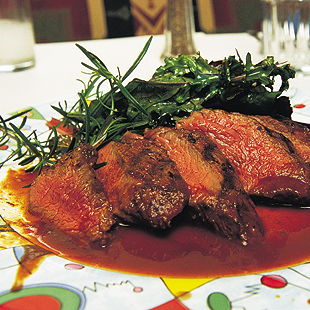
Photo by David N. Seelig
the art of grilling
By Greg Foley
In Mexico, it is called “la parilla.” In Italy, it’s known as “la griglia.” Virtually wherever one travels in the world today, there are fondly used terms to describe the grill.
The reasons are really quite simple. Grilling foods directly over fire or coals is the most primitive form of cooking, shared for millennia by cultures across the globe. And whether for cooking meats, fish or vegetables, the minimalism of the grill has been tested and proven generation after generation. But most of all, it’s because wherever you are—in a backyard, a riverside camp or a fine restaurant—foods cooked over a fire simply taste great.
“I like the simpleness of the grill,” said Scott Mason, executive chef and owner of Ketchum Grill, in downtown Ketchum. “With some foods, all you need to add is a little olive oil and a little salt. It’s a real Old World style of cooking.”
The process of grilling delectable foods starts with preparing the fire. Some cooks opt for using grills that employ old-fashioned charcoal briquettes or hardwood charcoal chunks, while others prefer the convenience of gas grills. Most trained chefs agree that cooking over hardwood coals—instead of a gas-fueled flame or charcoal—provides a more consistent, user friendly heat source and renders pure, true-wood flavors that can’t be beat.
At Ketchum Grill, Mason uses a wood-fired grill stoked primarily with hard fruitwoods, including apple and cherry wood.
“They have a substantial moisture content,” Mason said. “It helps keep the food moist.”
At The Sawtooth Club in Ketchum, billed as the first restaurant in Idaho to cook over a wood fire, chefs use only one type of wood: Texas mesquite.
“The wood imparts a variety of subtle, slightly smoky flavors,” said restaurant owner Tom Nickel. “It’s unmistakable, and you don’t have to do a whole lot to the food.”
All sorts of foods can be grilled successfully, including meats, poultry, game, fish and vegetables. And, compared to some other methods of cooking, grilling can yield a healthier finished product. The foods are not cooked in fat, as in sautéing, and much of the fat they carry drips away, into the coals.
In the West, grilling steaks and ground beef is synonymous with summer. Steaks that are marbled with fat can simply be brushed with olive oil, sprinkled with salt and pepper and put right onto the grates. Leaner cuts, such as London broil or flank steak, benefit more from marinades.
 In
all situations, Mason said, the heat of the fire should always be gauged
to the thickness and sensitivity of the food being prepared. Foods that
take longer to cook must be grilled over a lower heat.
In
all situations, Mason said, the heat of the fire should always be gauged
to the thickness and sensitivity of the food being prepared. Foods that
take longer to cook must be grilled over a lower heat.
“If you cook a thick steak over high heat, it’s just going to be burned on the outside and raw in the middle.”
Chicken, which can easily dry out on the grill, also lends itself well to being marinated and basted over the flames, but tastes divine when grilled with a simple mix of herbs and spices. In either scenario, grilling chicken in its skin can produce a crisp outer layer that locks in the meat’s juices. Mason recommends cooking poultry 80 percent of the way on the skin side and then finishing it on the interior side.
Grilled fish and shellfish can be perfect for lighter meals on warm summer evenings. Whole fish, filets or steaks can all be cooked successfully over a fire, but as with grilling meats, one must ensure the heat is not excessive. Fish cooks fast on the grill and can dry out very quickly.
Steaks cut from fish with sturdy flesh—such as tuna and salmon—work especially well on the grill. Smaller fish, such as trout and red snapper, are superb grilled whole.
Vegetables can be cooked on the grill in a variety of ways. Summer squash, eggplant, red peppers and zucchini can all be sliced or halved, brushed with olive oil and cooked right on the grates. Portobello mushrooms are best when cooked whole, but like most vegetables, can be sliced, skewered and grilled to perfection.
At The Sawtooth Club,
grilling is the preferred method for cooking most vegetables.
“We often just brush them with olive oil and balsamic vinegar,” Nickel
said. “It’s a real treat.”
In preparing grilled foods, the options for adding seasonings and sauces are abundant. In summer, Mason likes to focus on creating Latin-style flavors, using ingredients such as garlic, cumin, cilantro, lime and olive oil. And although old-fashioned barbecue sauces still abound, many chefs will recommend substituting a sauce that is based from an acidic food—such as vinegar, wine, tomatoes or soy sauce—or a salsa made from fruits or vegetables.
Through a little experimentation, Nickel said, one is certain to learn one thing about cooking on a grill: It’s not just for the Fourth of July anymore.
“For me, grilling is the way to go.” •