| current issue |
| features |
| Crossing the Frank |
| WWII Warbirds |
| The Casino Club |
| The Harriman Trail |
| arts |
| Dick Brown's choral |
| Sculptor R.C. Hink |
| Sun Valley Opera |
| Local Shakespeare |
| living |
| Garden Rooms |
| Sheep Wagon Redux |
| recreation |
| The Fosbury Flop |
| Motorcycle the SNRA |
| Hiking the Smokys |
| dining |
| Wines of Summer |
| All Things Cheese |
| Ice Cream |
| calendar |
| Summer 2004 |
| to-do |
| Sun Valley Essentials |
| listings |
| Galleries |
| Dining |
| Fitness |
| Golf |
| Equipment Rentals |
| Outfitters + Guides |
| Lodging |
| maps |
| Ketchum + Sun Valley |
| Hikes on Harriman |
| Local Art Galleries |
| the guide |
| Last Winter |
| Advertising |
| About Us |
| copyright |
| Copyright
© 2004 Express Publishing Inc. All Rights reserved. Reproduction in whole or in part in any form or medium without express written permission of Express Publishing Inc. is strictly prohibited. |
Produced & Maintained by Express Publishing, Box 1013, Ketchum, ID 83340-1013 208.726.0719 Voice 208.726.2329 Fax info@svguide.com |
| The
Sun Valley Guide is distributed free twice yearly to
residents and guests throughout the Sun Valley, Idaho resort area
communities.
Subscribers to the Idaho Mountain Express will receive the Sun Valley Guide inserted into the paid edition of their newspaper. |

Sleeping in style
by
Megan Thomas
Gone are the days of the minimalist sheepherder wagon. The historically utilitarian horse-drawn housing has come into its own as a “land yacht,” says Tom Hale.
Before the sheepherder wagon gained such prestige, it could be found traveling slowly over Idaho trails and easements that led to open grazing lands. The simple mobile homes provided bare bones shelter and necessities for the state’s Basque, Scottish and Peruvian sheepherders at a time when sheep, not ski conditions, dictated the Wood River Valley economy.
History maintains that during the late 1800s, the sheep industry in Ketchum topped the nation, second only in the world to Sydney, Australia. In the early days and until recently, sheep wagons graced the valley as primitive homes.
Although the wagons are still occasionally seen following the herds each spring and fall through the valley, times have changed and so have the wagons.
These days, homeowners are recycling abandoned sheepherder wagons into elaborate retreats, hideaways for overnight guests, romantic escapes and playhouses for children. The restoration of sheepherder wagons is an enchanting embrace of a bygone era.
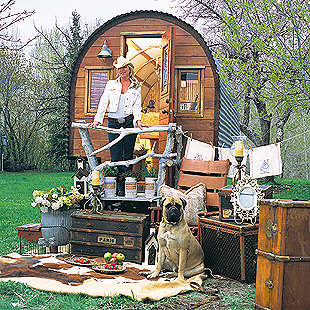
At first glance, sheep wagons, like the one resting outside Chateau West Interiors in Hailey with iron wagon wheels and curved tin roof, appear to be left behind by a careless herder. A closer glance at the aged wooden siding complemented by a pine front deck and stained glass windows reveals a world far removed from the rustic purposes.
•
With the help of the right craftsman, sheep wagons now adventure on a path that is part restoration, part recycling and part recreation. Tom Hale is a Ketchum carpenter who has refurbished four sheepherder wagons. What began as a challenge to complete an unfinished project has led to a hobby of sorts.
When he is not working at his day job, Hale reconstructs wagons and ventures into architectural mastery, including his most recent wagon outside Chateau West. Hale found the base of the 100-year-old original sheepherder wagon near Mackay and transformed it into a decorator’s dream.
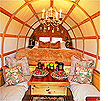
The interior showcases a floor, table and short walls made from the recycled mahogany of the River Street Retreat. Hale installed antique leaded windows on each side of the front door and an old enamel cast iron sink that drains to the outside. The wagon also has the conveniences of modern architecture with indoor outlets, electric lighting and full insulation.
Restoration work is time consuming and can take from six weeks to two months.
 “You
have to put together something that is not level or straight, Hale
explains. “It is almost like working on a boat; all ovals and small
spaces.”
“You
have to put together something that is not level or straight, Hale
explains. “It is almost like working on a boat; all ovals and small
spaces.”
Hale works magic with the limited space. Raising the roof, for example, significantly increases the perception of the space.
Hale refurbishes the wagons and decorators take the space in creative directions.
Decorator Susie Tetta of Chateau West designed the interior of Hale’s wagon “a little foofy and Western.” She even added a crystal chandelier to illuminate its romantic atmosphere.
After traveling through Custer and Blaine counties from Stanley to Picabo, the “Querencia” wagon now rests in Ketchum.
Claire Turner, an experienced interior designer, spent four months transforming the Querencia into a whimsical bedroom. She received the wagon as a birthday present from Pat Millington, former owner of the Susie Q Ranch near Picabo who developed a fascination with the wagons after delivering mail to sheepherders and seeing how they lived.
License plates from Idaho, California, Montana, New York and Oklahoma, all states Turner has called home, decorate the Querencia’s siding. The imaginative incorporation of the license plates conjures an unintentional metaphor for the intriguing journey of the modern sheepherder wagon.
Turner chose to raise the custom bows one foot above the previous height to allow more headroom and extended the wagon three feet to accommodate a queen size bed. Surprisingly, the small extension of space eliminates any sense of claustrophobia. Also, by carefully economizing the limited space, with tables that pull out from under beds and storage bins hidden under benches, sheep wagons are far roomier than one might expect.
A Western theme is carried by recycled Idaho artifacts and salvaged antiques from the Susie Q Ranch, like the stained glass windows. Every interior detail, from the 1905 elk doorknob to the Wells Fargo Express lamp, transports visitors to the Old West. The Western elements were carefully collected, including the cabinets with a weathered finish that Turner said may “look like Martha Stewart crackle but it’s the real thing”—century-old wood from Montana.
The wagon on the Dalzell property in Ketchum maintains the Western feel but serves a slightly different purpose: It’s a playhouse for children. According to Sue Dalzell, her grandchildren love to go out to it.
“It’s a place for them to play, eat and sleep,” says Dalzell.
The wagon features low, child-sized counter tops, tin cups and a single bed decorated in green gingham. A birdhouse nailed to the front invites youngsters into the space decorated with vintage postcards of Ketchum and Sun Valley. The wagon even has a skylight.
With luxuries like skylights, chandeliers and mahogany, sheepherder wagons have journeyed far beyond their origins.
As “land yachts,” the whimsical wagons preserve the story of Idaho’s sheepherders. If only the walls could talk. •