| current issue |
| features |
| Crossing the Frank |
| WWII Warbirds |
| The Casino Club |
| The Harriman Trail |
| arts |
| Dick Brown's choral |
| Sculptor R.C. Hink |
| Sun Valley Opera |
| Local Shakespeare |
| living |
| Garden Rooms |
| Sheep Wagon Redux |
| recreation |
| The Fosbury Flop |
| Motorcycle the SNRA |
| Hiking the Smokys |
| dining |
| Wines of Summer |
| All Things Cheese |
| Ice Cream |
| calendar |
| Summer 2004 |
| to-do |
| Sun Valley Essentials |
| listings |
| Galleries |
| Dining |
| Fitness |
| Golf |
| Equipment Rentals |
| Outfitters + Guides |
| Lodging |
| maps |
| Ketchum + Sun Valley |
| Hikes on Harriman |
| Local Art Galleries |
| the guide |
| Last Winter |
| Advertising |
| About Us |
| copyright |
| Copyright
© 2004 Express Publishing Inc. All Rights reserved. Reproduction in whole or in part in any form or medium without express written permission of Express Publishing Inc. is strictly prohibited. |
Produced & Maintained by Express Publishing, Box 1013, Ketchum, ID 83340-1013 208.726.0719 Voice 208.726.2329 Fax info@svguide.com |
| The
Sun Valley Guide is distributed free twice yearly to
residents and guests throughout the Sun Valley, Idaho resort area
communities.
Subscribers to the Idaho Mountain Express will receive the Sun Valley Guide inserted into the paid edition of their newspaper. |

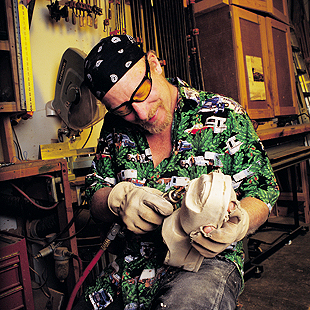
photo by David N. Seelig
The
Hinkian
world of whimsy
by Michael Ames
There are no squares in nature … and my work is all about nature,” says Wood River Valley sculptor R.C. Hink.
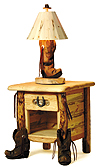
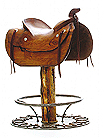
Also absent from nature are carved cowboy boots, bisected fish or stools with horse legs—all regular elements of Hink’s artistic vision.
Hink considers himself a humorist first, an artist second. His work is immediate in its whimsy.
 Step
into the Lynn Toneri-R.C. Hink Gallery in Ketchum and one finds carved
wooden cowboy hats hanging off the backs of hand carved chairs. Walls
are festooned with leather tassels, wooden guns, wooden horseshoes and
critters of all persuasions. Look up, the ceiling may feature the
underbellies of swimming trout or the paddling feet and feathery caboose
of a mallard. Take a seat on an elk hide stool. Kick the carved elk hoof
legs.
Step
into the Lynn Toneri-R.C. Hink Gallery in Ketchum and one finds carved
wooden cowboy hats hanging off the backs of hand carved chairs. Walls
are festooned with leather tassels, wooden guns, wooden horseshoes and
critters of all persuasions. Look up, the ceiling may feature the
underbellies of swimming trout or the paddling feet and feathery caboose
of a mallard. Take a seat on an elk hide stool. Kick the carved elk hoof
legs.
Relax. This is the world of R.C. Hink.
Hink has been working and selling his idiosyncratic, Western-tinged art in the Wood River Valley since the early 1980s.
Born near Bozeman, Mont., in 1956, Hink’s was a classic Western childhood steeped in the abundant wildlife of endless backyards. “The first thing I ever carved was a trout. Then I cut it in half and put the tail in one room with the head coming through the wall in the other.”
Thus began Hink’s quirky artistic journey that now finds him building complex bedroom sets, huge timber chairs and a menagerie of Wild West paraphernalia.
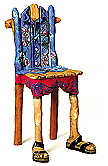
Hink uses a wide variety of woods: “alder, walnut, pine, birch, juniper, but most of my stuff is linden, also known as basswood.”
 Most
of Hink’s wood is locally harvested, standing dead wood. “Why cut down
something alive?” he asks.
Most
of Hink’s wood is locally harvested, standing dead wood. “Why cut down
something alive?” he asks.
Linden is a durable though softly textured wood with few knots. The peach fuzz surface encases a very hardy building material. “It won’t split or crack and can handle the abuse you expect from a bench with wooden cowboy boots for legs.”
When Hink first started building furniture in high school, he never thought the pastime could blossom into a career. Most of that early furniture, in a testament to its durability, still stands at his parents’ Mesa, Ariz., home.
The solidity of his wooden sculpture and furniture has roots in his early experiences with construction. “I was building houses and simple furniture,” Hink remembers. “But those were just boxes and squares. Is the human body a square?”
Hink is the rare type of person who not only knows what he believes, but strictly orders his life and work around those beliefs. He wanted to do something fun with this life and has. He dons a Hawaiian shirt in mid-winter, pulls the cord on his chainsaw and creates fanciful pieces of art.
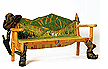 Hink
rejects the notion that his furniture is mere folk art or pure kitsch.
Hink
rejects the notion that his furniture is mere folk art or pure kitsch.
“Folk art is primarily functional. I take folk art and elevate it—with humor and fun and imagination—to fine art,” he says.
Hink’s list of influences is short. After noting that he likes some Frank Lloyd Wright architecture, he grins broadly and names his wife, Lynn Toneri, as his main influence.
Toneri has been an artist and gallery owner-operator in the Wood River Valley for 25 years. Her current Lynn Toneri-R.C. Hink Gallery is in the heart of Ketchum at Sun Valley Road and Leadville Avenue. She has managed galleries in 11 different valley locations and has included her own work in all of them. It seems natural, but most art gallery owners are not artists.
Toneri is a watercolorist whose work focuses on Sun Valley scenics and wildlife. The couple’s gallery is an intimate space that invites the casual walk-in customer to linger. Hink’s benches and stools invite a visitor to sit. So, one sits and gazes upon Toneri’s countless watercolors. And because in this gallery the owners are also featured artists, stories of the works’ origins begin to flow through conversation. Toneri’s Jack Russell terrier, Brandy, approaches and offers a belly for scratching. Visitors listen to the artists discuss their work, scratch the dog and linger.
 Toneri
and Hink share a gallery, a life and artistic careers. Curiously, both
are also ambidextrous. They critique each other’s work, but usually in
playful terms. “I give unsolicited advice,” Toneri says. “Too many
boots,” she whispers aside, referring to the ubiquitous carved boots in
Hink’s work.
Toneri
and Hink share a gallery, a life and artistic careers. Curiously, both
are also ambidextrous. They critique each other’s work, but usually in
playful terms. “I give unsolicited advice,” Toneri says. “Too many
boots,” she whispers aside, referring to the ubiquitous carved boots in
Hink’s work.
“I’ve probably carved over a thousand cowboy boots,” he boasts.
Hink works mostly with chainsaws at his Bellevue studio and averages four studio days a week. He spends his remaining time in his wife’s gallery. Married only five years, these newlyweds are tough to separate.
Occasionally their work and play overlap.
A favorite pastime for this pair is snorkeling, but they don’t save this warm-weather pursuit for southerly vacations. “We snorkel here in Idaho, in Silver Creek,” he says.
And the fish they see together are reborn in the gallery in two- and three-dimensional forms.
The pair is often in the gallery together, endlessly reshuffling arrangements and generally having a good time. This is no stuffy art gallery. Visitors won’t find imposing modern art. This is down to earth. “We get repeat visitors who come just because they say it makes them feel better to be here,” Toneri says. •