| current issue |
| features |
| Crossing the Frank |
| WWII Warbirds |
| The Casino Club |
| The Harriman Trail |
| arts |
| Dick Brown's choral |
| Sculptor R.C. Hink |
| Sun Valley Opera |
| Local Shakespeare |
| living |
| Garden Rooms |
| Sheep Wagon Redux |
| recreation |
| The Fosbury Flop |
| Motorcycle the SNRA |
| Hiking the Smokys |
| dining |
| Wines of Summer |
| All Things Cheese |
| Ice Cream |
| calendar |
| Summer 2004 |
| to-do |
| Sun Valley Essentials |
| listings |
| Galleries |
| Dining |
| Fitness |
| Golf |
| Equipment Rentals |
| Outfitters + Guides |
| Lodging |
| maps |
| Ketchum + Sun Valley |
| Hikes on Harriman |
| Local Art Galleries |
| the guide |
| Last Winter |
| Advertising |
| About Us |
| copyright |
| Copyright
© 2004 Express Publishing Inc. All Rights reserved. Reproduction in whole or in part in any form or medium without express written permission of Express Publishing Inc. is strictly prohibited. |
Produced & Maintained by Express Publishing, Box 1013, Ketchum, ID 83340-1013 208.726.0719 Voice 208.726.2329 Fax info@svguide.com |
| The
Sun Valley Guide is distributed free twice yearly to
residents and guests throughout the Sun Valley, Idaho resort area
communities.
Subscribers to the Idaho Mountain Express will receive the Sun Valley Guide inserted into the paid edition of their newspaper. |

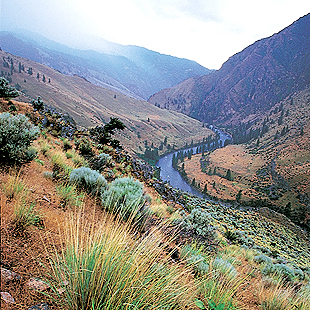
photo by Matt Leidecker
'A
lifestyle gone by'
Crossing the Frank Church
Wilderness by pack string
by Matt Furber
When Jake Lemon first proposed the idea of traveling the Rockies with a string of pack mules, longtime friend Bob Jonas turned him down.
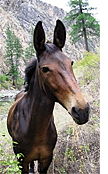
For Lemon, the mules were his ticket to the backcountry. An avid outdoorsman struggling with a bad back, Lemon considered the mules—Bernie, Rosie and Jed—a good solution.
Jonas thought the proposed six-month, Hailey to Mexico trip an interesting adventure but a hell of a challenge for two fellows unfamiliar with unruly draft animals. It was not the Ketchum wilderness guide’s idea for how to best spend the summer and fall. But Lemon was not to be dissuaded.
“He countered with the Frank Church, and I accepted,” Jonas said, referring to the wild heart of Idaho, the Frank Church-River of No Return Wilderness Area. “Jake didn’t have to take another breath before he said, ‘Let’s do it.’”
Easier said than done, of course.
 Jonas’ goal in
pursuing the historic type of travel was to scope out new wilderness
areas for a program he started called the Wild Gift. The mission of the
nonprofit organization is to provide future leaders, from 18 to 30, with
an experience in deep wilderness travels. The goal is to encourage
leadership skills that might benefit the human and natural communities.
The mules were a test of leadership skills.
Jonas’ goal in
pursuing the historic type of travel was to scope out new wilderness
areas for a program he started called the Wild Gift. The mission of the
nonprofit organization is to provide future leaders, from 18 to 30, with
an experience in deep wilderness travels. The goal is to encourage
leadership skills that might benefit the human and natural communities.
The mules were a test of leadership skills.
“I had already identified the Frank as one of three deep wilderness classrooms (for the Wild Gift),” Jonas said. “For me, in a literal sense, a wilderness experience is when I can start at a trail head and go for 50 miles and have it not be a motorized corridor.”
In the Western U.S., “the Frank” is one of the few areas where travelers can have such an experience.
The designated National Forest wilderness is 2.6 million acres and the largest wilderness area in the continental United States. It encompasses the drainage of the Middle Fork of the Salmon River, one of America’s charter Wild and Scenic Rivers. The Salmon River—“The River of No Return’’—also is one of the nation’s first designated Wild and Scenic Rivers. It marks the northern boundary of the Frank.
“Wilderness has other definitions for me, too,” Jonas said. “Being in the bowels of that kind of country, you really have the sense that you are away from man and the village ... you encounter few or no people.”
The Frank is rugged mountainous country with high, glaciated peaks and deep river canyons. The Salmon River and Middle Fork canyons are deeper than the Grand Canyon, and the Salmon canyon is second only to Idaho’s Hells Canyon, the deepest gorge in the continental U.S.
•
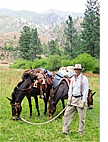
The first problem for Jonas and Lemon was finding the right animals and hoping they were compatible with each other and their handlers, and comfortable with carrying kitchen boxes and tack.
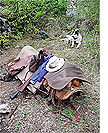
The pair spent many hours working with the mules, learning how to load, feed and care for them, and keep the pack string from getting lost.
 “A pack string ...
that’s a word that means a lot,” Jonas said. “I am intrigued by that
whole milieu. I gained a better appreciation, a commercial sense of what
was so common in the West, especially at the end of the road.”
“A pack string ...
that’s a word that means a lot,” Jonas said. “I am intrigued by that
whole milieu. I gained a better appreciation, a commercial sense of what
was so common in the West, especially at the end of the road.”
Travel with three mules requires constant packing.
The two pack string greenhorns consulted professional outfitters and studied a number of literary resources, including “Horses, Hitches and Rocky Trails,” Joe Back’s book often referred to as the horse packer’s bible. Born in 1889, Back moved to Wyoming at age 13, where he became an accomplished artist whose work is part of his book. But, in addition to being famed for his art, he also became an expert packer at a much younger age than Jonas and Lemon.
But, it’s never too late to learn, said Jonas.
At the beginning of their trip last summer, Jonas and Lemon put on the trail up the Yankee Fork north of Sunbeam, which is on Highway 75 between Stanley and Salmon.
With the help of friends John Vladimiroff and Wanda Cole, Jonas and Lemon ironed out many of the glitches in their pre-departure training with the animals.
“They were with us for the first 10 days, by then we got the packing down,” Jonas said.
The couple also helped Jonas and Lemon with their first re-supply.
“(A pack string) speaks to a lifestyle gone by,” Jonas said.
Although Jonas has an appreciation for the mode of travel, he had no interest in riding. “Never got on the mule for a single stride,” he said.
Loaded and strung together by “pigging string,” mules can move faster than a man hiking with a backpack. “Once they were all pigged, I never saw Jake again until he had a rodeo,” Jonas said.
One “rodeo” happened when Rosie knocked a kitchen box off her load on Waterfall Trail. She bumped Bernie, Lemon’s riding mule, who spooked, broke loose and took Lemon down a steep slope with the kitchen box.
The box slid down the slope about 150 yards, but Lemon and the mules all fared well. “It was a tribute to Jake’s riding skills and being able to handle the animals,” Jonas said.
The team of mules and
men had one week of clear horizons before summer fires started in the
area.
Evidence of wildfires even from the 1980s was the biggest surprise on
the trip, Jonas said. “(Saws were) absolutely a necessity ... (there
were) tremendous fire blow-downs,” he said.
In 2000, the Forest
Service evacuated the wilderness area because the fires were so intense.
Jonas and Lemon were not forced to leave, but they said even with a
crosscut saw to help clear the way, the team made a circuitous route in
the difficult terrain.
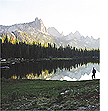 One of the biggest
fires of the season started at Falconberry, a famous outfitter’s camp
abandoned when the wilderness designation was established in 1980.
One of the biggest
fires of the season started at Falconberry, a famous outfitter’s camp
abandoned when the wilderness designation was established in 1980.
“We were probably the last two to visit the place before it burned down,” Jonas said. “We had smoky horizons the rest of the trip.”
For the most part the team camped near water and places where the mules could graze. They carried some grain, but it was mostly used as a treat to keep the mules loyal.
Their shakedown cruise took 41 days.
•
From the Yankee Fork
River the team headed to the
Loon Guard Station, Loon Creek and the Diamond D Ranch. They climbed
5,000 feet up Cache Creek to Sleeping Deer and headed north to Martin
Mountain, then down 5,000 feet to Flying B Ranch.
The Middle Fork splits the Frank. The east side is where Jonas and Lemon did the first part of their travels. Along the way are a number of backcountry landing strips and ranches.
Traveling the side canyons, tributaries flowed bigger than the Big Wood River, Jonas said. They did much of their traveling in higher country and witnessed the impact of blow-downs that happened over the winter, too. “Horse travelers must have a saw,” Jonas said.
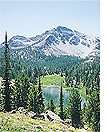
Jonas and Lemon spent two restful weeks in a popular area for backpackers and climbers called the Big Horn Crags. There the Forest Service had worked on the trails. They visited most of the lakes and went on day hikes, spending time peak bagging and fishing.
 Jonas’ wife, Sarah
Michael, and a friend, Karin Fisher, joined the trekkers there and added
Jonas’ dog Buck to the mix. “He became part of the string and stayed
away from the mules,” Jonas said.
Jonas’ wife, Sarah
Michael, and a friend, Karin Fisher, joined the trekkers there and added
Jonas’ dog Buck to the mix. “He became part of the string and stayed
away from the mules,” Jonas said.
During that time, Jonas said they experienced a katabatic wind in the trees, a wind that blows forcefully down a slope, like cold air off a glacier.
It occurred near Loon Creek, where they were the last to see the historic ghost quarters of the abandoned Falconberry outfitter’s camp intact.
However, the summer heat was intense, Jonas said. It was often 100 degrees Fahrenheit.
“We would tie up (and get in the river) bare-assed in a hole, soaking,” he said. Soaked pants and shirts would dry in minutes.
•
After they left Loon Creek, they did not see another soul until they reached the Middle Fork.
“Then it was like a pedestrian street,” Jonas said. “(At the) river I expected an incredibly sharp contrast to the up country … in terms of numbers of people ... it’s not a wilderness experience.”
But Jonas said there is vast country between the highly visible Middle Fork and the Big Horn Crags.
“It’s virtually without traffic. That’s neat,” he said.
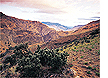 Eventually the team
crossed the Middle Fork and went up Big Creek to Soldier Bar and Taylor
Ranch, which is operated by the University of Idaho. The ranch nearly
burned in the 2000 fires. “The owner told of a firestorm that created
its own wind energy,” Jonas said. “The Forest Service hot shot crews
were able to save the ranch.”
Eventually the team
crossed the Middle Fork and went up Big Creek to Soldier Bar and Taylor
Ranch, which is operated by the University of Idaho. The ranch nearly
burned in the 2000 fires. “The owner told of a firestorm that created
its own wind energy,” Jonas said. “The Forest Service hot shot crews
were able to save the ranch.”
With a pained expression Jonas reflects on a tough day trekking to Golden Creek Ridge.
“At sundown there was nothing but bushwhacking as far as you could see. In some places (trails) have been given up,” he said. “(Fires left) incredible damage; it was a terrific lesson in fire ecology and fire management.”
They saw four separate stages of re-growth, starting with perennial and succulent plants, followed by brush, then thick stands of small trees and, finally, the climax stage of a mature forest.
Jonas and Lemon never used tents. “We wouldn’t have wanted them,” he said. “It was too damn hot.”
From one high ridgeline Jonas and Lemon got a view of the Chamberlain Basin, located in the northwest quadrant of the wilderness area. It is a large plateau, a famous hunting area that covers 500 square miles. “What impressed us most was how much had burned,” Jonas said.
Idaho’s wolf reintroduction project was responsible for their first important sign of wildlife near Cold Meadows in the Chamberlain Basin.
“There was a Forest Service crew there at the backcountry landing strip,” Jonas said. “Wolves were talking all evening. (The Forest Service crew) said it was the best serenade of the summer.”
•
They spotted two bighorn sheep, but few deer and elk, in part because wolves had dispersed local wildlife, and there was no question that fires also contributed to redistributing animals like deer and elk, Jonas said. “It’s a double whammy: fire and wolves,” he said.
Jonas said people in the Wood River Valley tend to see concentrated winter game populations because animals come to the valley bottoms to feed. “In the summer they are dispersed in huge country. You can’t go up one drainage and expect to see a wildlife bonanza.”
In a two-year trekking sortie Jonas and Michael and Buck took across Alaska from 1996 to 1998 they didn’t see a single wolf, Jonas added.
However, in the Frank after crossing Sheepeater Ridge, named for the Shoshone Indians who used to inhabit the region and were known for their hunting techniques, Jonas and Lemon descended Fish Creek to Fish Lake for their best wildlife experience of the trip.
“We cut our way down to the lake at 2 a.m. I cabled Buck every night. That’s just my way. He was barking and growling … the first wolf (howled) ... there were about 10 voices. They were trying to lure Buck out, there is no doubt in my mind.”
Near the end of the trip the team took Horse Heaven Ridge to Mackay Bar on the Salmon River. They also climbed up 5,000 feet to Chicken Peak, which has an impressive vista of the wilderness area, Jonas said.
“It’s about as rugged a country as you can find, like two Baldys stacked one on top of the other ... mean switchbacks,” he said.
On the last night of the trip they lost the mules.
 “It was the only
time,” Jonas said. “For a greenhorn, Jake did amazingly well (on) one of
the roughest mule pack trips you could take.”
“It was the only
time,” Jonas said. “For a greenhorn, Jake did amazingly well (on) one of
the roughest mule pack trips you could take.”
But, for Jonas the trade off taking mules isn’t worth it, and it’s the main reason he’s not traveling with Lemon this summer.
“I couldn’t camp where I wanted to ... (campsites were) dictated by graze and water.”
The six-week trip last summer turned out to be a test drive for a six-month adventure this summer. Lemon and the mules started out in Arizona this spring. He hopes to ride all the way to Canada by the end of the season. •