| current issue |
| features |
| Crossing the Frank |
| WWII Warbirds |
| The Casino Club |
| The Harriman Trail |
| arts |
| Dick Brown's choral |
| Sculptor R.C. Hink |
| Sun Valley Opera |
| Local Shakespeare |
| living |
| Garden Rooms |
| Sheep Wagon Redux |
| recreation |
| The Fosbury Flop |
| Motorcycle the SNRA |
| Hiking the Smokys |
| dining |
| Wines of Summer |
| All Things Cheese |
| Ice Cream |
| calendar |
| Summer 2004 |
| to-do |
| Sun Valley Essentials |
| listings |
| Galleries |
| Dining |
| Fitness |
| Golf |
| Equipment Rentals |
| Outfitters + Guides |
| Lodging |
| maps |
| Ketchum + Sun Valley |
| Hikes on Harriman |
| Local Art Galleries |
| the guide |
| Last Winter |
| Advertising |
| About Us |
| copyright |
| Copyright
© 2004 Express Publishing Inc. All Rights reserved. Reproduction in whole or in part in any form or medium without express written permission of Express Publishing Inc. is strictly prohibited. |
Produced & Maintained by Express Publishing, Box 1013, Ketchum, ID 83340-1013 208.726.0719 Voice 208.726.2329 Fax info@svguide.com |
| The
Sun Valley Guide is distributed free twice yearly to
residents and guests throughout the Sun Valley, Idaho resort area
communities.
Subscribers to the Idaho Mountain Express will receive the Sun Valley Guide inserted into the paid edition of their newspaper. |

Summer's
savory staple
by Gregory
Foley
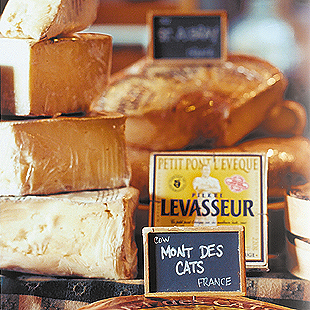
Caprini, Montrachet and Valençay. The romantic, rhythmic names roll off the tongue with a vague sense of familiarity. Fine wines, perhaps, or hot spots that can’t be missed on the next tour of Europe?
No, they are cheeses, symphonies of aroma and flavor derived from centuries of tradition.
Cheese has long been misunderstood by most Americans. Through much of the 20th century, many of us believed it came only in individually packaged slices or pour-spout canisters. Often, we thought it was out of place if it weren’t wedged between two slices of bread or draped generously over macaroni.
In recent years, however, Americans have woken up to discover what many Europeans have known throughout modern times: Cheese, with all its varieties and applications, is undoubtedly one of life’s great culinary pleasures.
France, Europe’s greatest purveyor of dairy products, is dotted with small villages that are synonymous with the unique cheeses they produce. Charles de Gaulle, the popular post-World War II president of France, once quipped, “How can you govern a country which has 246 varieties of cheese?”
According to experts, the number of true cheese varieties produced in France today is something more akin to 200, with another 100 or so offered as minor variations. Scores of other tempting, handcrafted cheeses are produced in Italy, Switzerland, Great Britain, Holland, Denmark, and in recent years, the United States.
In summer, when picnics and casual outdoor gatherings are the norm, most cheeses truly find their niche.
So, when the summer menu calls for cheese, how do we navigate the coolers full of Camembert and Comté? The answer is quite simple: Just as we would with meat or produce, we review the options and consider which choices will best suit the occasion.
Soft, ripened cheeses, including Brie and Camembert, are versatile foods appropriate for all sorts of summer gatherings. Their rich, creamy textures and mild, earthy flavors are hard to resist, served with crackers and fruit or in prepared dishes.
The best Bries—which many connoisseurs believe come from Meaux, in eastern France—contain between 50 and 60 percent butterfat. True Camembert comes from Normandy, a coastal region of France renowned for its fine milk and dairy products.
However, an abundance of other soft cheeses can rival Brie and Camembert for a place on the plate.
Double- and triple-cream cheeses, with butterfat contents ranging from 60 percent to 75 percent, take the delicacy of soft cheeses to new heights. Saint-André, popular among the French, is a triple-cream cheese that matches up ideally with dessert fruits and robust breads.
Semi-soft cheeses, slightly firmer to the touch, can be served in a multitude of ways.
Fontina, from Italy, exudes rich, nutty flavors that can stand alone or blend well in Italian-style prepared dishes.
Gouda and Edam, Holland’s best-known cheeses, are particularly good in omelets and warm sandwiches, but also hold up during long summer outings.
Tomme de Savoie, from the mountainous Savoie region of southeast France, is a delightful, medium-bodied cheese that is perfect for picnic lunches.
Semi-firm cheeses, which range from mild to sharp, are excellent for cooking or for use in an appetizer cheese plate.
Emmentaler is a nutty, slightly oily Swiss—and Savoyard—cheese that melts well, but is also excellent sliced and served with a crisp, cool white wine. Comté is a French Gruyère from Savoie that provides a more robust alternative to Gruyère from Switzerland, where it originated.
A traditional St. George—a Portuguese-style, cheddar-like cheese named after an island in the Azores—is made in Sonoma County, Calif. Made from raw cow’s milk, it is an incomparable summer picnic cheese.
Hard cheeses, which are typically aged for at least one year, include Asiago, Grana Padano, and Romano. Often grated over pastas and salads, hard cheeses are also superb served sliced with fresh fruit or a crusty bread.
 Parmigiano
Reggiano, perhaps the best-known hard cheese, is produced in immense
wheels near Parma, Italy. Esteemed for its nutty taste and grainy
texture, it is derived from the milk of cows that feed only on fresh
grass throughout the spring, summer and fall.
Parmigiano
Reggiano, perhaps the best-known hard cheese, is produced in immense
wheels near Parma, Italy. Esteemed for its nutty taste and grainy
texture, it is derived from the milk of cows that feed only on fresh
grass throughout the spring, summer and fall.
Goat cheese, or chèvre to the French, is typically rich, creamy and tangy. It comes in a wide variety of flavors and shapes; some are mixtures of goat’s milk and cow’s milk.
Goat cheese is a perfect dessert companion for fruits, berries and Porto wine, but is not to be overlooked as an addition to summer salads.
Humboldt Fog, from Northern California, is a renowned light chèvre accented with a ribbon of fine ash.
Blue cheeses, which gain their unique, pungent flavors from edible molds, also come in a variety of styles. Gorgonzola, from Italy, Stilton, from England, and Roquefort, a French blue made from sheep’s milk, are classic examples that pair well with green salads, but truly shine with walnuts, oysters and endive.
Enlightened steak eaters will melt a dollop of Stilton over a grilled New York strip or filet mignon.
Point Reyes Original Blue, from coastal California, is a relative newcomer to the cheese world that should convert any blue-cheese skeptic.
Creamy, white cheeses are best served with breakfast or dessert. Mascarpone, the king of dessert cheeses, is the key ingredient of classic tiramisu.
The grandest of summer desserts, a bowl of fresh strawberries or raspberries, never tastes better than with a generous dollop of mascarpone. •