| click here for the |
| front page |
| features |
| fire lookouts |
| flytying |
| beavers |
| craters of the moon |
| arts |
| peter woytuk |
| printmaking |
| handmade guitars |
| living |
| high desert gardens |
| pavers |
| summer fitness |
| recreation |
| skateboarding |
| danny thompson mem |
| galena |
| dining |
| salads |
| margaritas |
| calendar |
| summer 2003 |
| to-do |
| sun valley essentials |
| listings |
| galleries |
| dining |
| lodging |
| fitness |
| golf |
| equipment rentals |
| outfitters + guides |
| maps |
| ketchum street map |
| sun valley street map |
| local art galleries |
| Galena summer trails |
| fire lookouts: Idaho |
| fire lookouts: locator |
| the guide |
| last winter |
| advertising |
| about us |
| copyright |
| Copyright
© 2003 Express Publishing Inc. All Rights reserved. Reproduction in whole or in part in any form or medium without express written permission of Express Publishing Inc. is strictly prohibited. |
| Produced
& Maintained by Express Publishing, Box 1013, Ketchum, ID 83340-1013 208.726.0719 Voice 208.726.2329 Fax info@svguide.com |
| The
Sun Valley Guide is distributed free twice yearly to
residents and guests throughout the Sun Valley, Idaho resort area
communities.
Subscribers to the Idaho Mountain Express will receive the Sun Valley Guide inserted into the paid edition of the newspaper. |

An
Exploration in Natural Forms
the sculpture of Peter
Woytuk
by Pat Murphy
Peter Woytuk is a sculptor of elastic and changing moods. He finds that big, very big, is beautiful but also that small, very small, can be just as eye-catching.
At 45, photographer-turned sculptor Woytuk is something of a sensation in the art world. In the estimation of the Paris-based daily newspaper, International Herald Tribune, he should be regarded as “the greatest animal sculptor of the Western world in the closing years of the 20th century.”
 Such
lavish homage stems from Woytuk’s life-like and usually life-sized
bronzes of animals, so realistic they trigger double takes among Sun
Valley and Ketchum onlookers wondering whether what they see is alive.
Such
lavish homage stems from Woytuk’s life-like and usually life-sized
bronzes of animals, so realistic they trigger double takes among Sun
Valley and Ketchum onlookers wondering whether what they see is alive.
Woytuk’s works give new meaning to the word variety. They range from bronze sculptures of animals weighing four-and-a-half tons to an inch-and-a-half bronze of a raven weighing about as much as a large feather.
For nearly two years, dozens of unique works have been on outdoor display in Sun Valley and Ketchum, creating a stir as well as providing popular sightseeing attractions for family vacation photographs and competing with the weather as objects of local chatter.
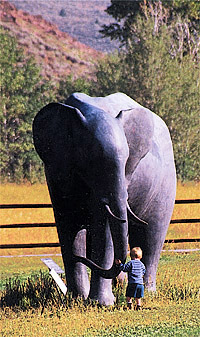
The Anne Reed Gallery, which is hosting Woytuk’s works locally, created a major traffic-stopper when it positioned two of Woytuk’s life-sized bronze elephants in the meadow beside Sun Valley Road just outside of downtown Ketchum.
At first glance, the gray-colored metal pachyderms—a four-and-a-half ton “male” and a three-and-a-half ton “female”—appeared to be a pair of genuine elephants strolling through an African savannah in search of a water hole. There they stood, extended trunks seeming to sniff their surroundings, unchanged by the coming and going of seasons, except for occasional blankets of snow on their backs during the winter.
 The
setting became irresistible for photographs beside the sculptures. Not
far from the Sun Valley Road site in the heart of Ketchum, an outdoor
exhibition area behind the Anne Reed Gallery featured enormous
sculptures of bulls—perhaps twice life size and weighing 1,400 pounds
each—reclining blissfully, while a flight of remarkably life-like
sculptures of animated ravens cluster on a nearby perch, some with their
wings frozen in mid flap.
The
setting became irresistible for photographs beside the sculptures. Not
far from the Sun Valley Road site in the heart of Ketchum, an outdoor
exhibition area behind the Anne Reed Gallery featured enormous
sculptures of bulls—perhaps twice life size and weighing 1,400 pounds
each—reclining blissfully, while a flight of remarkably life-like
sculptures of animated ravens cluster on a nearby perch, some with their
wings frozen in mid flap.
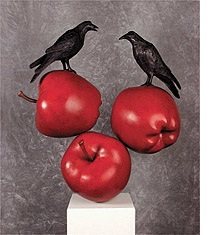
“Cravens”—Woytuk’s
zoological contraction he sometimes uses to describe look-alike crows
and ravens—are ubiquitous fixtures in Woytuk collections. He developed a
fascination for their lively behavior—crows and ravens spend 90 percent
of their time at play, he says—and as a consequence has created nearly
three dozen. Some are perched on pedestals, some on stacks of fruit,
others stacked acrobat-like on top of each other, one on the lip of
teacup.
Woytuk is planning his ultimate animal work: a 6- to 8-foot-long raven standing on a large rock, a sculpture that eventually would weigh 20 tons.
Also joining the bulls and ravens at various times over the past several years have been other Woytuk creations—including a pile of huge crushed beverage cans fashioned in bronze, one of Woytuk’s departures from serious realism to whimsy. The common chicken hen also stirs Woytuk’s whimsy: His hen representations are comedic, plump, ovoid shapes resembling Easter eggs with no attempt at realism.
Other sculptors deal with the human form. Why animals for Woytuk?
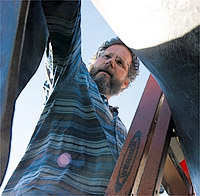 “First,
I don’t really think of myself as an animal sculptor, but a sculptor who
does animals,” the amiable Woytuk explains from Thailand, one of his
homes. “With animals, I have lots of room to play, suggest, to invent,
to communicate.”
“First,
I don’t really think of myself as an animal sculptor, but a sculptor who
does animals,” the amiable Woytuk explains from Thailand, one of his
homes. “With animals, I have lots of room to play, suggest, to invent,
to communicate.”
As for swinging from the very large to the small, Woytuk says, “it’s important to push both directions, and sometimes working with one scale helps you work better with the other.”
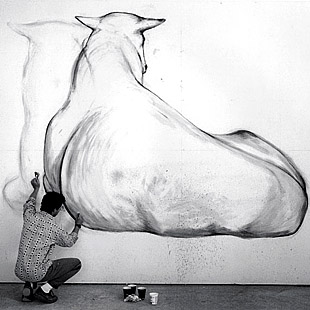
If Woytuk’s finished works are fascinating, consider the almost unimaginable process involved in designing and casting enormous elephants and bulls in bronze on a scale rare in the world of sculpture. It begins with this stunning reality: casting a life-size or larger bronze elephant or bull equivalent to the weight of an automobile can only be done in foundries of faraway Thailand or China that have immense capabilities for melting 10,000 pounds of bronze in a single pour.
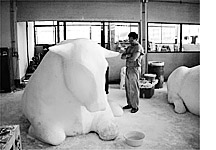
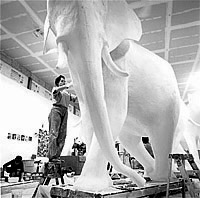
So Woytuk’s big creatures become the stuff of a complex globe-girdling production. After sketches comes a small clay model known as a maquette, from which a plaster model is made. The plaster model is sliced into one-and-a-half inch segments, then displayed by an overhead projector on a wall, from which Woytuk and his assistants cut large life-size pieces in polystyrene foam.
These large foam pieces then are assembled into the large animal for casting as a life-size plaster model, which is shipped by freighter to Asia for casting in bronze. According to Woytuk, this process—from initial design to casting and returning the finished sculpture to the United States—usually takes a year and a half to two years.
Underpass height restrictions on U.S. highways force Woytuk to limit the height of his sculptures to 12 feet to accommodate the 13-foot 6-inch limits of truck underpasses.
 One
sight that must’ve given pause to seamen on passing ships was the time
Woytuk had to ship an elephant sculpture, which was too large for a
container, on an open deck across the Pacific Ocean back to the United
States from Asia.
One
sight that must’ve given pause to seamen on passing ships was the time
Woytuk had to ship an elephant sculpture, which was too large for a
container, on an open deck across the Pacific Ocean back to the United
States from Asia.
Although Woytuk
dislikes discussing prices of his works, and leaves those decisions to
galleries,
the price of an elephant he says is $250,000. His “cravens” sell for
between $4,000 and $5,000.
Woytuk’s large animal work is in such demand he’s planned extended editions of the bulls and elephants. In turn, that means he must make three or four extended trips to Asia, some lasting three months.
Woytuk has lost count of his prolific output—hundreds of sculptures, he believes. Among large works, he’s completed six large elephants (four are at a North Carolina zoo), five large bulls, one giant beverage can display, two different great sheep, three great hens. Woytuk works also are in Mexico and Europe, displayed at homes, corporations, schools and parks.
Outdoors is his preferred exhibition venue.
“Displaying pieces outside makes you compete with all else outside—trees, buildings, mountains,” he says. “What once looked big inside is suddenly dwarfed in an exterior environment.”
He and his companion, Copper Tritscheller, who handles much of Woytuk’s business affairs as well as assisting in adding finish to his sculptures, live in a two-room hotel suite in Chachoengfao, Thailand, as well as maintaining a home and studio in Santa Fe, N.M., and an office in Kent, Conn.
 Woytuk
describes his Thai surroundings a few hours from the capital city of
Bangkok as a “rich cultural mix” in a traditional setting—rice paddies,
nearby rain forest, wild elephants roaming the area, monkeys, near a
river and reclusive from civilization.
Woytuk
describes his Thai surroundings a few hours from the capital city of
Bangkok as a “rich cultural mix” in a traditional setting—rice paddies,
nearby rain forest, wild elephants roaming the area, monkeys, near a
river and reclusive from civilization.
As captivated as Woytuk is with animals for his works, there are themes he’s rejected.
A woman wanted to commission him to execute a bronze walrus wearing glasses, smoking a pipe and reading a book.
“It was for her husband’s library, and I think it was supposed to look like him,” Woytuk said, bemused. “Sweet, but not for me.”