| click here for the |
| front page |
| features |
| fire lookouts |
| flytying |
| beavers |
| craters of the moon |
| arts |
| peter woytuk |
| printmaking |
| handmade guitars |
| living |
| high desert gardens |
| pavers |
| summer fitness |
| recreation |
| skateboarding |
| danny thompson mem |
| galena |
| dining |
| salads |
| margaritas |
| calendar |
| summer 2003 |
| to-do |
| sun valley essentials |
| listings |
| galleries |
| dining |
| lodging |
| fitness |
| golf |
| equipment rentals |
| outfitters + guides |
| maps |
| ketchum street map |
| sun valley street map |
| local art galleries |
| Galena summer trails |
| fire lookouts: Idaho |
| fire lookouts: locator |
| the guide |
| last winter |
| advertising |
| about us |
| copyright |
| Copyright
© 2003 Express Publishing Inc. All Rights reserved. Reproduction in whole or in part in any form or medium without express written permission of Express Publishing Inc. is strictly prohibited. |
| Produced
& Maintained by Express Publishing, Box 1013, Ketchum, ID 83340-1013 208.726.0719 Voice 208.726.2329 Fax info@svguide.com |
| The
Sun Valley Guide is distributed free twice yearly to
residents and guests throughout the Sun Valley, Idaho resort area
communities.
Subscribers to the Idaho Mountain Express will receive the Sun Valley Guide inserted into the paid edition of the newspaper. |

Riding
the
Concrete Wave
by Elizabeth
Sullivan
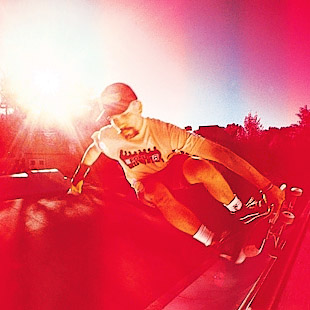
It’s gnarly, wack, insane, giant, killer and epic, consisting of groms, mongo-footers, ollies, grinds, alley-oops, and McTwists. It may sound like a horror flick, but it is here in the Wood River Valley: skateboarding.
Time has transformed this wonderful sporting alternative into a fun and accepted lifestyle that may seem complex in its moves and language, but is simpler to understand than the physics involved in it. And more Wood River Valley residents and visitors are giving it a whirl.
 Skateboarding
has a vast history of highs and lows and has taken on a whole new form
in its evolution.
Skateboarding
has a vast history of highs and lows and has taken on a whole new form
in its evolution.
The first Roller Derby Skateboard was for sale in 1959. Clay wheels
entered the picture and sidewalk surfing began to take root on “concrete
waves.” After a decline due to its inferior products in the ‘60s, a
surfer named Frank Nasworthy helped develop urethane wheels—the ‘70s
boom of skating street style exploded.
In 1978, Alan Gelfand invented the “ollie”—the foundation of almost all the new-school tricks—which catapulted skating’s popularity. Not too long after, Tony Hawk emerged on the scene, winning his first contest in 1982 and skateboarders’ tricks took to new heights. By the early ‘90s the recession slumped skateboarding’s popularity into the underground until 1995 when it re-emerged from its sleep with broad exposure at the ESPN 2 Extreme Games.
Today, skating is more mainstream than ever with its own video games on the market, skateparks blooming across the countryside and even the availability of college scholarships such as the Patrick Kerr Skateboard Scholarship, a fund established by mothers of skateboarders in Pennsylvania. And it’s now considered safer and more social than in earlier years. Overall, it is a “hella” fun sport and lifestyle.
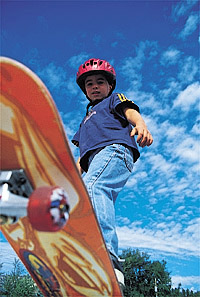 More
parents are encouraging their little groms—youngsters—to try
skateboarding, yet it’s imperative that the “newbies” are properly
geared in their protective gear. Also, when introducing young ones to
the skateparks, parents should take the time to join them in getting to
know the groups of people that ride there. There is a very structured
social etiquette and pecking order within each scene. The camaraderie
and communication while skating is very solid at skateparks.
More
parents are encouraging their little groms—youngsters—to try
skateboarding, yet it’s imperative that the “newbies” are properly
geared in their protective gear. Also, when introducing young ones to
the skateparks, parents should take the time to join them in getting to
know the groups of people that ride there. There is a very structured
social etiquette and pecking order within each scene. The camaraderie
and communication while skating is very solid at skateparks.
Andy Gilbert of the Sun Valley Ski Education Foundation is an avid skater, and he spearheaded the project for Dreamland Skateparks’ creation of the new Hailey skatepark.
“It’s not something you can just drop your kid off at and say ‘see ya later’ without knowing they have become accustomed to the respect, etiquette, and order that is established at these parks,” he emphasizes. “Knowing how the system in the park works is what keeps the riding safe.”
Part of that skateboarding culture is language, and it’s not as foreign as some may think. It’s easily learned by listening to what the kids call out and watching their corresponding moves.
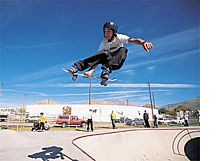
When a skater is about to enter into the bowl or the halfpipe, he shouts, “Dropping in!” Skaters always call out which direction they will be heading, whether it’s the shallow or deep end. And everyone looks out for skaters who wipe out by shouting “watch out, someone’s down.” Bunnies, or neophytes, may cringe at the sight of bacon in the pan—a skater who has just taken a bad spill in the pipe and shrivels up over the impact—but will soon get over it if they have a hardcore—not afraid to take risks—attitude.
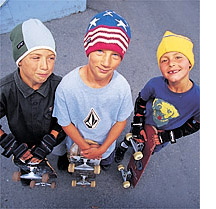 A
beginner’s first step in skating is finding out whether they’re a
regular-foot—left foot forward on the board—or a goofy foot—right foot
forward. Next, they get their carving down—skating long arcs—and stair
bashing—riding down stairs. Then it’s on to some air moves with
grabs—maybe a method—grabbing the same side of the board—or a mute—their
right hand reaches across the front of their legs and grabs their left
foot—or a stalefish—reaching behind and grabbing the outside of the
opposite skate.
A
beginner’s first step in skating is finding out whether they’re a
regular-foot—left foot forward on the board—or a goofy foot—right foot
forward. Next, they get their carving down—skating long arcs—and stair
bashing—riding down stairs. Then it’s on to some air moves with
grabs—maybe a method—grabbing the same side of the board—or a mute—their
right hand reaches across the front of their legs and grabs their left
foot—or a stalefish—reaching behind and grabbing the outside of the
opposite skate.
Once some of the basic steps are achieved, skaters can play around with different stances, such as riding switch or banana—riding the opposite foot forward than they normally do—or styling mongo-foot—pushing off the board with the front foot to gain momentum instead of using the usual back foot. Then a skater can come out of a trick with a fakie—riding out in their normal stance but riding backwards. The list of tricks is limitless.
“It’s an easy sport to get into, and once you get down the basic moves, the possibilities are endless, ” says an e-mailer, named Uncomprehendaburg, on the Transworld skateboarding Web site.
More teens are pulling off tricks such as hand plants, an air-to-fakie, and frontside- or backside-180s in vert skating—skating on vertical structures like ramps—at an earlier age. And in street skating, more maneuvers such as railsliding, heelflips, frontside pop shove-its, and variations of grinds are more common.
“A kickflip is a popular trick among younger kids, ages 11 to 15. (It is a variation on the ollie, where the skater kicks down sharply with the balls of his or her feet causing the board to spin around before landing back on it.) They are always happy to land one, as it’s a stepping stone to a lot of other tricks,” says Aaron Meza, editor of Skateboarder Magazine.
So what is the Holy Grail of skateboarding?
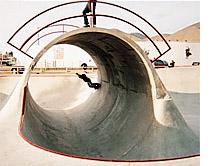 According
to most of the skate magazines and Web sites, it is progression. Taking
it to the next level is what all skaters strive for. Why is progression
the huge obsession in skating?
According
to most of the skate magazines and Web sites, it is progression. Taking
it to the next level is what all skaters strive for. Why is progression
the huge obsession in skating?
“Because, it’s no fun to do the same thing over and over again,” according to John Speaker of Dillsburg, Pa., as mentioned in the Transworld Skateboarding Web site.
Riding a variation of terrain is the best way to improve a skater’s ability, agility, and stamina.
“The Hailey park is great for pumping around or snaking the concrete bowls with more transitions (aka trannies). It’s very flowy,” says Jens Peterson, a Hailey resident. “And the Ketchum park has a combination of concrete and smaller wood ramps and rails that are in a tighter design. This is good for getting technical moves down.”
Both parks are free to enter, and there are no set rules from the cities, only from the skaters who ride there.
And if you think you’re up to it, or know someone who is, the Board Bin, located in Ketchum, is sponsoring a few contests including their Fifth Annual Skate Contest this August.
So, bunnies, don’t be labeled a flatlander. Put on your armor and hardcore attitude and drop in to the vert ramp. There’s nowhere to go but up.