| click here for the |
| front page |
| features |
| fire lookouts |
| flytying |
| beavers |
| craters of the moon |
| arts |
| peter woytuk |
| printmaking |
| handmade guitars |
| living |
| high desert gardens |
| pavers |
| summer fitness |
| recreation |
| skateboarding |
| danny thompson mem |
| galena |
| dining |
| salads |
| margaritas |
| calendar |
| summer 2003 |
| to-do |
| sun valley essentials |
| listings |
| galleries |
| dining |
| lodging |
| fitness |
| golf |
| equipment rentals |
| outfitters + guides |
| maps |
| ketchum street map |
| sun valley street map |
| local art galleries |
| Galena summer trails |
| fire lookouts: Idaho |
| fire lookouts: locator |
| the guide |
| last winter |
| advertising |
| about us |
| copyright |
| Copyright
© 2003 Express Publishing Inc. All Rights reserved. Reproduction in whole or in part in any form or medium without express written permission of Express Publishing Inc. is strictly prohibited. |
| Produced
& Maintained by Express Publishing, Box 1013, Ketchum, ID 83340-1013 208.726.0719 Voice 208.726.2329 Fax info@svguide.com |
| The
Sun Valley Guide is distributed free twice yearly to
residents and guests throughout the Sun Valley, Idaho resort area
communities.
Subscribers to the Idaho Mountain Express will receive the Sun Valley Guide inserted into the paid edition of the newspaper. |

The Surprising World of Printmaking
by Jo Murray
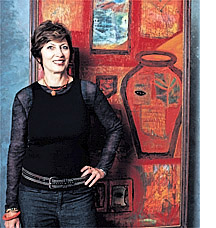
“I love printmaking,” artist Gay Odmark says. “I like the organic process, with its rough edges. I know where I’m headed, but I have no idea if I will get there. As much as I want to control things, printmaking is totally out of control. There is an element of surprise about it that I love.”
 Such
enthusiasm is common among artists who have worked in this millennia-old
medium. And the Wood River Valley is enjoying a resurgence of art in the
medium thanks to two young artists who had a relatively modest goal
after college: They didn’t want to support themselves by waiting tables.
Such
enthusiasm is common among artists who have worked in this millennia-old
medium. And the Wood River Valley is enjoying a resurgence of art in the
medium thanks to two young artists who had a relatively modest goal
after college: They didn’t want to support themselves by waiting tables.
When Nate and Jennifer Galpin-Mikesh moved to Hailey, they were all too familiar with the “day jobs” most artists hold early in their careers. The Galpin-Mikeshes took a different approach. They installed a specialty printing press in their garage and opened Vita Brevis Experimental Printmaking.
Their commercial venture has proven successful thanks in part to groundwork laid by another family member. Previously the only nearby presses were in private studios owned by Nate’s mother, Ketchum resident Cally Galpin, and nationally known artist Theodore Waddell, who has studios here and in Montana. Cally took a printmaking course with Waddell in the late 1990s, and then bought her own press. Although she does not sell her work commercially, she invited other local artists to try the press.
“I remember when Cally called me about her press,” says Abby Grosvenor, an artist and former restaurateur in the valley. “I loved printmaking in college. Prints are very intimate, and they show the mark of the artist’s hand. But even when I lived near San Francisco, there were no presses available except for very expensive ones. So I painted and drew instead.”
Printmaking, in its most basic sense, is a process using pressure to transfer an image from a plate, whether metal, wood or stone, to another surface such as paper or canvas. Prints can be generally classified as relief, intaglio or planographic, depending on how they are made. In relief printing, the image comes from a raised surface on the plate. Contrarily, intaglio prints come about from an image recessed in the plate. In planographic prints the image comes from a flat plate on which greasy ink or a grease crayon has been used to create the image. But that’s where the simplicity ends. There are many ways in which to create an image on the plate, such as engraving or chemically etching and many variables in the printing process itself.
 Grosvenor
is represented by Frederic Boloix Fine Arts in Ketchum and has the
curious distinction of being the only living artist represented at the
gallery. However, the other pieces Boloix carries are prints by Picasso
and Matisse. Not bad company, if you can keep it.
Grosvenor
is represented by Frederic Boloix Fine Arts in Ketchum and has the
curious distinction of being the only living artist represented at the
gallery. However, the other pieces Boloix carries are prints by Picasso
and Matisse. Not bad company, if you can keep it.
“I bought one of Abby’s works for my personal collection,” recalls Boloix. “My clients kept coming in to look at Picasso, and they wanted to buy Abby’s prints as well. When I bought something for myself, I ended up selling it. So I started representing Abby, too.”
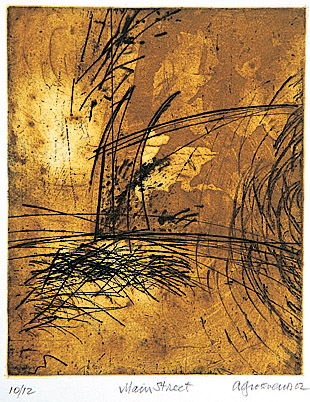
Grosvenor’s work has richly layered textures of brown, gold and black. “Her prints have a wide spectrum in gradations of color, which is a sign of good printmaking,” Boloix says. She will also at times apply gold leaf to a work after printing. One mixed media monotype titled “Homage á John Paul Jones” went through the press 15 times. “With the monotype process (in this case printing multiple layers) you can get a blended effect that you couldn’t get with a brush, say with watercolors,” Boloix adds.
“What keeps Abby’s
work together, gives it a form, is she is always incorporating geometric
figures. They give the work a sense of balance when they are juxtaposed
against freer gestures,” Boloix says.
Another of Grosvenor’s works titled “Main Street” expresses the element
of spontaneity that appeals to printmakers. To get the subtle scuffing
marks in it, she put one of the two plates she used to make the print in
the street and let cars run over it.
“Printmaking is always a tension between disciplines. You don’t have the control you do in painting. Yet part of the excitement is that things just happen,” Grosvenor says.
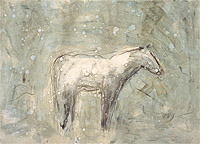 Odmark,
who will show prints and other works in a show opening October 10 at the
Gail Severn Gallery in Ketchum, points out one obvious difficulty in
printmaking: “The process itself is dyslexic. The final print will never
be the way I draw it; it’s always going to be reversed.” Artists like
Odmark and Grosvenor have simply learned to write and draw the mirror
image of the result they seek.
Odmark,
who will show prints and other works in a show opening October 10 at the
Gail Severn Gallery in Ketchum, points out one obvious difficulty in
printmaking: “The process itself is dyslexic. The final print will never
be the way I draw it; it’s always going to be reversed.” Artists like
Odmark and Grosvenor have simply learned to write and draw the mirror
image of the result they seek.
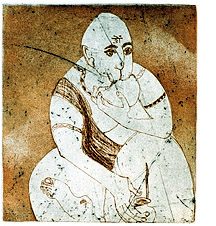
Odmark’s work reflects the heritages of her British mother and India-born father in Lahore, now part of Pakistan. They fled during the bitter fighting in 1947, and she lived in London, San Francisco and Paris before settling here. Her current work focuses on “the Indian smorgasbord of gods and goddesses. You can choose the gods for your own needs,” she adds. Printmaking, she says, captures the mixture of playfulness and seriousness she wants her Indian images to reflect.
Waddell, like other printmakers, is intrigued by the medium’s unexpected nature.
“It’s like ceramics,” says the artist, whose work includes oils, sculpture and prints. “When you put a pot into the kiln, you’re never sure exactly how it is going to come out.”
He is currently working on a series of pastel woodcuts, yet another process of printmaking. The Gail Severn Gallery in Ketchum represents Waddell.
“Woodcuts are very physical,” he explains. “They give you a visceral feeling. It’s almost like creating sculpture when you’re cutting the wood.”
Waddell uses a special Japanese chisel and plywood with a soft veneer of basswood, a type of linden tree. The resulting pale hues are almost transparent —very different from traditional woodcuts with their darker tones.
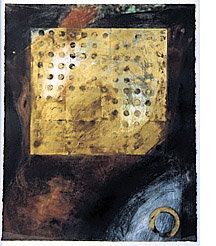 Waddell,
whose work is in galleries and museums across the nation as well as the
private collections of Robert Redford and Ringo Starr, has two presses.
He will use his newly acquired “proof” press, designed for both text and
line drawings, to produce a series of woodcuts this summer in
collaboration with Kirk Robertson. Robertson, a Nevada poet, will
compose poems based on the original Lewis and Clark journals, and
Waddell will create woodcuts of places the explorers visited.
Waddell,
whose work is in galleries and museums across the nation as well as the
private collections of Robert Redford and Ringo Starr, has two presses.
He will use his newly acquired “proof” press, designed for both text and
line drawings, to produce a series of woodcuts this summer in
collaboration with Kirk Robertson. Robertson, a Nevada poet, will
compose poems based on the original Lewis and Clark journals, and
Waddell will create woodcuts of places the explorers visited.
The Waddell-Robertson collaboration is in keeping with the spirit that pervades printmaking. While creating art is often a lonely endeavor, printmaking involves collaboration between the artist and the press operator. The materials themselves become part of the collaborative process, often yielding unexpected results.
The Galpin-Mikeshes
create their
own work, available at Ochi Fine Art in Ketchum, in a variety of
mediums. Nate focuses on mass media control of contemporary life, both
physically and metaphorically, and Jennifer focuses on the
commercialization of the female form.
Of the element of surprise in printmaking Jennifer Galpin-Mikesh says,
“I both like that and hate it.
It’s sometimes infuriating, and it’s sometimes even better than you expected.”
The plus, her husband adds, is that “printmaking lets you do things you can’t do in any other medium. And the more comfortable you become with the medium, the better work you can do.”
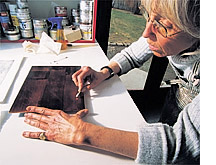 The
availability of their press inspired painter Mary Roberson, whose oil
wildlife portraits and landscapes are at the Kneeland Gallery in
Ketchum. “I just like the look and feel,” says Roberson of her first
print, which incorporates an image of a bison cow.
The
availability of their press inspired painter Mary Roberson, whose oil
wildlife portraits and landscapes are at the Kneeland Gallery in
Ketchum. “I just like the look and feel,” says Roberson of her first
print, which incorporates an image of a bison cow.
While the medium can be full of happy surprises, it also requires tremendous discipline. Waddell recently was choosing between two versions of a print. In one, the blue plate was printed before the green plate. In the other, the order was reversed, with a noticeably different effect.
“In painting, it’s very easy to make a change,” adds Grosvenor. “With a printing plate, it’s far more difficult. I’m much more willing to sit and work with something now than when I was in graduate school.”
“One reason for printmaking’s widespread appeal is its diversity,” says Suzy R. Locke, a San Francisco Bay Area art consultant for corporations and private collectors. “Prints can have textures, patterns and colors, and they can be abstract or representational.”
In addition to the unique aspects of the art, price makes prints attractive to collectors.
“You can find very wonderful images at reasonable prices,” says Locke. “If you can’t afford a painting, you can still get the best of the artist’s work in a form specifically designed for the medium.”