| click here for the |
| front page |
| features |
| fire lookouts |
| flytying |
| beavers |
| craters of the moon |
| arts |
| peter woytuk |
| printmaking |
| handmade guitars |
| living |
| high desert gardens |
| pavers |
| summer fitness |
| recreation |
| skateboarding |
| danny thompson mem |
| galena |
| dining |
| salads |
| margaritas |
| calendar |
| summer 2003 |
| to-do |
| sun valley essentials |
| listings |
| galleries |
| dining |
| lodging |
| fitness |
| golf |
| equipment rentals |
| outfitters + guides |
| maps |
| ketchum street map |
| sun valley street map |
| local art galleries |
| Galena summer trails |
| fire lookouts: Idaho |
| fire lookouts: locator |
| the guide |
| last winter |
| advertising |
| about us |
| copyright |
| Copyright
© 2003 Express Publishing Inc. All Rights reserved. Reproduction in whole or in part in any form or medium without express written permission of Express Publishing Inc. is strictly prohibited. |
| Produced
& Maintained by Express Publishing, Box 1013, Ketchum, ID 83340-1013 208.726.0719 Voice 208.726.2329 Fax info@svguide.com |
| The
Sun Valley Guide is distributed free twice yearly to
residents and guests throughout the Sun Valley, Idaho resort area
communities.
Subscribers to the Idaho Mountain Express will receive the Sun Valley Guide inserted into the paid edition of the newspaper. |

Pavers
and the
Art of Functionality
by Chris Brock
The Wood River Valley is the “paver capital of the world.” So says Kyle Worthington, longtime area resident and landscaping construction contractor at Hailey Nursery.
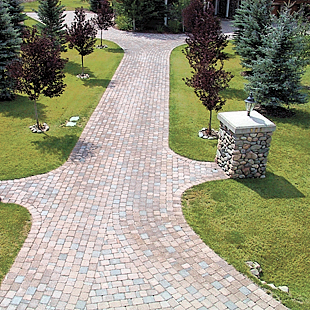
A tour of area residential neighborhoods drives home Worthington’s point, as home after home reveals unique artistic applications of these highly compressed concrete bricks, marching up driveways, through gardens and lawns to front doors and backyard spas.
Simply put, pavers
are everywhere in this valley.
They came into broad use locally in the 1970s as landscape designers and
construction managers began to see functional, as well as aesthetic
value to their use.
More visually appealing than asphalt, gravel or concrete previously used to hide this geothermally active area’s many piped home-heating and snowmelt systems, pavers made repairs to these aging systems easier because they are not mortared into place. Finely crushed stone is brushed into the spaces between the pavers. Such non-ridged installation makes pavers suitable for the harsh freeze-thaw cycles of the local climate and essentially maintenance free.
During a period of rapid growth in the home building industry during the 1990s, the number of paver installations skyrocketed as homeowners in exclusive Sun Valley, Elkhorn and other areas of the valley too far from natural hot spring-fed water systems in Ketchum took advantage of new radiant heat technologies to create their own systems.
Pavers again were the material of choice to conceal the boiler-fed radiant heat snowmelt systems under driveways and pathways.
“Doug (Webb) and Webb Landscape were a major factor in the volume of paver installations in this area at that time,” says Kurt Eggers, a 12-year resident and owner of Eggers Associates landscape architecture firm.
 Pavers
are functional and durable, and using them is just plain smart. Pavers
pay for themselves in 15 to 20 years when compared to other common
materials (asphalt, concrete, wood), which can bear a heavy maintenance
cost. Webb understood this and more early on.
Pavers
are functional and durable, and using them is just plain smart. Pavers
pay for themselves in 15 to 20 years when compared to other common
materials (asphalt, concrete, wood), which can bear a heavy maintenance
cost. Webb understood this and more early on.
Despite many functional installations, the aesthetics of pavers is what catches the passer-by’s eye. The multitude of design possibilities offered by the appealing patterned surfaces and new colors make pavers a favorite for pathways and general landscape design use.
This combination of aesthetics and functionality was not lost on the owners of Sun Valley Resort, who added extensive installations of pavers to the luxurious Bald Mountain base lodges in Warm Springs and River Run during construction in the 1990s.
Although the beds on which they nestle require proper preparation and base materials, in many installations, pavers can be reset into new designs as homeowners’ use of the space evolves.
As homeowners and landscape architects invent new, unique applications for pavers, manufacturers strive to keep pace. Once offering a mere three colors, manufacturers have increased their paver palette to approximate a dozen shades, ranging from Shadow to Latte, and introduced new sizes, shapes and surface finishes.
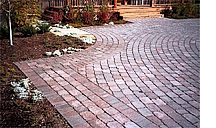
New shapes allow homeowners to arrange pavers in linear patterns—such as running bond and herringbone—as well as in sweeping fans and circles. Manufacturers, including Westcon and Abbottsford, who introduced the wildly popular Roman or Old Country Stone pavers (with the rough, tumbled edge look designed to mimic the Roman roadways of Europe), have expanded the scope of paver applications.
In the current landscape design climate, Eggers has noticed a shift toward more creative paver designs as manufacturers attempt to match the unique tastes of homeowners.
“New blood” in the valley has also augmented paver design options as more landscape businesses relocate here, according to Eggers.
“There are more landscape architects landscape ideas with them,” says Eggers.
New ideas have homeowners and landscape architects using pavers more creatively instead of merely to “pave.”
“I think there may have been a lack of knowledge about what people could do with pavers,” says Ben Young, landscape architect with Clearwater Landscaping. “If they know more about what they can do, they might be more apt to try them.”
Instead of sticking to tried and true design methods, such as using long spans of roman-style pavers on driveways and patios, designers now employ a full range of paver shapes and colors to create patterns that play off architectural themes of homes and landscape.
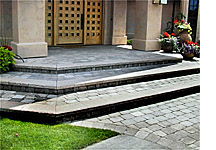 Fan
shapes and circles give focus and provide a counterpoint to predictable
rectangular designs. Designers tend to opt for patterns of varied color
in soldier courses—pavers aligned horizontally to the general layout—to
create dynamic borders separating disparate design themes and containing
others.
Fan
shapes and circles give focus and provide a counterpoint to predictable
rectangular designs. Designers tend to opt for patterns of varied color
in soldier courses—pavers aligned horizontally to the general layout—to
create dynamic borders separating disparate design themes and containing
others.
Other designs complement elements of the natural environment.
Eggers, as well as Nina Steffens of Clearwater Landscaping, suggest a more liberal use of stone and rock in conjunction with pavers: large landscape boulders at a patio edge with pavers precisely cut to the boulder contour and stone slab steps where an elevation change is necessary.
Such elements achieve a more natural rustic look, and, although the time, care and skill required for installation are greater and more costly, this marriage of hardscape materials enhances the lines and curves of the natural environment. Planting beds are added to soften hard edges.
As trends and tastes change, homeowners and designers continue to strive for truly unique looks, trying new and innovative techniques fearlessly, as they employ this building block of originality to shore up the valley’s title of “paver capital of the world.”