| click here for the |
| front page |
| features |
| fire lookouts |
| flytying |
| beavers |
| craters of the moon |
| arts |
| peter woytuk |
| printmaking |
| handmade guitars |
| living |
| high desert gardens |
| pavers |
| summer fitness |
| recreation |
| skateboarding |
| danny thompson mem |
| galena |
| dining |
| salads |
| margaritas |
| calendar |
| summer 2003 |
| to-do |
| sun valley essentials |
| listings |
| galleries |
| dining |
| lodging |
| fitness |
| golf |
| equipment rentals |
| outfitters + guides |
| maps |
| ketchum street map |
| sun valley street map |
| local art galleries |
| Galena summer trails |
| fire lookouts: Idaho |
| fire lookouts: locator |
| the guide |
| last winter |
| advertising |
| about us |
| copyright |
| Copyright
© 2003 Express Publishing Inc. All Rights reserved. Reproduction in whole or in part in any form or medium without express written permission of Express Publishing Inc. is strictly prohibited. |
| Produced
& Maintained by Express Publishing, Box 1013, Ketchum, ID 83340-1013 208.726.0719 Voice 208.726.2329 Fax info@svguide.com |
| The
Sun Valley Guide is distributed free twice yearly to
residents and guests throughout the Sun Valley, Idaho resort area
communities.
Subscribers to the Idaho Mountain Express will receive the Sun Valley Guide inserted into the paid edition of the newspaper. |

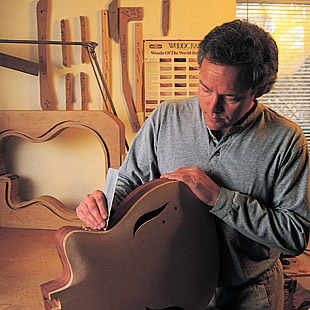
Working with the Mysteries of Sound
by Greg Stahl
With the tap of a finger, the wood comes to life, hums a subtle note and withers into the recesses of the Hailey workshop. Guitar builder Armando Alcalde shaves a sliver from a brace glued to the thin plate of Engelmann spruce and taps it again. The melodic sound is faint but firm.
“Each individual instrument has its own flavor and uniqueness to it,” Alcalde says. “There’s always a little mystery in building an instrument, but it’s mystery within parameters I understand, so I can definitely design toward a certain sound.”
The thin sheet of wood in Alcalde’s hands was to become the top of a jazz flattop guitar, one of nine models the musician builds. The unique characteristics of a selected wood, including grain, stiffness and the way it vibrates, are the primary sources of the colorful tones an acoustic guitar produces.
“A guitar is a kind of drum,” Alcalde says. “It produces its sound like a diaphragm. But it’s happening at a fairly small magnitude. The bracing pattern, along with the thickness of the plates, is hugely important to the sound. Even the shape of the braces can affect the sound.”
The Hailey musician and luthier is working with design principles that evolved over hundreds of years. Establishing a firm history of the instrument, however, is a little like trying to trace one’s family lineage to Adam and Eve.
Guitar building and playing are arts dating at least to the 14th century in Spain, even though guitar-like instruments have existed since ancient times.
The people of Malaga, a coastal city in southern Spain, are thought to have invented the modern version. The early instrument was a “four course” guitar, from which the ukulele is derived. The first guitars were very small, and were strung with four pairs of strings, each pair called a course.
The guitar became popular in other European countries in the 16th and 17th centuries, and by the late 17th century a fifth course of strings was added below the other four.
 In
the mid-18th century the guitar attained its modern form, when the
double courses were made single and a sixth string was added above the
lower five. Guitar makers in the 19th century broadened the body,
increased the curve of the waist, thinned the belly and changed the
internal bracing patterns. Old wooden tuning pegs were replaced with
modern machine heads.
In
the mid-18th century the guitar attained its modern form, when the
double courses were made single and a sixth string was added above the
lower five. Guitar makers in the 19th century broadened the body,
increased the curve of the waist, thinned the belly and changed the
internal bracing patterns. Old wooden tuning pegs were replaced with
modern machine heads.
Alcalde continues the centuries-old art as a player, builder and instructor. He has been playing guitars for 32 years and building them for about 11. His guitars bear the Alcalde insignia: an off-center notch cut from the instruments’ headpieces.
Alcalde’s interest in the guitar grew from his affection for the blues, but his musical palate has grown an affinity for the diverse and harmonically complex sounds of jazz. Nonetheless, he is proficient at an array of disciplines, including bluegrass, folk, blues and jazz, and he says his knowledge of music in general, and guitar playing in particular, are boons to his guitar building.
“One thing I offer people as a builder is that I’m a player. Playing music is part of my work, too. I view the instruments from a player’s perspective. I modify them for each player, so I’m not just building them to my liking. I think about what works and what doesn’t for different people and different styles of playing.”
If everything goes as planned, the end result will be a guitar of size and sound to fit its player’s tastes. But despite the time and energy he puts into guitar making, Alcalde says he won’t forsake guitar playing for the business or art of the craft.
“I don’t want to stop being a player to build. I feel like my playing is a complement to the building. Each thing helps the other, and I don’t want to stop one to do the other.”
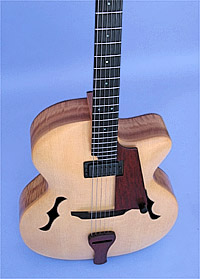
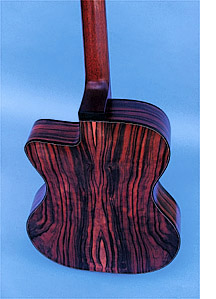
Alcalde sometimes has several guitars in varying states of completion. This spring, he worked primarily on an archtop model with a beautiful quilted maple body. Archtop guitar bodies begin as thick pieces of wood that are carved using planes and small, delicate chisels. The carving results in rounded tops and backs that produce percussive sounds compared with their flattop cousins.
Archtops were originally used as acoustic rhythm instruments in big-band jazz, but are also some of the loudest of all acoustic instruments.
“They have what I think of as a ‘woody thwack’ sound to them,” Alcalde says. “Flattops tend to ring more. They resonate more, so in a way they have more of a richer sound, because there are more overtones in the sound. But the archtops tend to have a sound where the individual voices of a chord, for instance, tend to be more pronounced.”
In fact, if you catch one of his local performances, Alcalde will probably be playing one of the archtop models he built for himself.
 “I
perform with my archtop almost all the time, because I can get an
acoustic sort of sound but at the volumes you need to perform. And I
feel like I can play a Mississippi John Hurt kind of country blues
finger picked thing and it sounds good on there, but I can also play a
modern jazz tune, and it sounds good for that. It has sounds that match
anything I really might play.”
“I
perform with my archtop almost all the time, because I can get an
acoustic sort of sound but at the volumes you need to perform. And I
feel like I can play a Mississippi John Hurt kind of country blues
finger picked thing and it sounds good on there, but I can also play a
modern jazz tune, and it sounds good for that. It has sounds that match
anything I really might play.”
Though he plays some of his instruments more regularly than others, Alcalde says he hasn’t built any one favorite.
“Each one I’m always excited about. It’s a little hard to give them away sometimes, because they take a lot of time and energy. Though I always get a kick out of seeing the person’s eyes light up.”
Alcalde says he doesn’t want to build more than five or six guitars a year, and his instruments aren’t for everybody. Only committed musicians willing to spend thousands of dollars for handmade, customized guitars may want to seek out luthier Alcalde’s skills.
As for the travels his guitars have made or performances they have given after leaving the Hailey workshop, Alcalde says he doesn’t track them but hopes the instruments have found happy homes.
“I think and hope that people are playing them every day and enjoying them.”