| click here for the |
| front page |
| features |
| fire lookouts |
| flytying |
| beavers |
| craters of the moon |
| arts |
| peter woytuk |
| printmaking |
| handmade guitars |
| living |
| high desert gardens |
| pavers |
| summer fitness |
| recreation |
| skateboarding |
| danny thompson mem |
| galena |
| dining |
| salads |
| margaritas |
| calendar |
| summer 2003 |
| to-do |
| sun valley essentials |
| listings |
| galleries |
| dining |
| lodging |
| fitness |
| golf |
| equipment rentals |
| outfitters + guides |
| maps |
| ketchum street map |
| sun valley street map |
| local art galleries |
| Galena summer trails |
| fire lookouts: Idaho |
| fire lookouts: locator |
| the guide |
| last winter |
| advertising |
| about us |
| copyright |
| Copyright
© 2003 Express Publishing Inc. All Rights reserved. Reproduction in whole or in part in any form or medium without express written permission of Express Publishing Inc. is strictly prohibited. |
| Produced
& Maintained by Express Publishing, Box 1013, Ketchum, ID 83340-1013 208.726.0719 Voice 208.726.2329 Fax info@svguide.com |
| The
Sun Valley Guide is distributed free twice yearly to
residents and guests throughout the Sun Valley, Idaho resort area
communities.
Subscribers to the Idaho Mountain Express will receive the Sun Valley Guide inserted into the paid edition of the newspaper. |

Lords
of the Fly
Sun Valley in vanguard of
fly tying heritage
by Ken Retallic
I heard the siren call of Idaho’s blue-ribbon trout streams long before I drove over Targhee Pass and dropped into the broad bowl of the Island Park Caldera two decades ago.
As sunset dissolved into the twilight of a serene July evening, I watched enraptured as a long line of fly casters floated their lines down the sweeping curves of the legendary Henry’s Fork at Last Chance. Concentric circles and dimples in the butterscotch glow of the mirror smooth stream marked the subtle “rise forms” of trout feeding on one of the Henry’s prolific fly hatches.
The beauty of fly-fishing is that trout live in picturesque environs. Yet, nothing captivates a fly fisher more than a progression of rise forms dimpling a stream like the sprinkling of a gentle rain. For, it’s in the “ring of the rise” that fulfillment occurs for the fly fisher.
Many people think fishing is passive, but it’s not.
Fly-fishing, especially, is an art and a science as much as it’s a sport. To do it well, you have to understand the habits and habitats of the fish and their prey. One also must be a student of the teachings and traditions imparted by fly-fishing’s forebears and today’s innovators. An enduring aspect of fly-fishing’s traditions is the ever-present urge of its practitioners to improve techniques and equipment, and invent better fly patterns.
The hatch masters who created the tried-and-true fly patterns we still cast today—and today’s burgeoning crop of increasingly creative fly tiers—are the true artists of fly-fishing.
Many of the more innovative ones developed their craft over the past 75 years fishing Western waters. Idaho fly tiers were in the vanguard of this heritage and their successors continue the tradition, including those who specialize in solving the mysteries of Sun Valley’s two premiere trout streams: Silver Creek and the Big Wood River.
“Have you ever looked at a fly and wondered ‘Where on earth did that thing come from?’” asks Bruce Staples, an Idaho Falls author-historian and master fly tier. “Finding the answer to that question can be another fascinating aspect of fly-fishing. The answer to this question for the Renegade and its progeny, or other flies that evolved from this creation, is a creativity story typical in the art of fly tying.”
 The
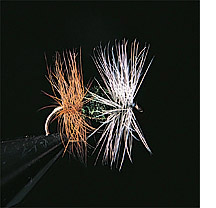
Renegade was conceived by Taylor “Beartracks” Williams, the first guide
at the Sun Valley Lodge. A hunting and fishing companion of Ernest
Hemingway, Williams also took Papa’s son Jack under his wing. His first
trip to Silver Creek in 1940 was not his most auspicious outing on a
spring creek. The fly patterns he tried were too big to fool the
quintessential spring creek’s wary rainbow trout.
The
Renegade was conceived by Taylor “Beartracks” Williams, the first guide
at the Sun Valley Lodge. A hunting and fishing companion of Ernest
Hemingway, Williams also took Papa’s son Jack under his wing. His first
trip to Silver Creek in 1940 was not his most auspicious outing on a
spring creek. The fly patterns he tried were too big to fool the
quintessential spring creek’s wary rainbow trout.
“I believe (Williams) also mentioned the Renegade as a possibility, which I rejected out of hand though I probably shouldn’t have as it does a fair job of giving an impression of an egg-laying caddis (fly),” Hemingway related.
Williams first tied the Renegade “for an evening of fishing on central Idaho’s Malad River,” Staples said in a Federation of Fly Fishers newsletter article. “Fore and aft patterns were not new, even then. They were conceived in Europe centuries before. But Beartracks’ pattern, tied in his Sawtooth Shack fly shop that 1928 afternoon in Gooding would become the world’s best known of this type.”
White hackle in front of the Renegade gives it high visibility and brown hackle in the back lends physical and artistic balance. “Williams could not have chosen a better material than peacock herl to form the body. It remains, in this age of hi-tech synthetics, a consummate attractor of fish,” Staples said.
Marv Taylor, a Boise author, columnist and fly tying innovator, agreed. “The Renegade has probably caught more fish in Idaho than any other dry fly pattern.”
 Hemingway,
who served as an Idaho Fish and Game commissioner in the 1970s, is
credited with being the savior of Silver Creek, which offers remarkable
public access at the Nature Conservancy’s Silver Creek Preserve and two
Idaho Fish and Game management areas near Picabo.
Hemingway,
who served as an Idaho Fish and Game commissioner in the 1970s, is
credited with being the savior of Silver Creek, which offers remarkable
public access at the Nature Conservancy’s Silver Creek Preserve and two
Idaho Fish and Game management areas near Picabo.
Hemingway also donated an old homestead on the Little Wood River, south of Carey, to the state for preservation as a fly-fishing only water. He named it in memory of “Papa’s best friend in Idaho, Taylor ‘Beartracks’ Williams.”
As a lifelong proponent of the gentlemanly traditions of fly-fishing and coldwater fisheries conservation, Hemingway, too, is remembered by a fly pattern—the Hemingway Special.
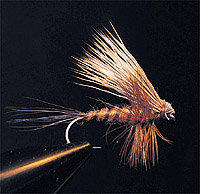
A “tent-wing” caddis fly pattern that has a low-riding profile perfect for spring creeks, like Silver Creek and the Henry’s Fork, the Hemingway Special was created in the 1970s by Mike and Sheralee Lawson of St. Anthony, Staples said in his new book, “Trout Country Flies From Greater Yellowstone Area Masters.” In some publications and fly shops today, including Mike Lawson’s Henry’s Fork Angler at Last Chance, it is also referred to as the Hemingway Caddis.
Another fly pattern that has stood the test of time also dates back to Sun Valley’s earliest days. Appropriately named the Hatch Master, it was created by Dick Alfs, who ran the first fly shop at the Sun Valley Lodge. It is a masterpiece of simplicity that can represent a variety of mayflies—pale morning dun, green drake, mahogany dun or blue-winged olive—simply by changing the colors of its materials and tying it at the appropriate size.
“Alf’s pattern, which hammers fish during mayfly emergence, is tied with a single dyed mallard breast feather whose quill extends over the shank of the hook,” Greg Thomas noted in his new book, “Best Flies for Idaho.” The quill is then trimmed to create a split tail. The rest of the feather is tied forward so the tips become the wings, and a standard wrap of hackle in front and back of the wings completes the fly.
Another practitioner of the KISS principle was Ruel Stayner of Twin Falls, a devotee of nymph and streamer fishing who plied the depths of Magic Reservoir on the Big Wood River from its earliest days. The Stayner Ducktail, created in the 1920s, still ranks as one of the most popular—and productive—patterns in Idaho.
The Stayner Ducktail is tied with an olive chenille body, offset by a bright orange hackle fiber for the tail and throat feathers, and a barred mallard flank feather tied flat as a wing. It can be fished as a caddis emerger, a damselfly nymph or a minnow in distress.
The Magic Perch streamer pattern is an example of an innovator taking a lesson from one of his mentors and improving on it. Tied by Warren Schoth of Wendell, its yellowish hues were chosen as a more color-oriented variation of the Stayner Ducktail to replicate yellow perch, the most common baitfish in Magic Reservoir.
Schoth, who died this year, owned Riverborn Fly Company and distributed flies throughout Idaho, Wyoming and Montana. Other popular originals of Schoth’s include the Idanha Yellow Jacket, Malad Ant, Rocky Mountain Caddis, Master Nymph, Hare’s Ear Rubber Leg Nymph, and the N.A. Steelhead Bugger, also known as the Volcano Bugger for its hot orange motif.
 “Warren
was a great gentleman, and often participated in our fly tying
demonstrations,” said Susanne Connor, a guide with Lost River Outfitters
in Ketchum. “He had a great brown drake spinner pattern.”
“Warren
was a great gentleman, and often participated in our fly tying
demonstrations,” said Susanne Connor, a guide with Lost River Outfitters
in Ketchum. “He had a great brown drake spinner pattern.”
Conner’s boss, Scott Schnebly, is a great gentleman, too. He also has a great sense of humor. Two of his “killer diller” flies are named the Fifi and the Philo Betto.
Weighted with chrome
eyes at the head, the Fifi is an improved, somewhat flattened version of
a steelhead egg pattern with a red Krystal Flash tail. Burnt orange yarn
is typically used for the “egg,” although Schnebly acknowledged that,
some years, fluorescent green yarn produces more steelhead.
The fly’s name? Schnebly joked that it reminded him of a poodle fresh
from the groomer’s, but he’s deadly serious about the effectiveness of
the fly on the upper Salmon River.
Also, the only joke about the Philo Betto pattern, Schnebly said, is its name that comes from the Clint Eastwood character in the movie “Every Which Way But Loose.”
“It’s a bad-ass fly, so we named it after a bad-ass character.”
The inspiration for the streamer fly came about after a day on the river with his son, who captured a few Wood River sculpin during his explorations. It’s tied with an olive-dyed pheasant rump feather, or filoplume, as a tail and a palmered olive-dyed pheasant rump feather body.
Schnebly and the other fly shop owners carrying on the traditions of Sun Valley fly-fishing—Terry Ring at Silver Creek Outfitters in Ketchum, Bill Mason at Mason Outfitters in Sun Valley, and David Glasscock at Idaho Angling Services in Picabo—cater to a more sophisticated clientele nowadays. Today’s fly fishers, who have more discerning tastes in pattern selection, are products of the renaissance in fly-fishing that’s occurred since the 1970s .
 Many
new fly patterns—especially for mayflies and the better-known caddis
species—are more species-oriented and more precisely tied in the correct
sizes and colors in hopes of delivering more consistent results during
the different stages of metamorphosis of aquatic insects. This is
especially true for fly fishers who come to test their mettle against
challenging trout on streams like Silver Creek.
Many
new fly patterns—especially for mayflies and the better-known caddis
species—are more species-oriented and more precisely tied in the correct
sizes and colors in hopes of delivering more consistent results during
the different stages of metamorphosis of aquatic insects. This is
especially true for fly fishers who come to test their mettle against
challenging trout on streams like Silver Creek.
Mason, for example,
offers a specialty line of fly patterns, including his Baetis spinner,
Baetis nymph, green drake and great western red quill.
All of the fly shops, including Headwaters-Wood River Outfitters in
Ketchum, have worked out the seasonal occurrences of the region’s major
fly hatches and provide daily or weekly updates on their chalk boards
and Web sites on fishing conditions for Silver Creek, the Big Wood River
and the Big Lost River.
Staples’ book, “Trout Country Flies From Greater Yellowstone Area Masters,” is an excellent new resource for serious students of fly tying. It is a remarkable compilation of all the legendary fly tiers and modern innovators of southern Idaho, southwestern Montana and western Wyoming. It includes complete tying instructions for hundreds of fly patterns.
Thomas’ book, “Best Flies for Idaho,” is a good reference for both fly tiers and fly fishers since it also offers fishing tips for each of the patterns.
Also available are “Bill Mason’s No Nonsense Guide to Fly Fishing in Idaho” and “Fly Fisher’s Guide to Idaho” by Ken Retallic and Rocky Barker.