| click here for the |
| front page |
| features |
| fire lookouts |
| flytying |
| beavers |
| craters of the moon |
| arts |
| peter woytuk |
| printmaking |
| handmade guitars |
| living |
| high desert gardens |
| pavers |
| summer fitness |
| recreation |
| skateboarding |
| danny thompson mem |
| galena |
| dining |
| salads |
| margaritas |
| calendar |
| summer 2003 |
| to-do |
| sun valley essentials |
| listings |
| galleries |
| dining |
| lodging |
| fitness |
| golf |
| equipment rentals |
| outfitters + guides |
| maps |
| ketchum street map |
| sun valley street map |
| local art galleries |
| Galena summer trails |
| fire lookouts: Idaho |
| fire lookouts: locator |
| the guide |
| last winter |
| advertising |
| about us |
| copyright |
| Copyright
© 2003 Express Publishing Inc. All Rights reserved. Reproduction in whole or in part in any form or medium without express written permission of Express Publishing Inc. is strictly prohibited. |
| Produced
& Maintained by Express Publishing, Box 1013, Ketchum, ID 83340-1013 208.726.0719 Voice 208.726.2329 Fax info@svguide.com |
| The
Sun Valley Guide is distributed free twice yearly to
residents and guests throughout the Sun Valley, Idaho resort area
communities.
Subscribers to the Idaho Mountain Express will receive the Sun Valley Guide inserted into the paid edition of the newspaper. |

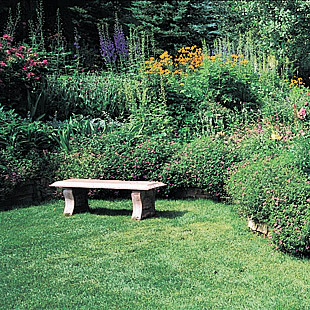
Evoking Nature in the Garden
by Dana DuGan
Gardening is not always easy. You want an easy hobby? Try line dancing,” pens Don Engebretson, creator of the Web site “Renegade Gardener—a lone voice of horticultural reason for USDA Zones 2 through 4.”
Gardening—like any art form—takes time to master, but in the harsh freeze-thaw climate of the Wood River Valley, it also takes stamina.
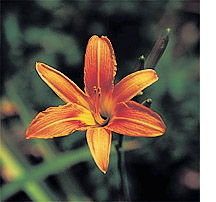 “It’s
so hard to grow here,” gardening enthusiast Criss Fallowfield learned
early on when she moved here from Rhode Island. Now in tune with the
climate, Fallowfield’s flourishing garden is featured on the Sawtooth
Botanical Garden Tour in July. “It’s trial and error. You just try again
the next year.”
“It’s
so hard to grow here,” gardening enthusiast Criss Fallowfield learned
early on when she moved here from Rhode Island. Now in tune with the
climate, Fallowfield’s flourishing garden is featured on the Sawtooth
Botanical Garden Tour in July. “It’s trial and error. You just try again
the next year.”
Indeed, successful gardeners know the trick to gardening is patience.
And the act of gardening encourages a Zen-like sense of cooperation with
nature.
One of the inherent challenges of gardening in the Wood River Valley is the variation in climates: They may even fluctuate from lot to lot within a given neighborhood. Yes, climate, soil, altitude, exposure and location, the principles used to select vegetation for a garden, change quickly in this narrow slice between mountain ranges.
Gardeners here must understand the sun’s path, wind exposure, soil content (volcanic, rocky, stream bed, prairie) and moisture level, which can vary dramatically between the shadow of Bald Mountain and the sunny valley floor, before making plant selections. This area has the potential for frost in any given month. In some years things flourish, in other years they don’t.
Although there are challenges in high-altitude gardening, there are ways to avoid many pitfalls.
First, map the space and plan the plantings on paper. Set a goal or determine the theme that is to be achieved. Note the elements mentioned above that affect the property. Take all these items to a local professional nursery to learn what has a chance of survival under those conditions. Beware.
Hardiness in the valley can vary from Zone 3 in Chocolate Gulch north of Ketchum to Zone 5 in Bellevue, but areas in between can move up or down that range, depending on walls, hills, wind barriers, rivers or the lack of natural protection.
A good design takes into account the seasons enjoyed by valley gardeners and parlays leaf shape and color on shrub varieties to fill in when the blossoms are gone.
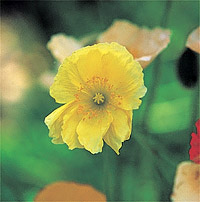 Contrast and harmony
in a garden depend on the colors and shapes of plantings in relation to
each other. Planting for shape and color of foliage is as important as
blossom color. Tall plants with similar heights and foliage crammed next
to each other minimize the visual effect and work better contrasted by
something softer and horizontal like lady’s mantle, artemesia or mound
grasses.
Contrast and harmony
in a garden depend on the colors and shapes of plantings in relation to
each other. Planting for shape and color of foliage is as important as
blossom color. Tall plants with similar heights and foliage crammed next
to each other minimize the visual effect and work better contrasted by
something softer and horizontal like lady’s mantle, artemesia or mound
grasses.
Likewise, colors can clash. To avoid this glaring error, be a color aficionado. Check an artist’s color wheel to find complementing colors. Transitional colors can be vital in taking the eye from one planting area to the next.
A good garden should ultimately look as if it belongs. A garden in tune with the surrounding areas has organic symmetry. Think of fields of lavender in France, grapevines on arbors in Italy, palm trees in the tropics, and rose gardens in England. Here in the valley, lush palms would look ridiculous.
In addition to shapes and colors, gardeners must design for low water consumption. This is a desert area. After the snow melts, little rainfall supplements the water table. Xeriscape is the design choice here.
Tenets of xeriscapers are of the practical variety. Don’t mix plants of high- and low-water needs in the same area. Plant drought-resistant varieties on the hillside, and the thirsty bloomers at the base where water collects. Use mulches to retain soil moisture; use soakers and don’t over water. Limit the size of turf areas, and try native turfs such as Idaho fescue in place of thirsty Kentucky bluegrass.
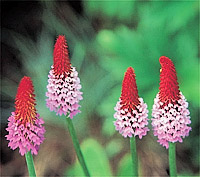 “So
many people think of xeriscape as dry, colorless landscape. You can have
areas—within your garden—that require more water. It’s about appropriate
planting,” Chrissie Huss, head gardener at the Sawtooth Botanical
Garden, said.
“So
many people think of xeriscape as dry, colorless landscape. You can have
areas—within your garden—that require more water. It’s about appropriate
planting,” Chrissie Huss, head gardener at the Sawtooth Botanical
Garden, said.
Seeds culled from native wildflowers are ideal, and their blossoms grace many valley gardens. Among these are the many varieties of penstemons, the quintessential Western flower that boasts a huge color range in more than 250 species, some native to the area, including purple strictus, shrubby fruticosus, pinifolius, payettensis, dark blue cyaneus and low growing hot rock deustus.
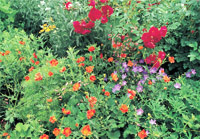
Among the familiar perennials that also thrive are delphinium, lupine, daisy, hollyhock, lady’s mantle, iris, coral bells, coneflower, poppy, columbine, euphorbia, allium, salvia, mullein, sedum and veronica.
For most, gardens are a combination of tried and true natives and zone hardy plants, and hole filling annuals. Try cheery snapdragons, wispy tall cosmos that gratifyingly reseed, zinnias with happy faces of bright colors, geraniums, marigolds, petunias, verbenas, daisies, portulaca, sunflowers and bachelor buttons.
After deciding the location, style and palette of the garden, it’s time to work the soil, which generally ranges from clay to sand to lava or rock.
Clay soil is hard on roots, so it needs additional compost and peat moss to loosen it up, but it’s good for its ability to hold moisture. Sand, on the other hand, has ample space for roots to spread and reservoirs of air, but water slips through it swiftly.
To get the garden soil on track, contact the University of Idaho extension office, which does soil testing from its office in Hailey.
 Every
fall, professional gardener Michelle Hampton, affectionately known as
the compost queen, covers clients’ gardens with a thick layer of
compost. On alternate years she switches to steer manure. This protects
the plants over the long winter, and helps aerate and nourish the garden
come spring when she works it all in. Besides water and sun, all plants
need oxygen, worms and healthy soil to thrive.
Every
fall, professional gardener Michelle Hampton, affectionately known as
the compost queen, covers clients’ gardens with a thick layer of
compost. On alternate years she switches to steer manure. This protects
the plants over the long winter, and helps aerate and nourish the garden
come spring when she works it all in. Besides water and sun, all plants
need oxygen, worms and healthy soil to thrive.
For Wood River Valley gardeners, the trick is to understand gardening for hot summer days, cool nights and dry conditions, as well as hungry wildlife.
“In the spring we
have problems with voles,” Huss said. “I use mouse traps, or you can
shove a hose in their holes. There are also solar and battery operated
sonic noisemakers that drive them away.”
Huss added, it’s “par for the course to have deer damage” in the garden.
“I cover things with row covers, and also use sensors that are hooked up to a hose. These are triggered by motion and send out a squirt of water,” says Huss. The latter needs to be moved frequently as the deer get wise to the system.
Once all the elements are in place, gardens thrive here. The proof can be enjoyed on two garden tours held each summer—one in Hailey and one sponsored by the Sawtooth Botanical Garden.
And all gardeners—whether award winners or not—would do well to remember the most important ingredient in any garden project: fun. As Engebretson puts it quite rightly: “Irreverence is essential. We’re playing in the dirt for Heaven’s sake.”